George Gordon, Lord Byron
George Gordon, Lord Byron (1788-1824)
descended from two aristocratic clans with colourful backgrounds
became a Lord at age 10; attended Harrow and Cambridge
suffered from a malformed foot, a source of much embarrassment
became a fashionable celebrity, involved in various sex scandals
model for the “Byronic hero,” a prevailing Romantic archetype • assisted in the Greek war for independence (NAEL D630-34)
Byron, Don Juan (1819-1824)
pronounced Don Joo’-un
published in instalments from 1819 until Byron’s death in 1824
meant to be read rapidly, to reflect its improvisational method of composition
longest satirical poem in English, consisting of some 2,000 stanzas
satirizes the archetypal Spanish libertine, traditionally a man of enormous sexual energy but in Byron’s poem depicted as a naif (NAEL D690-91)
Byronic Hero
a mysterious and gloomy figure, superior in his passions to the common run of humanity, whom he regards with disdain
tortured by an enormous, unnamed guilt that drives him towards an inevitable doom
exerts a powerful, erotic attraction upon other characters
depicted in Byron’s Childe Harold (1816) and Manfred (1817)
model for Heathcliff in Brontë’s Wuthering Heights (1847) (NAEL D631, Baldick 47)
risk takers
strong silent type
Byron, Don Juan (1819-1824)
seduced by Julia; sent abroad
captured by pirates into slavery
taken to Turkish harem
further exploits in harem
affair with Turkish Sultana
escape from harem to Europe
romantic intrigues in Europe
goes to way in Europe
in the Russian court
sent from Russia to England
in the English court
safeguards daughter LEila
party with Amundevilles
English country life, fox hunt
Lady Adeline advises marriage
interacts with a ghost
unfinished diversion
Canto: Italian for ‘song’, a subdivision of an epic or other narrative poem, equivalent to a chapter in a prose work (Bladuck, 52)
Don Juan in Music and Literature
1630: Gabriel Tellez (Tirso da Molina), El burlador de Sevilla
1665: Moliere, Le Festin de Pierre
1676: Thomas Shadwell, The Libertine
1736: Carlo Goldoni, Don Giovanni Tenorio o sia il Dissoluto
1786: W. A. Mozart, Don Giovanni
1824: Lord Byron, Don Juan
1830: Alexander Pushkin, The Stone Guest
1872: Robert Browning, Fifine at the Fair
1903: George Bernard Shaw, Man and Superman
1958: Henri de Montherlant, Don Juan
Picaresque
from the Spanish picaró, meaning “rogue” or “scoundrel”
traditionally, a work with a picaroon as its hero, a quickwitted servant of several masters
recounts their escapades in firstperson with an episodic structure
can now refer to a loosely structured sequence of episodes recounting a hero’s long journey
mostly in prose, but Byron’s Don Juan is a poetic example (Baldick 277-78)
Mock Epic
a poem employing the lofty style and the conventions of epic poetry to describe a trivial or undignified series of events
a kind of satire that mocks its subject by treating it in an inappropriately grandiose way
often include epic conventions such as invocations, battles, supernatural machinery, etc.
most famous example in English is Pope’s The Rape of the Lock (1712-14) (Baldick 229)
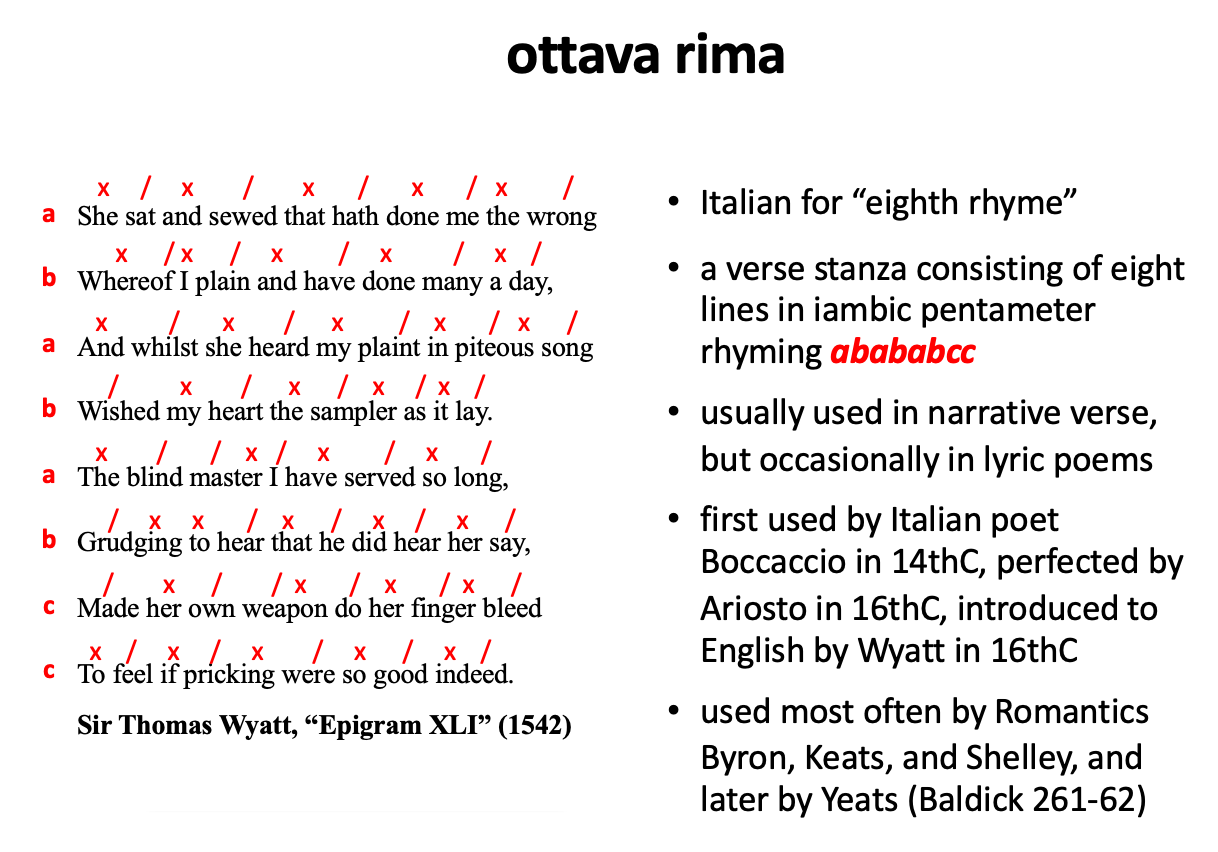
Ottava Rima