M2: Carbohydrates
Carbohydrates
- organic compounds composed of carbon, hydrogen, and oxygen atoms.
- Functional groups:
- Hydroxyl and Carbonyl groups
- polyhydroxy aldehydes or ketones, or compounds that can be hydrolyzed by them.
- called sugars and starches
- Functions:
- Energy source, structural component
- In the body, they are used for bursts of energy needed during exercise in the form of glucose.
- Synthesized:
- In green plants by photosynthesis (the energy from the sun is stored as chemical energy in carbohydrates
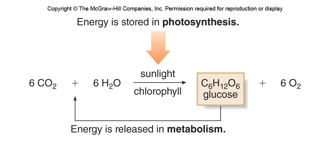
Main Branches:
Classification of Carbohydrates
- Monosaccharides
- Disaccharides
- Polysaccharides
1. Monosaccharides
- Description:
- Sweet tasting (relative sweetness varies greatly)
- polar (hydroxyl groups; dipole-dipole) compounds with high melting points
- presence of so many polar functional groups capable of hydrogen bonding makes the monosaccharides very water-soluble
- Definition: Simplest form of carbohydrates
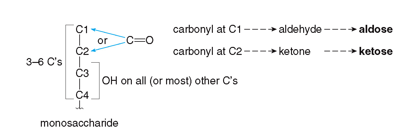
- generally have 3-6 C atoms in a chain with an aldehyde or ketone ending and many -OH groups
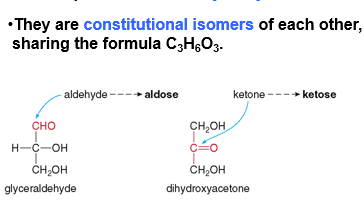
- Simplest forms (isomer: same molecular formula but different structural formula)
- aldehyde monosaccharide: aldose
- simplest: glyceraldehyde
- ketone monosaccharide: ketose
- simplest: dihydroxyacetone
- Classification: (by the number of C atoms in its chain
- Trioses
- 3 carbon atoms,
- such as glyceraldehyde (aldotriose) and dihydroxyacetone (ketotriose).
- Tetroses
- 4 carbon atoms,
- such as erythrose and erythrulose.
- Pentoses
- 5 carbon atoms,
- such as ribose and deoxyribose (found in DNA).
- Hexoses
- 6 carbon atoms,
- such as glucose (blood sugar), fructose (fruit sugar), and galactose (found in milk).
- Heptoses
- 7 carbon atoms,
- such as sedoheptulose.
- Trioses
Common Monosaccharides
- Glucose (dextrose)
- blood sugar and most abundant
- normal blood glucose level 70-110 mg/dL ..100mL
- excess is stored as polysaccharide glycogen or fat
- Insulin regulates blood glucose level
- Galactose
- sugar in milk
- one of the components of disaccharide lactose (glucose + galactose)
- Galactosemia- lack enzyme needed to metabolize galactose, which accumulates and causes cataracts and cirrhosis
- Fructose
- sugar in fruits
- one of the components of disaccharide sucrose (glucose + fructose)
- a ketohexose in honey, twice as sweet as table sugar w/ the same # of calories per gram
Fischer Projection Formula (Open chain)
- all carbohydrates have 1 or more chirality centers
- optical isomers → enantiomers
- one chirality center : two possible enantiomers
- ~~D~~ → -OH on the right side
- L → -OH on the left side
- if many, the farthest from the carbonyl group is considered
- D naturally occurring enantiomer
- wedged and dashed lines can be withdrawn
Haworth Projection (Cyclic Form/Close Chain)
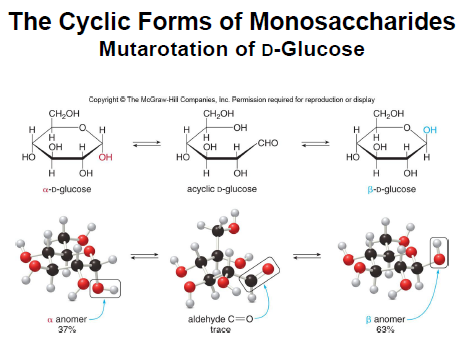
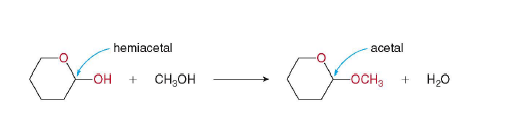
- Hemiacetal - when an aldehyde reacts with an alcohol
- the c atom that is part of the hemiacetal is the new chirality center, called anomer carbon
- 2 cyclic structures
- alpha anomer (-OH down)
- beta anomer (-OH up)
- Mutarotation of D-Glucose
- powder form (open chain) but when dissolved in water (goes cyclic structure)
- Ketohexoses
- like fructose
- form five-membered rings with two anomers
Reduction and Oxidation of Aldehyde Carbonyl Group
- Reduction
- decrease of carbon to oxygen
- lose oxygen
- gain of Hydrogen
- reduce to alcohol
- Oxidation
- increase of carbon to oxygen
- gain oxygen
- lose of hydrogen
- into acid
- Aldoses can be oxidized
- Ketones cannot be oxidized
2. Disaccharides
- Two monosaccharides linked together
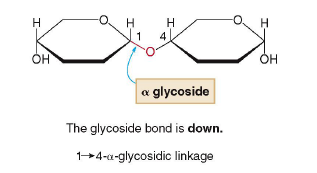
- link together to form an acetal (chiral center with an OR group and water)
- The bond that joins them is a glycosidic linkage
- free anomeric carbon - anomeric carbon + 4th
- Reducing
- no free anomeric carbon - anomeric carbon +anomer carbon
- alpha glycosidic bond - linkage is downwards
- carbon #1 of mono 1 to carbon #4 of mono 2
- 1→4 alpha glycosidic bond
- beta glycosidic bond - linkage is upwards
- first mono on top and 2nd mono is a little bit higher
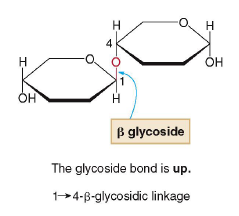
- Functions:
- Energy storage, sweetening agents
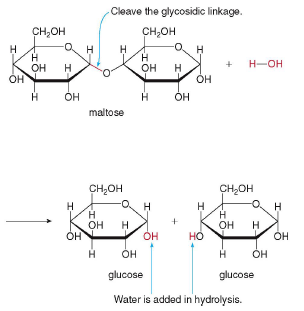
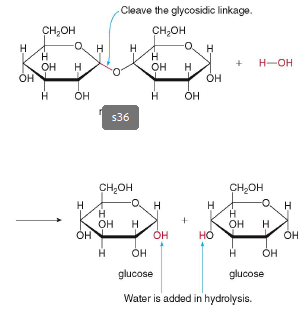
- Hydrolysis
- water (H2O) is added
- cleaves the C-O glycosidic linkage
- 2 monosaccharides form
- aided by enzymes during metabolism
- ex. maltose
Common Disaccharides
1. Sucrose
- Components:
- Glucose + Fructose
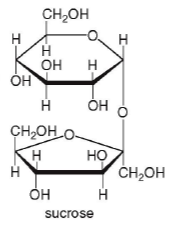
- not a reducing sugar because it lacks a free anomeric carbon
- Functions:
- Table sugar, energy source
- very sweet but contains many calories, many artificial sweeteners are developed
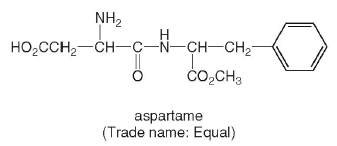
- Aspartame
- sold as Equal
- hydrolyzed into phenylalanine
- cannot be processed by those with the condition phenylketonuria
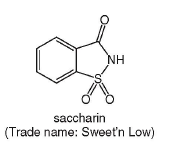
- Saccharine
- sold as Sweet’n Low
- used extensively during World War I
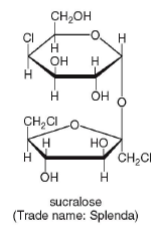
- Sucralose
- Sold as Splenda
- similar structure to sucrose
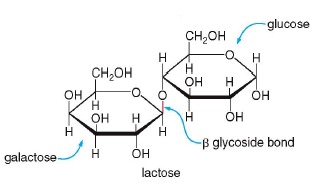
2. Lactose
- Components:
- Glucose + Galactose
- joined by 1→4 beta glycosidic bond
- Functions:
- Milk sugar, the energy source for infants
- Lactose Intolerance:
- no longer produce the enzyme lactose-- making it impossible to digest causing abdominal cramps and diarrhea
3. Maltose
- Components:
- Glucose + Glucose
- Functions:
- Produced during starch digestion
3. Polysaccharides
- Definition: Long chains of monosaccharides
- Examples: Starch, Glycogen, Cellulose
- Functions: Energy storage, structural support
Common Polysaccharides
1. Starch
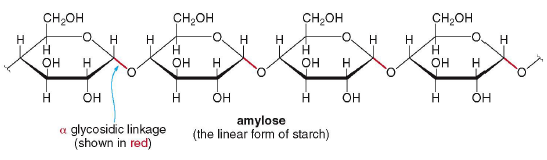
- anomer: alpha
- made up of repeating glucose units joined by alpha glycosidic linkages
- present in:
- corn, rice, wheat, and potatoes
- Types: Amylose, Amylopectin
- both can be digested by enzyme amylase
- Amylose (20%)
- unbranched polymer
- 1→4 alpha glycosidic linkages
- the first main type of starch
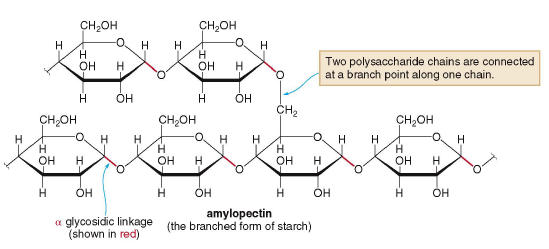
- Amylopectin (80%)
- branched polymer;
- second main type of starch
- 1→4 and 1→6 alpha glycosidic linkages
- Functions:
- Energy storage in plants
2. Glycogen
- major form of polysaccharide storage
- similar to amylopectin structure
- many ends available for hydrolysis
- Functions:
- Energy storage in animals
- when glucose is needed for energy:
- glucose units are hydrolyzed from the ends of glycogen polymer
- Location:
- Stored in liver and muscle cells
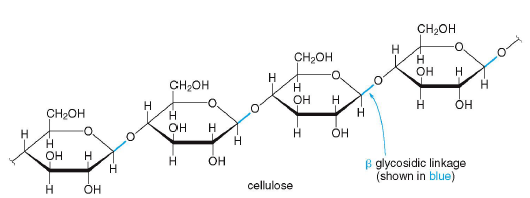
3. Cellulose
- anomer: beta
- unbranched polymer made up of repeating glucose units joined by 1→4 beta glycosidic linkages
- Found:
- cell walls of all plants;
- gives support and rigidity to woods, plant stems, and grass
- Functions:
- Structural component of plant cell walls
- Digestion:
- Indigestible by humans; we do not possess the enzyme to hydrolyze cellulose (beta-glycosidase)
- dietary fiber
- still important in our diets:
- makes up the insoluble fiber; important in adding bulk to waste to help eliminate it more easily
Useful Carbohydrate Derivatives
- Glycosaminoglycan (GAGs)
- group of unbranched carbohydrates derived from alternating amino sugar and glucuronate units
- ex. hyaluronate
- extracellular fluids that lubricate joints and in the vitreous humor of the eye
- ex. chondroitin
- component of cartilage and tendons
- osteoporosis - supplements
- Chitin
- joined from N-acetyl-G-glucosamine units joined together
- Blood Type
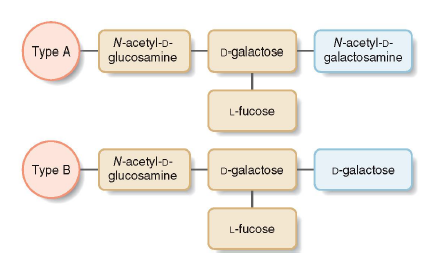
- based on 3 or 4 monosaccharides attached to a membrane protein of red blood cells
- each blood types have these:
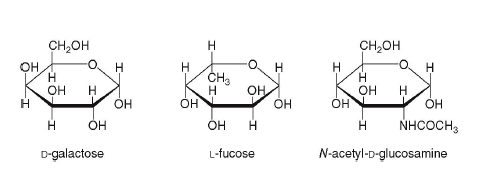
- Typa A has a fourth monosaccharide:
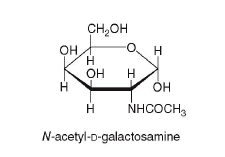
- Type B contains additional D-galactose unit
- Type AB has both Type A and Type B carbohydrates
- The blood of one individual may contain antibodies to another type.
- Those with type O blood are called universal donors, because people with any other blood type have no antibodies to type O.
- Those with type AB blood are universal recipients because their blood contains no antibodies to A, B, or O.
Mind Map: Isomers
Central Idea: Isomers
- Isomers are molecules that have the same molecular formula but different structural arrangements.
Main Branches:
- Structural Isomers
- Stereoisomers
1. Structural Isomers
- Structural isomers have different connectivity of atoms.
Sub-branches:
- Chain Isomers
- Differ in the arrangement of the carbon chain.
- Position Isomers
- Differ in the position of functional groups or substituents.
- Functional Group Isomers
- Differ in the functional group present.
- Ring Isomers
- Differ in the arrangement of atoms to form different cyclic structures.
2. Stereoisomers
- Stereoisomers have the same connectivity of atoms but differ in the spatial arrangement.
Sub-branches:
- Geometric Isomers
- Differ in the arrangement of substituents around a double bond or a ring.
- Optical Isomers
- Differ in the arrangement of substituents around a chiral center.
- Enantiomers
- No
- n-superimposable mirror images.
- Diastereomers
- Stereoisomers that are not mirror images.
Conclusion:
- Isomers are important in understanding the diversity and complexity of organic molecules. They can have different physical and chemical properties, which can impact their behavior and reactivity.