Chemistry- Intermolecular Forces
Intermolecular forces - Forces between 2 Different Molecules
3 Main Types of Intermolecular Forces
London Dispersion Forces - Only forces acting between non-polar molecules
Dipole-Dipole Forces- Attractions between polar molecules
Hydrogen Bonding/Bond - Bonded to N, O, F Unshared electron pair on adjacent
Phase Changes
Changing phases involves overcoming intermolecular forces.
Solid —→ Liquid: Melting
Liquid —→ Gas: Vaporization
Solid ——> Gas: Sublimation
Liquid —→ Solid: Freezing
Gas —→ Liquid: Condensation
Gas —→ Solid: Deposition
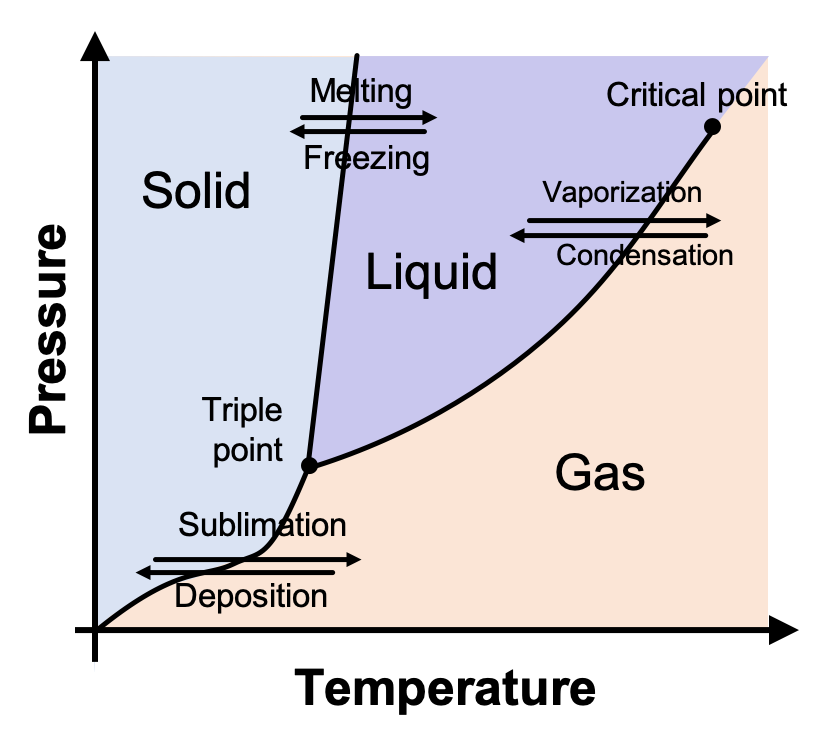
Phase Diagrams :
K = C + 273.15
Triple Point: All 3 phases co-exist in equilibrium
Above Critical point: Its in the supercritical point
Normal: One atmosphere of pressure
The Phase Diagram for water is different because the solid-liquid equilibrium line has a negative slope
Cohesion/Adhesion
Cohesion: forces of attraction between like molecules
Adhesion: forces of attraction between unlike molecules
Cohesive forces cause Surface Tension
Molar Heat Of Fusion: energy required to melt one mole of a substance
Molar Heat Of Vaporization: the amount of heat needed to vaporize one mole of a substance
Specific Heat Capacity: the amount of energy required to raise the temp. of a substance by 1 (C)