PHIL101 Empiricism L4
Scepticism
Sceptics challenge us by claiming that the justifications for our beliefs are subject to an infinite regress.
Empiricists claim we can halt this regress by drawing upon sense experience.
Rationalists claim we can halt this regress through the use of reason or pure thought.
Philosophers of Scepticism:
John Locke
David Hume
René Descartes
The a priori / a posteriori distinction
A priori means we can know p independently of experience
A posteriori means we require experience to know p
“All bachelors are unmarried.” We don’t have to ask every bachelor if they are unmarried to know that this statement is true, as it is based on the definition of the terms involved. Showcases A prori knowledge.
In contrast, the statement “It is raining outside” requires empirical investigation to verify its truth, illustrating a posteriori knowledge.
The analytic / synthetic distinction
A related, but crucially independent, distinction is between analytic and synthetic judgments. This distinction is not about how we can know the proposition, but instead about what makes the proposition true
To say that p is analytic means that p is true in virtue of the meanings of the terms in p.
To say that p is synthetic means that p is not analytic.
Analytic: We know that all bachelors are unmarried because the term 'bachelor' inherently includes the quality of being unmarried, illustrating an analytic judgment.
Synthetic: In contrast, a synthetic judgment would be a statement like 'The bachelor is happy,' where the truth of the statement depends on empirical observation rather than the meanings of the terms involved.
Co-extensiveness
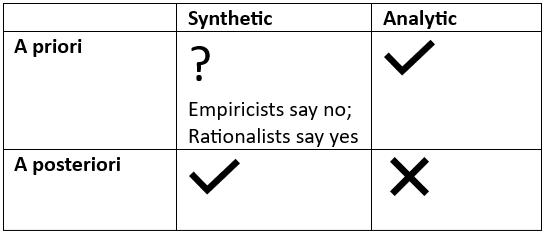
One way of understanding the difference between Empiricism and Rationalism is that Empiricists think that analytic and a priori always go together, and that synthetic and a posteriori always go together.
This means that for empiricists, knowledge is derived from experience, while rationalists argue that some knowledge can be gained independently of experience through reason alone.
Empiricism
As we’ve seen, empiricism can be understood as the view that our senses can provide us with knowledge, thus stopping the infinite regress. There are many varieties of empiricism, but in the most stringent forms, empiricism holds that only our senses can provide us with knowledge.
John Locke
Human mind at birth as being a blank slate or tabula rasa.
As we go through life we accumulate impressions through our senses and thus fill up the page.
We can also ‘recombine’ the ideas acquired through sense to form new ideas.
The sceptical challenge to empiricism
Illusions
The favourite sceptical attack on sense experience lies in the existence of illusions.
Illusions can distort our perception of reality, leading us to question the reliability of our senses as sources of knowledge.
Rather, the claim goes, they give us ideas of how the world is, and those ideas may not match reality.
Dreams
Dreams can further complicate our understanding, as they can create vivid experiences that feel real but are entirely fabricated by our minds, raising doubts about the distinction between what is genuinely experienced and what is merely imagined.
Can you be certain you're not dreaming now?
Hallucinations
Hallucinations are perceptions that occur in the absence of external stimuli, causing individuals to experience sensations that are not grounded in reality. They can occur in various forms, including visual, auditory, or tactile sensations. Hallucinations raise questions about the reliability of our senses, similar to illusions and dreams, as they challenge the distinction between genuine experiences and those fabricated by the mind.
Skeptics say that our sensory experiences could easily be misleading, making it difficult to ascertain what is truly real.
Sceptical questions
If you can’t trust your senses when faced with these illusions/dreams/hallucinations, how can you be certain that they are telling you the truth in any given situation?
Don’t these illusions/dreams/hallucinations show us something else? Locke and others believed that these sorts of cases show us that the objects of our direct perception must be ideas rather than the things in the world themselves.
Sceptics ask: if what we are perceiving are only ever ideas, how do we conclude anything about the external world that we suppose gives rise to those ideas?
In other words, could our ideas of sense experience be no more than that – ideas?
Empiricist replies: primary and secondary qualities
Primary qualities are those that exist within the object itself, such as shape, size, and motion, while secondary qualities, such as colour and taste, are dependent on our perception and may vary from person to person.
Secondary Qualities, therefore, are subjective and can change based on individual experiences and contexts, highlighting the distinction between what is inherent in the object and what is interpreted by the observer. For example: colour, smell, felt texture, felt temperature.
Locke claimed that the secondary qualities consist in a power to cause sensations in observers and that they are the result of minute arrangements of primary qualities
Primary and secondary qualities
‘by convention sweet and by convention bitter, by convention hot, by convention cold, by convention colour; but in reality atoms and void’ - Democritus
This perspective emphasises the idea that our perceptions of these qualities are not direct reflections of the objects themselves, but rather interpretations shaped by our sensory experiences and cognitive processes.
Empiricist replies: Senses are reliable under the right circumstances
Thus, while our perceptions may be influenced by conventions, they are also grounded in empirical evidence that can be observed and tested, leading to a more accurate understanding of the nature of reality.
Empiricist replies: A conjunction of sense-experience is reliable