Muscle Mechanics and Energy
Contraction and Movement
Isometric muscle contraction- If an animal pushes on a heavy object without moving it, the activated muscles generate force without shortening.
Isometric contractions are responsible for maintaining body posture
If the animal is able to move the object, the activated muscles will shorten as they develop force this is called isotonic muscle contraction
isotonic contractions generate limb movements
When the animal begins to push, some time will elapse before the muscles develop sufficient force to set the object in motion. A period of isometric contraction will therefore always precede an isotonic contraction.
Muscle tone is a state of subconscious isometric contraction that occurs even in voluntarily relaxed muscle.
If the nerve supply to a muscle is interrupted (for example, by an injury), the muscle loses its tone and becomes flaccid. If the nerve connection is not re-established, the muscle fibres begin to shrink. This is termed atrophy
Muscle Fibre Force
Length- tension relationship
Sarcomere length, and in turn muscle length, is one determinant of the force developed by an individual muscle fibre.
At the optimal sarcomere length, all of the myosin heads are positioned to be in contact with actin molecules and form crossbridges, and the contraction will generate the maximum amount of tension possible. This property of muscle is called the length-tension relationship.
At very short sarcomere lengths, the thin filaments are pulled so close that they meet in the middle and overlap, which covers their binding sites and interferes with the ability to form crossbridges with thick filaments.
At very long sarcomere lengths, the opposite occurs – the thin filaments are so far apart that they lose most of their contact with the thick filaments.

Motor Units
Motor units contract maximally or not at all. This means that the amount of contractile power generated by an entire muscle depends on the number of motor units involved
Recruitment- The process of adding additional motor units to produce a graded increase of force
Muscle fibres of various motor units are intermingled, so that two fibres of the same motor unit are not adjacent to each other.
Some will be on one side of the muscle or deep within, others on the other side or superficial.
This means that even a weak contraction (which recruits only a few motor units) will recruit muscle fibres scattered throughout the muscle to ensure symmetrical contraction.
Otherwise, a weak contraction would activate only one region of the muscle and the contraction would pull unevenly on the bone.
Exercise
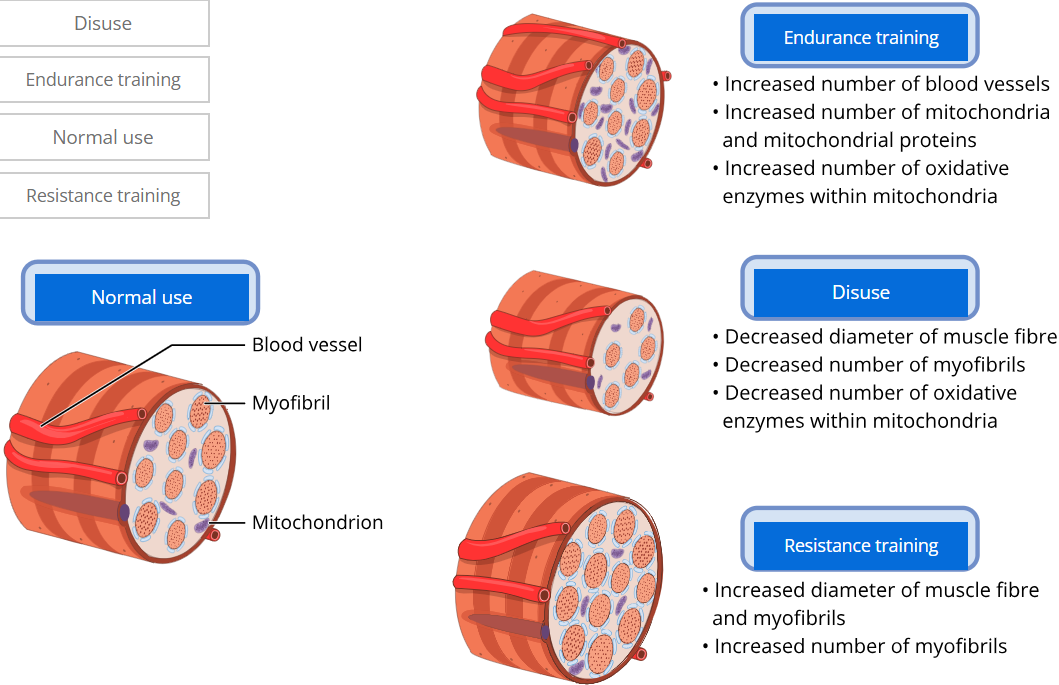
Resistance or strength training features a moderate increase in the frequency of motor unit activation and a large increase in force production.
Resistance or strength exercises require repeated short bursts of muscle action that overload and stress the muscle.
significant muscle growth also reflects the participation of muscle stem cells (satellite cells). The stem cells of adult muscle are located at the periphery of the muscle fibre.
Exercise stimulates these stem cells to proliferate, producing new myoblasts (precursors of muscle cells) that fuse with existing muscle fibres to make them larger – this is termed hypertrophy
Endurance training is training that increases the frequency of motor unit activation with a moderate increase in force.
It requires sustained low-level muscle action to improve muscle blood supply and increase the number of mitochondria.
The overall result is enhanced oxidative capabilities of the muscle, resulting in an improved ability to use fuels to make ATP
Disuse: In response to physical inactivity, the diameter of a muscle fibre decreases due to loss of myofibrils, another cause of the condition called atrophy.
the amount of oxidative enzymes decreases, and the fibre has a lower capacity for oxidative catabolism. The result is a decline in both strength and endurance.
ATP and Muscle Activity
ATP fuels important aspects of muscle activity; for example:
The Na+/K+ ATPase pump that maintains the sarcolemma membrane potential.
Creation and breaking of crossbridges.
The calcium pump that actively transports calcium back into the sarcoplasmic reticulum.
Muscle cells are constantly generating ATP by a variety of processes. The main three are:
Aerobic metabolism
Anaerobic glycolysis
Resynthesis of ATP from creatine phosphate
A contracting muscle fibre may use all of the available processes to varying degrees, depending on the muscle type, the intensity of contraction, and the duration of the muscular activity.
ATP Generation Processes
Muscles contain only a small amount of ATP, sufficient to fuel a few seconds of activity. Because ATP concentrations must be maintained within a narrow range, several mechanisms rapidly regenerate ATP from ADP and prevent excessive depletion
One important mechanism uses creatine phosphate, which donates its phosphate group to ADP to form ATP. This reaction produces creatine and ATP and provides a rapid source of energy during the first few seconds of intense exercise.
Fatigue
When skeletal muscle is vigorously exercised for a long time, it loses the ability to respond to nerve stimulation, a condition known as muscle fatigue
Blood supply
The major limit in submaximal endurance exercise is the ability to generate ATP. Untrained muscles fatigue because they have a blood delivery problem – they don't have enough capillaries bringing nutrients to their muscle fibres.
One of the benefits of endurance training is the growth of more blood vessels supplying muscle fibres. In these trained individuals, glycogen stores then become the limiting factor.
Phosphate accumulation
Fatigue in maximal anaerobic exercise is thought to reflect phosphate accumulation. Energy is liberated from ATP by cleaving off one phosphate.
Maximal exercise uses a lot of ATP in a short time, resulting in the accumulation of phosphates. Phosphate interferes with contraction directly by blocking crossbridge formation, as well as indirectly by reacting with calcium in the SR and reducing its release into the sarcoplasm.