Bio 2 Exam Notes
Characteristics of Living Systems
On Study Guide
Levels of Biological Organization
- A cell is the smallest, most basic unit of life
- Evolution explains diversity and unity of life.
- Results in heritable traits that promote surivial and reproductive success.
- Biology: the scientific study of living organisms and how they evolve.
Metabolism
- All the chemical reactions in a cell
- Requires energy to maintain order
- Photosynthesis & Cellular Respiration(ATP)
- Homeostasis: maintenance of internal conditions within certain boundaries
Reproduction and Development
- DNA- defined set of characteristics
- Everyone’s cell has the same DNA, it’s just ordered differently.
- Genetic offspring have traits like their parents.
- Reproduction
Adaptation
- Any modification that makes an organism suited to its way of life
- Better adapted organisms tend to survive and produce more offspring
- Over time, organisms become modified by the process of natural selection
- All organisms descended from a common ancestor
Not on study guide
Structure determines function
- How individuals Interact with the functions is how the species will change overtime.
- Function: how the body is used for benefit
- human hand (grabbing and fine control)
Vertical descent w/ mutation
- Between same species
- Horizontal gene transfer (non-offspring)
- Swaping genetic material between 2 different species
- Seen in the beginning
Not on study guide
Origin and History of Life
On Study Guide
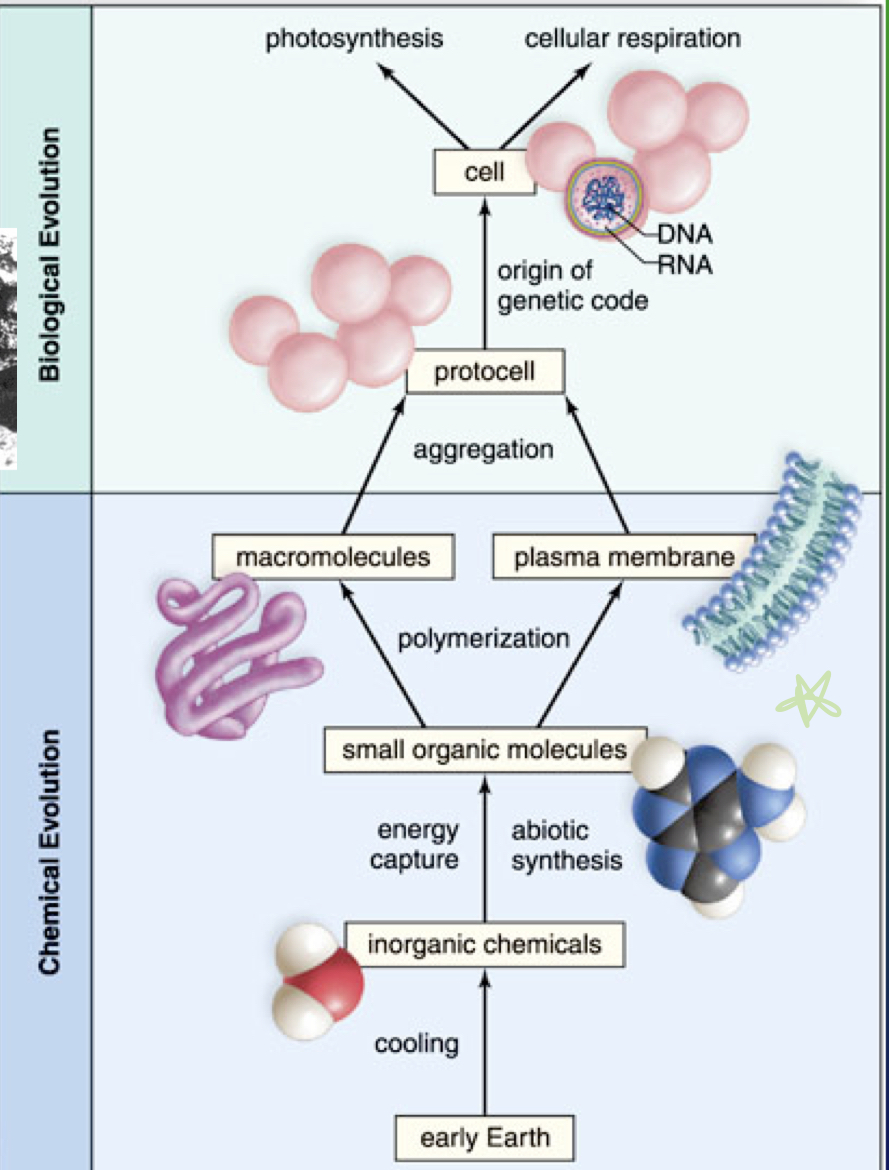
Overlapping stages
- For life to occur…
- Nucleotides and a.a.’s produced prior to the existence of cells
- Nucleotides and a.a.’s became polymerized to form DNA, RNA, and proteins
- Polymers became enclosed in membranes
- separate living molecules
- polymers encoded in membranes evolved cellular properties.
Primitive earth
- Reducing atmosphere hypothesis (abiotic synthesis)
- Oparin/Haldane Hypothesis
- Basically unlivable
- Components: H2O vapor, N2,CO2
- Too hot for liquid water ( earth cooled →oceans formed)
- Called “reducing” because there was little free oxygen
- Primordial soup: very energetic/thick
- Volcanoes and lightning
- cause of spontaneous formation of organic molecules
Miller/Urey’s experiment
- Showed that biochemicals could be produced from simple, nonbiological sources
- Simulated early life ==(ask which part of life I.e. primitive Earth?)==
- Very small organic molecules can turn into very big molecules
- First to use scientific method
- Found amino acids after experiment
- Using glass apparatus was crucial
- Simulated elements found in the environment during this time periods.
- Recent studies found more amino acids and sugars than the original experiment.
- Organics can be made under a variety of different conditions
Extra-terrestrial hypothesis
- Organic carbond from asteroids and comets stocked in prebiotic soup
Deep-sea vent hypothesis
- Key organics arose at deep-sea vents
Clay hypothesis
- Hypothesis of the origins of the 1st cell
- Monomer (simple organics) polymerize on solid surface (clay, mud, inorganic crystals) into more complex organics
- Stromatolites: mats of mineralized cyanobacteria
- “living fossils”
- Protobiont
- Cell-like structures
- Had boundaries (membrane)
- Polymers on the inside contained information
- and had enzymatic function
- self-replication
- Chemical Selection
- Why we know RNA was first because
- It can store information
- Capacity for replication
- Enzyme functions (Ribozymes)
Advantages of DNA/RNA/Protein world
- Information Storage
- DNA takes on informational role, so RNA can do other things
- DNA is less likely to suffer mutation
- more stable for DNA storage
- Metabolism
- Proteins have greater catalytic potential and efficiency
- can also perform other tasks (cytoskeleton, transport, etc)
- ==better for __?==
- DNA in our cells is transcribed to RNa, etc
- may not be how it started (chicken and egg story)
- Chances are it was RNA, can do what DNA and proteins can do
- can store info like DNA, and enzymes like proteins can do (metabolism)
- RNA mutates faster, so when DNA came into existence, it would’ve taken over bc of double helix and can store information
- Proteins are more effective
Fossils
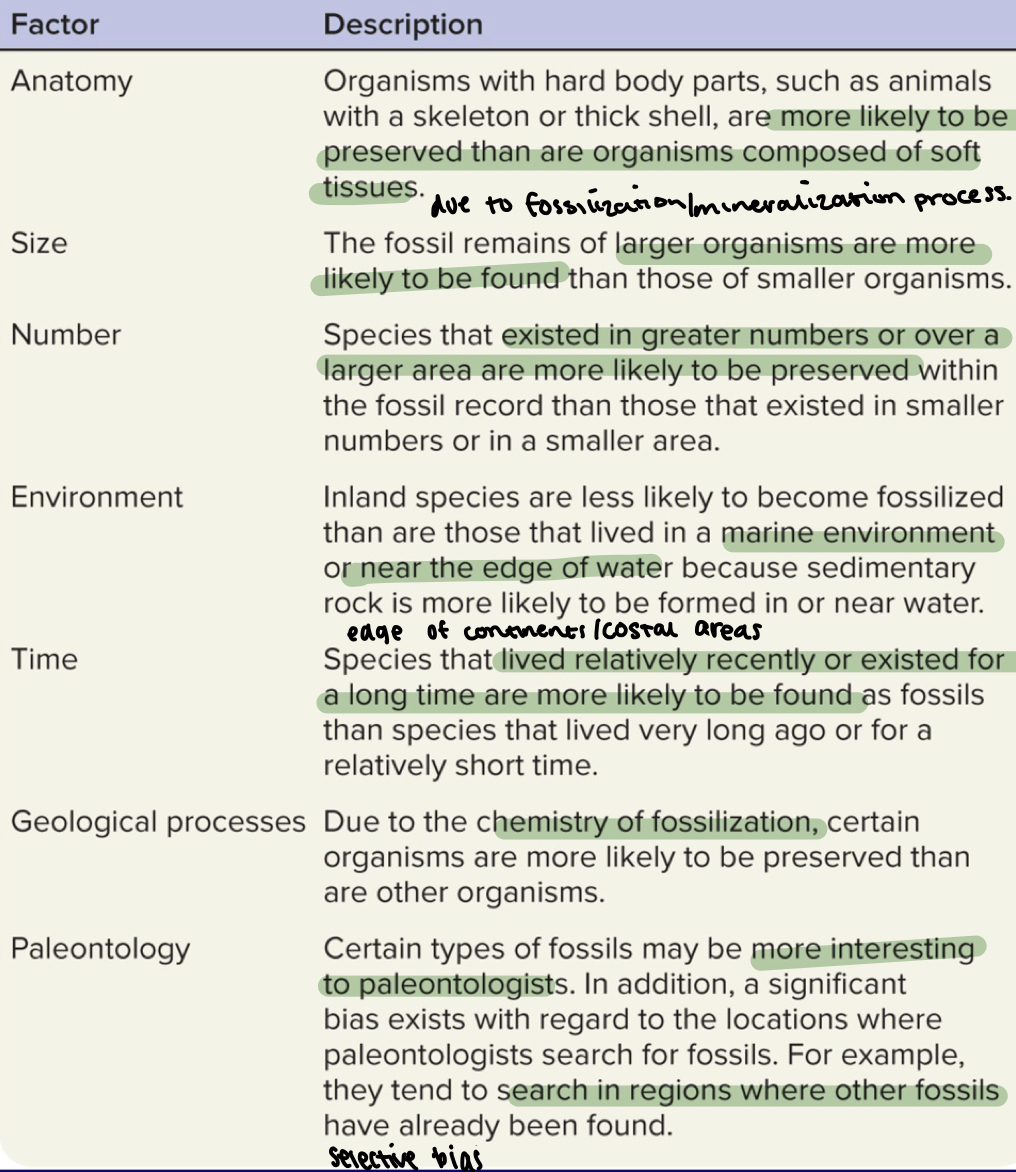
- Remains and traces of past life
- Somewhat biases process, soft shells don’t show up as often as hard bones
- I.e. vertebrates vs Insects and stools
- Sedimentation
- When the animals dies, the sediment converted to rock
- these are recognizable in the rock, called strata
- starta of the same age have similar fossil assemblages
Paleontology
- study of fossil records
==macroevolution==
- Evolution of whole taxonomic groups over long periods of time
Dating of fossils
- Relative dating: age based on surround fossils and rock at the same time
- Index fossils : assigned age of the rock by the fossils found in it
- Both were popular in 18th and 19th century
Absolute Fossil Dating
- More concrete, know exactly when the fossil/strata was alive
- Radioisotopes - radioactive elements (more neutrons than protons, so they are excitatory)
- Half-life
- unstable but decay in a constant time
Absolute Fossil dating
- More concrete, know exactly when the fossil/strata was alive
- Radioisotopes - radioactive elements (more neutrons than protons, so they are excitatory)
- Half-life
- unstable but decay in a constant time
- Half-life
Geological (biological) time scale - factors influencing patterns
- Climate/temp (temperature at artic and equator)
- Atmosphere (lack of oxygen)
- land masses (continental drift)
- floods/flaciation, volcanic eruptions/meteorite impacts
Precambrian Time: prokaryotes, stromatolites, eukaryotes, multicellularity (Ediacaran)
- 87% of Geologic time with little or no atmospheric oxygen
- Lack of ozone shield allowed UV radiation to bombard Earth
- First cells came into existence in aquatic environments
- Prokaryotes
- Cyanobacteria (left fossils) & added oxygen to atmosphere
- Eukaryotic cells arose (2 bya)
- Endosymbiotic Hypothesis: two different species being dependent on one another
- Rise of aerobic species
- Cells are half bacterial and half archaean
- Eons: Hadean -> Archaeon -> Proterozoic (when life begins)
Paleozoic era - Cambrian, Ordoviciian, Sulurian, Devonian, Carboniferous, Permian
Overview
- “Well displayed life”
- 3 major mass extinction events
Important periods
- Cambrian
- Warm, wet with oxygen, no ice at poles
- Existent phyla developed
- First vertebrates (520 mya)
- Evidence of soft and hard shell animals
- High diversity of Cambrian due to:
- Favorable environment (oxygen)
- Evolution of hox genes
- Genes that determine body patterning
- Predator/prey “Arms Race”
- Predators had to find new ways to hunt
- All species can be pointed to one of these as their ancestors, no other species has been identified from other eras.
- Ordovician*
- Warm temp and moist atmosphere
- Diverse marine invertebrates: trilobites(3 body part animals) and brachiopods(shelled animals i.e clams)
- Primitive plants and arthropods first invade land
- End: abrupt climate change (large glaciers) resulted in mass extinction (60% marine inverts)
- Silurian
- Stable climate, glaciers melted
- Significant vertebrates (fishes, plants, coral reefs)
- Large colonization by terrestrial plants (seedless vascular) and animals (arthropods)
- Mainly plants on the land
- Devonian*
- N dry; S wet is wet due to oceans
- Terrestrial species
- Gymnosperms(seeds for dispersal) emerge insects emerge
- Tetrapods - amphibians emerge
- Invertebrates in oceans
- Age of fishes
- Coral reefs
- Carboniferous Period
- Rich coal deposits formed
- Cooler w/land covered by swamps
- Organisms further diversified
- Large plants
- First flying insects
- Amphibians
- Amniotic egg emerges: Reptiles
- Permian
- Continental drift formed supercontinent Pangaea
- Regions dry w seasonal fluctuations
- Forests -> gymnosperms
- Amphibians prevalent but reptiles dominant
- First mammal-like reptiles
- End: largest known mass extinction event
- Cause: Global warming and too much carbon
- 95% of marine species killed
Mesozoic era(Age of the Reptiles) - Triassic, Jurrasic, Cretaceous
Consistently hot climate, dry terrestrial environments, little if any ice at poles
- Triassic*
- Gymnosperms dominant
- Reptiles abundant (1st dinosaurs appeared)
- 1st true mammals (looked like mice)
- Jurassic
- Dinosaurs achieved enormous size
- Mammals remained small and insignificant
- 1st bird
- Cretaceous*
- Dinosaurs began precipitous decline (extinction: meteorite and volcanism)
- Mammals:
- Began an adaptive radiation
- Moved into habitats left by dinosaurs
- 76% marine species extinct (needed heat but meteorites covered sun)
- 75% of all plant species died
Cenozoic era
Age of mammals
- Tropical conditions replaced by a colder, drier climate
- Mammals continued adaptive radiation (birds, fishes, insects diversified)
- Flowering plants already diverse and plentiful
- Tertiary Period (Paleogene and Neogene) - Older humans, nethanderals
- Primate evolution began
- Quaternary Period: Where we as humans (and other primates) are today
- Age of man
- Homo sapiens appear
Mass Extinctions - the importance of them, 1-5, 6+
- 6th mass extinction (Holocene, Anthropocene)
- Humans= Global Superpredators
- Vanished after Human Civilization
- 83% of wild mammals
- 80% of marine mammals
- 50% of plants
- 15% of fish
- Avg 68% decline in monitor pops (21,000) of mammals, birds, amphibians, reptiles, and fish
- Significant declines in tropical subregions of the Americans (94%) and AFrica (65%)
- Freshwater biodiversity declining fastest
- Megafauna particularly vulnerable
- ⅕ of wild species are at risk this century due to climate change alone
Not on the Study Guide
- How life comes to exist
- Life requires interplay between DNA, RNA and proteins
- Living cells come from pre-exisiting cells
Darwin and Evolution
History of Evolutionary Thought - Plato, Aristotle, Scale of Nature, Christianity and Divine
- Pre-Darwinian (1831)
- Influenced by Theology, Myth and Superstition; leading back to ancient Greece
- Anaximander: organisms evolve over time
- Plato
- Follows socrates
- Objects are temporary reflections of ideal forms
- “Essentialism”: ideal forms that live somewhere else
- Theory of forms
- Aristotle
- All living things can be arranged in a linear hierarchy- Scala naturae
- Creationism: a god is absolute creator of heaven and earth, out of nothing, by act of free will
- Includes Christians, Jews, and Muslims
- Spontaneous Generation
- “Living coming from the nonliving”
- I.e Rotting meat produces maggots
- Father of Classic Taxonomy
- Scala Naturae
- Great Chain of being
- Establishes man as dominate and perfect form of life
- Sets man above and Apart from nature
- Incorporated into belief that earth and its creatures are the result of special creation,that they
have not changed since they were created
\n
*Insert scale*
\n
Creation, Ray, Linnaeus and Taxonomy, Count Buffon,
\n
Taxonomy matured during lath 17th to mid 18th century
- Science of naming organisms
\n
- John Ray
- 1st thorough study of natural world
- Carolus Linneaeus
- Fixity of species
- Each species had
- Ideal structure and function
- Place in the scala naturae
- Binomial system of nomenclature
- Count George Buffon
- Wrote 44-volume catalog of all known plants and animals
- Suggested life forms and change over time
- Erasmus Darwin (grandfather of Charles)
- Suggests common descent
- Evidence in developmental patterns, artificial selection, vestigial organs
\n
Cuvier - comparative anatomy, paleontology, Catastrophism
- First to use comparative anatomy to develop a system of classification
- Founded Paleontology: fossils
- Proposed Catastrophism
- Past local catastrophes in past had caused strata to have new fossils
- After each catastrophe; region was repopulated
- Had evidence that organisms because extinct
\n
Lamarck - inheritance of acquired characteristics
- First biologist to propose evolution and link diversity with environmental adaptation
- Concluded more complex organisms are descended from less complex organisms
- Proposed Inheritance of Acquired Characteristics: Lamarckianism
- Childhood trauma: can change gene expression
\n
Geology - Charles Lyell, uniformitarianism
- Earth is subject to slow but continuous cycles of erosion and uplift
- Long slow change
- Proposed Uniformitarianism: rates and processes of change are constant
- Principles of Geology: connects to Darwin
\n
Darwin and Voyage of the HMS Beagle - Galapagos Islands, Tortoises, Finches
- Darwin went to college to be a surgeon but didn’t like it
- Went to the military school after, was bad at that
- Enjoyed exploring the natural world
- Got a job on HMS Beagle: goal was to collect specimen from around the world and bring it back to England
- Got seasick, lasted 5 years and was a unpaid trip
- Darwin’s theory
- Geological observations consistent with Hutton & Lyell
- Biogeographical observations
- Study of the geographic distribution of life forms on Earth
- Darwin saw similar species in similar habitats
- Reasoned related species could be modified according to environment
- Galapagos Islands
- Tortoises
- Darwin observed tortoise neck length varied from island to island
- Proposed that speciation on islands correlated with a difference in vegetation
- Finches
- Darwin observed many different species of finches (13) on various islands
- Speculated they could have descended from a single pair of mainland finch
Natural Selection and Adaptation, Variations, Struggle for Existence
- Essay on the Principle of Population: Struggle for Existence
- Written by Thomas Malthus (political economist)
- Each generation has the same reproductive potential as the previous generations
- Reproductive potential is greater than environment can support
- Death, disease, and famine were inevitable if population is to have stability
- Alfred Russell Wallace
- Darwin read his manuscript, work was presented at meeting of Linnean Society
*Insert Darwins chart of natural selection*
\n
Survival of the Fittest, Industrial Melanism, Adaptive Melanism (video: Rock Pocket Mice)
\n
- Fitness is the relative reproductive success of an individual
- Most-fit individuals in population capture disproportionate share of resources
- Interactions w/environment determine which individuals reproduce the most
- Adaptation
- Changes that help a species become more suited to environment
- Product of natural selection
- Industrial Melanism
- Before industrial rev.
- Peppered moths: 10% dark colored; 90% light colored
- After industrial rev.
- Soot in atmosphere, tree trunks darkened, etc
- Peppered moths 80% dark colored 20% light colors
- Adaptive Melanism
- Moth example from the industrial revolution
- *insert rock pocket notes*
\n
Evidence for Evolution
Morthology: study of structure and design
- Comparative Anatomy
- Homologous Structures
- Anatomically similar because they are inherited from a common ancestor
- May be functionally similar or not
- Want to use to construct ancestral trees
- Analogous structures
- Serve the same function
- Not constructed similarly
- Don’t share common ancestor
- Convergent evolution
- Vestigial Structures
- Fully-developed anatomical structures
- Reduced or obsolete function in descendent groups
- We are developed with them as our ancestors needed them but now they have no use to us
- I.e Human appendix, male breast tissue/nipple
- Wisdom teeth
- Comparative Development
- Embryology
- All vertebrate embryos look similar at an early age, as they all descended
from a common ancestor
- All have
- Postanal tail
- Paired pharyngeal (gill) pouches (in parathyroid gland, tubes that run from
Middle ear to throat, still there but a different function)
- Dorsal, hollow, nerve cord
- Notochord (becomes vertebral column; starts as cartilage)
\n
- Fossil Record
- Fossils record history of life from past
- Document a succession of life forms from simple to more complex
- Sometimes record is complete enough to show descent from ancestor
- Biogeography
- Geographical evolution of plants and animals
- Consistent with origin in one locale and then spread to accessible regions
- ^Animals more isolated than mainland, different adaptations in the same animals
- Continental drift; tectonic plates
- Molecular Homologies
- Almost all organisms
- Use same basic biochemical molecules
- Utilize same DNA triplet code
- Utilize same 20 amino acids in proteins
- Utilize ATP as energy source
- Genetic Homologies
- When very similar, suggest recent common descent
- More different, suggest more ancient common descent
\n \n
Evolution in a Genetic Context - Microevolution
- Population Genetics: study of genes and genotypes in population
- Helps us understand how genetic variation is related to phenotypic variation
- Genes in Natural Populations
- Genes can be monomorphic (99% = 1 allele) or polymorphic ( 2 or more alleles)(more likely)
- Polymorphism comes from
- Duplication of gene region
- Deletion of significant region of gene ( disease & death)
- Change in a single nucleotide (SNP)(smallest and most common change in gene)
- Allele frequency: # of copies of a specific allele in pop/total # of individuals in a pop
- Genotype frequency: # of individuals with a particular genotype/total # of individuals in a pop
\n
Hardy-Weinberg Principle
\n
- Genes remain in equilibrium (constant frequency) over time (in each succeeding generation of a
sexually reproducing pop) as long as 5 conditions met
- Equation
- p + q = 1
- p^2 + 2pq + q^2 = 1
- Allele freq
- p = freq. of dominant allele
- q = freq. of recessive allele
- Genotype freq
- p2 = freq of homozygous dominant genotypes
- q2 = freq of homozygous recessive genotypes
- 2pq = freq of heterozygotes
- Conditions to be met( will never occur, natural selection will always happen)
- No mutations
- Allelic changes do not occur, or changes in one direction are balanced by changes in
opposite direction(no gene dup, exon shuffling or horizontal gene transfer
- No gene flow
- Migration of alleles into or out of pop does not occur
- Random mating
- Individuals pair by chance and not according to genotypes
- No genetic drift
- Pop is very large and changes in allele frequencies due to change alone are insignificant
- No selection
- No selective agent favors one genotype over another; all are equal adapted
\n
Causes of Microevolution
- Genetic Mutations
- Raw material for evolutionary change; source of genetic variability
- Source of new alleles; new combinations of alleles; source on which other evolutionary forces
can act
Not goal-directed; not result of environmental necessity
Random events depending on environmental conditions
Other forces acting
Gene Flow- Gene Migration
- Movement of alleles between pops when
- Gametes or seeds (plants) are carried into another pop
- Breeding individuals migrate into or out of pop
- Continual gene flow reduces genetic divergence between pops & typically increases genetic
diversity within pop
Nonrandom mating: when individuals do not choose mates randomly
- Assortative mating
- Individuals select mates with their phenotype and reject opposites
- Increase # of homozygotes
- DIsassortative mating
- Dissimilar phenotypes mate preferentially
- Increase # of heterozygotes
- Inbreeding
- Mating of 2 genetically related individuals
- Chose a mate from same genetic lineage
Genetic Drift
- Changes allele frequency due to random chance
- Can cause gene pools of two isolated pops to become dissimilar
- Some alleles lost and some fixed
- Bottleneck effect
- Species is wiped out and created based on new genetics
Founder effect
- New pop is started from just a few individuals
- Alleles carried by pop founders are dictated by chance
- Formerly rare alleles will either
- Occur at higher frequency
- Be absent in pop
Same principal(genetic drift)
- Random, effect will be greater on smaller pop
- Bottle neck:
- Only 10 survive, they will be the only to reproduce
- Baby’s will have the genes that those 10 have
- Disease, volcano ash,
- Founder effect:
- population that is good size, but other members go somewhere else
- Think of pilgrims
- The Amish
- Mutations occur at higher freq. Because they only reproduce with each other
Natural Selection - directional selection, stabilizing selection, disruptive selection
- Abiotic
- Climate, water availability, minerals
- Biotic
- Competition, predation, sexual selection
- Directional Selection
- Individuals at one extreme of a phenotypic range have greater reproductive success in environment
- Curve shifts in that direction
- Stabilizing selection
- Intermediate phenotype is favored
- Peak of curve increases and tails decrease
- I.e human babies with low or birth weight less likely to survive
- Disruptive (Diversifying) Selection
- Two or more extreme phenotypes are favored over intermediates; bimodal distribution
- Balancing Selection
- Maintains genetic diversity
- Balanced polymorphism
- 2 or more allele are kept balance, and therefore maintained in a population over the cour
Se of many generations
- Two common ways
- For a single gene, heterozygous is favored
- Negative frequency dependent reaction
- Rare individuals have high fitness
- Keeping allele that may be dangerous in pop, to confer an advantage (in certain population)
- Keeping one good allele and one bad allele
- Sickle gene and other gene, so that you aren’t going to be effected if you are both
- Predators recognize prey by having a general idea in their head
- Rabbit and fox example
- Fox will look for white and small thing, so dog can look like one.
- Brown rabbit will survive
Speciation
- Two types
- Anagenesis
- The transformation of the one species into a new species over time
- Cladogenesis
- The splitting of one species into two
- Definitions of species
- Typographical(Morphological): Species is defined by fixed, essential features.
- Each species has a unique structure that makes it distinct.
- Based on unchanging features
- Pre Darwin
- Biological Species Concept: Species is a reproductive community of populations
- Reproductively isolated from others
- Occupies a specific niche in nature, interbreeding with a common gene pool.
- Ecological Species Concept
- Using the ability of organisms to successfully occupy their own ecological niche or habit
- Including their use of resources and impact on the environment, to distinguish
Species
- Many similar organisms that use the environment in similar ways
- Phylogenetic (Evolutionary) Species Concept
- A species is an irreducible group of organisms diagnosably distinct from other such groupings and which there is a parental pattern of ancestry and descent.
- morphological(anatomical), chromosomal, molecular characters used.
\n
Reproductive Isolating Mechanisms
Inhibit gene flow between species and maintain distinctiveness of species
- Prezygotic: discouraged attempts to mate
- Habitat isolation
- Temporal (monthly difference) isolation
- Behavioral (mating difference) Isolation
- Mechanical (anatomy) Isolation
- Gamete(sperm/egg don’t match) Isolation
- Postzygotic: Prevent hybrid offspring from developing of breeding
- Hybrid Inviability (Zygote Mortality) - hybrid won't be accessible
- Hybrid Sterility - hybrid can’t mate with hybrids
- Hybrid Breakdown - offspring of offspring doesn’t reproduce
\n
Modes of Speciation
- Allopatric speciation: Natural phenotype that disrupts flow
- Two geographically isolated populations of one species → become different species over time
- May be due to differing selection pressures in differing environment
- Most common
- Adaptive Radiation
- Members of a species invade several new geographically separate environments
- Population become adapted to the different environments
- From one ancestral species
- Sympatric speciation
- One population develops into two or more reproductively isolated groups
- No prior geographic isolation (no physical barriers to interbreeding)
- Autoploidy: 2n plant -> 2 gamete (+n) = triploid (sterile, seedless)
- Alloploidy: tetraploid hybridization in plants
- Results in self fertile species
- Reproductively isolated from either parental species
Not on Study Guide
\n
Special Case of Natural Selection
- Sexual selection
- Directed at certain traits of sexually reproducing species that make it more likely individuals to find of choose a mate and/or engage in successful mating
- Males are affected more
- Sexual selection =/ good overall
- Intrasexual - same sex (males compete for mating opportunities or territories)
- Intersexual - opposite sex (females choose with males possessing a particular phenotype)
Maintenance of Variations
- Genetic variability
- Populations with limited variation may not be able to adapt
- Exposed allele(phenotypes) are subject to natural selection
Pace of Evolution
- Phyletic Gradualism: speciation occurs gradually
- “Living fossils”: sharks, crocodiles, etc
- Statis (stable condition) is apparent, not real
- Transational link found
- Ancestral spp. transformed into new species
- Punctuated Equilibrium: speciation occurs rapidly
- Species experiences stasis
- Transitional links not found
- Subpopulation becomes new spp.
Classification of Living Things
Taxonomy, Phylogeny, naming, identifying, classifying
- Systematics: study of the biological diversity and evolutionary history of life on earth
- Taxonomy: Branch of biology concerned with identifying, naming, and classifying organisms (both living and extinct)
- Name: Only 1 scientist gets to “name” a species
- Identify: anyone can with a key
- Classify: groups a species with its closest relatives
- Began with the ancient Greeks and Romans
- Aristotle classified organisms into groups such as horses, birds, and oaks
- John Ray: believed that each organism have set name based on anatomy & physiology
Binomial nomenclature: Genus + specific epithet
- First word: Genus
- Second word: specific epithet
- One species within its genus
- Species is referred to by full name (genus species)
- Genus name can be used alone to refer to a group of related species
\n
Classification, gets more specific as you go down
- Domain: one or more supergroups
- Supergroup: one or more kingdoms
- Kingdom: one or more phyla
- Class: one or more orders
- Order: one or more families
- Family: one or more genera
- Genus: one or more species
- Species
\n
- Higher the category, more inclusive
- Same domain: general characteristics in common
- Classification categories can be subdivided into more categories:
- Superorder
- Suborder
- Infraorder
- DIstinguishing species on the basis of structure
\n
Goal of Systematics
- Discover all species (impossible)
- Reconstruct phylogeny (evolutionary history of a group)
- Classify accordingly
Phylogenetic Tree
- Diagram indicating lines of descent
- Each branching point
- Divergence from common ancestor
- Represents an organism that gives rise to two new groups
Primitive characters
- Present in all members of a group, and present in the common ancestor
Derived characters
- Present in the some members of a group but absent in common ancestor
\n
Tracing Phylogeny
- Fossil Record
- Better to find hard fossils rather than soft fossils
- Fossil record is incomplete
- Often difficult to determine the phylogeny of a fossil
- Homology
- Refers to features that stem from a common ancestor
- Homologous structures are related to each other through common descent
- Same underlying anatomy
- Convergent Evolution - Analogy(look similar but not related, have similar environmental pressures)
- Acquisition of a feature in distantly related lines of descent
- Feature is not present in common ancestor
- Parallel Evolution
- Independent evolution of similar traits, starting from similar ancestral condition
- Several species respond to similar challenges in a similar way
- Following parallel paths w/out common ancestors, species deal with similar things
\n
Molecular data:
Protein Comparison
- Immunological techniques
- Degree of cross reaction used to judge relationship
- Amino acid sequencing
- Similar sequence in same protein indicates close relationship
RNA and DNA Comparisons
- Systematics assumes:
- Two species with similar base pair sequences are assumed to be closely related
- Two species with differing base-pair sequences are assumed to be only distantly related
Molecular clocks
- Change is slow because sequences are rare
- Use non adaptive nucleotide sequences
- Assumed constant rate of (neutral) mutations over time
- Favorable mutations are rare
- Detrimental mutations are quickly eliminated
- Most mutations are neutral
\n
Traditional Evolutionary Systematics
Classifying organisms using assumed phylogeny with emphasis on phenotype
- Mainly uses anatomical data
- Common ancestry and degree of structural difference
- Phylogenetic trees by applying evolutionary principles
- Not strict in making sure all taxa are monophyletic
Grouping
- Monophyletic groups
- Taxon whose units all evolved from a single parent stock; most recent common ancestry and all
- Descenednts
- Paraphyletic groups
- Sometimes okay
- Some structure that makes it distinct
- All ancestors common but not all descendants
- Polyphyletic groups
- Never okay
- All descendants none of the ancestors are in the same group.
- *insert picture*
\n
Cladistic Systematics
Traces evolutionary history of the group under study
- Synapomorphies
- Shared derived characteristics
- Arranges taxa into cladogram(special type of phylogenetic tree)
- Clade: Evolutionary branch that includes a common ancestor with all its descendant species
\n
Classification systems
- 5-kingdom system
- Was a plants(plantae), animals(animalia), protists(protista), fungi and monera(prokaryotes)
- 3 domain system
- Turned into Domain Eukarya, Bacteria and Archaea
- Bacteria and Archaea were so different that they had their own domains.
- Difference in rNA base sequences, plasma membrane and cell wall chemistry.
- Eukarya
- Un- and multicellular organisms, cells with a membrane bound nucleus
- Sexually reproduction
- Kingdoms:
- Fungi, Plantae and, ANimalia
- NEW: Protists and Hemimastigotes
Not in Study Guide
Parsimony
- Cladist guided by this principal
- Arrangement requiring the fewest assumptions is preferred
- Simplest reasoning is accepted (not always the best answer though)