Unit 2: Social Influence
Conformity and Obedience Presentation (Module 14)
Obedience: Direct order from a person of authority
Conformity: Alter behavior to adhere to social norms
Compliance: Direct request from one person to another
Obedience: Direct order from person of authority
Famous study: Milgram
75 volts= grunt of pain
120 volts= verbal protests are louder and more insistent
150 volts= complain about heart condition
300 volts= pounds on wall but no verbal distress
330 volts= unresponsive
Please continue
The experiement requires that you continue
You must continue
You have no other choice. You must go on
Although the shocks may be painful, they’re not dangerous
Whether the learner likes it or not, you must go on until has learned all the word pairs correctly
Norms:
Explicit- written down/stated
Implicit- unstated rules of behavior
Descriptive- how a typical person might act
Injunctive- what we feel is expected of us
Types of Influence
Normative: conform to acceptance
Public compliance
social validation
Informational: think others are more competent/have more information
ambiguous contexts
internalization/private acceptance
Social Validation: an interpersonal way to locate and validate the correct choice
look to behavior of similar others
The more people performing the behavior, the more persuasive it is
list procedure and scarcity
Asch (1951)
75% conformed at least once
37% across all trials
Situational Determinants of Conformity
Insecrutiy
> 3 members
Unanimous
Observable
Admire Group
No Prior Act
Desire for Accuracy
Baron, Vandello, and Brunsman (1996)
Asked students to choose a criminal suspect from a lineup
IV #1: time to view
IV #2: motivation for accuracy
Results:
When uncertain, motivated to be accurate increased conformity.
When certain, motivation to be accurate decreased conformity
Who resists?
Nonconformist: a person who resists influence does their own thing
Anti-conformist: reacts against social influence, does the opposite of what they think is expected
Reactance: Doing the opposite of what we are pressured to do reasserts our personal freedom to choose
Compliance: direct efforts to change behavior
Ingratiation
That’s-not-all technique
labeling technique
Reciprocity
Influences
emotion distance of the victim
closeness/legitimacy of authority
institutional authority
group influence
Women?
Yes! Displayed same rates as men but showed more nervousness
Replications?
Burger (2006-2009): Partial replication (up to 150 volts)
70% obedience
Impact?
Stricter APA ethical codes
Mandate human research by approved by the Institutional Review Board (IRB)
Persuasion (Modules 15 & 16)
Attitudes: relatively enduring, learned evaluation of people, objects, ideas, etc. that range from positive to negative
ABC Model:
Affect = Feelings
Behavior = Actions/Interactions
Cognitive = Beliefs
Attitude Change
Motivations:
~Accuracy - hold more accurate worldview
“I want to learn more about sustainability.”
~Consistency - Want a consistent self-view
“I am going to recycle, bring reusable bags to the supermarket, etc”
~Approval - gain social approval/acceptance
“People will judge me if I don’t recycle”
Persuasion: change in private attitudes or beliefs as a result of receiving a message
4 events:
~Attention: Hold attention by actors, volume, colors
“Strange” things capture/keep attention
Zygernick effect: if we start something and can’t finish it, bothers us until it is
~Comprehension: audience must understand the message
Ex: “if-then” themes)
~Acceptance: must accept premise of message
Ex: when are certain ads played
~Retention: must remember the message
Ex: “Call in the next 5 minutes to receive a bonus”
Dual Process Models
Spontaneous attitude change: message —→ smile —→ attitude change
Thoughtful attitude change: message —→ message —→ cognitive elaboration —→ attitude change
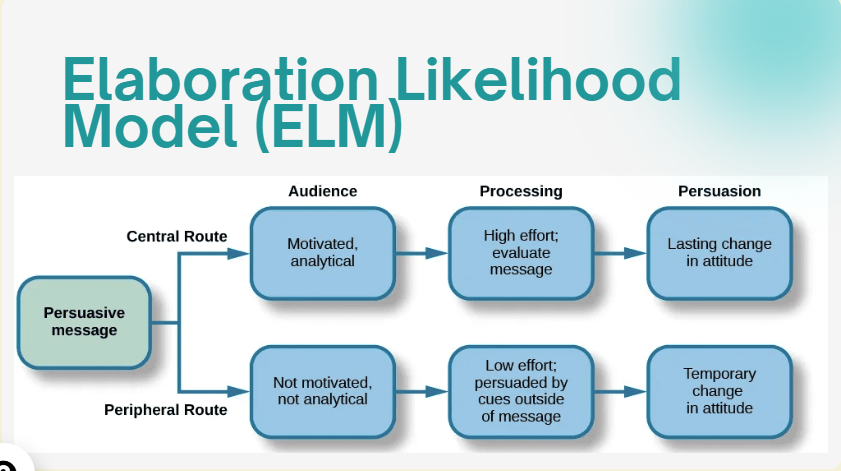
Elaboration Likelihood Model (ELM):
Central (deep) vs peripheral (shallow) routes
Routes are mutually exclusive and depend on the careful scrutiny given to the message
Emphasizes motivation to achieve “correct” attitude
Heuristic-Systematic Model (HSM):
Systematic (detailed, thoughtful) vs heuristic (simple, shortcuts)
Simultaneous processing
Emphasizes sufficiency in processing
Who said it?
Credibility
Expertise: Know the relevant facts, especially important for highly complex messages
Trustworthiness: likelihood of sharing in an unbiased fashion
Convert communicators
Arguing against self-interest
Likability and Attractiveness
Scowling can increase credibility in ambiguous situations but reduce it in unambiguous situations
Similarity
Most change seen when communicator is trustworthy and expert
Sleeper effect: low credibility communication becomes more effective over time
The message itself may be valid despite communicator
3 processes:
Credibility —→ Internalization
can be believe the “right” position
Attractiveness —→ Identification
want to be more like the communicator
Power —→ Compliance
Say we agree even when we don’t
Depends on what is measured!
Salience: Easy to remember it
Surveillance: who’s watching
What was said?
Two approaches:
Emotion: Fear, humor
Fear is very effective, especially if there are specificrecommendations about how to prevent the negative consequences
Positive emotion can have similar effects
Cognition: messages that don’t appear to be designed to change attitudes are more successful than those intended to manipulate
Stealing thunder: revealing potentially incriminating evidence first to negate impact
Advertisement wear-out: inattention and irritation that occur after encountering the same advertisement too many times
explicitness of the conclusion
To Whom was it said?
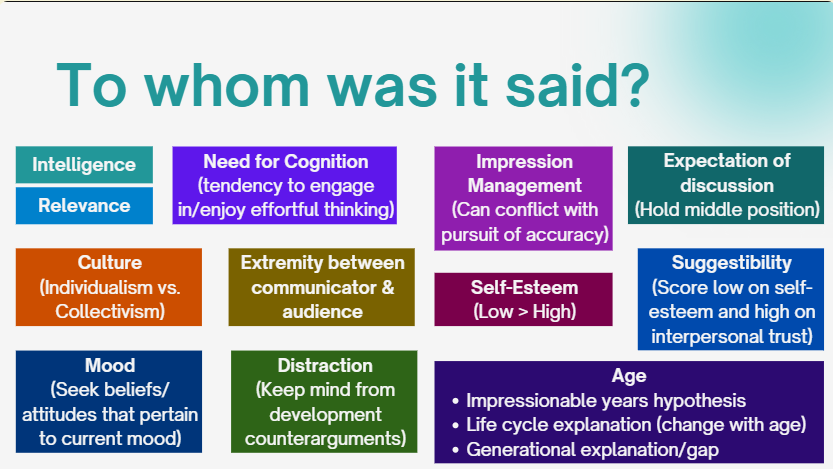
Audience factors:
Receptivity: are they paying attention, do they understand the message, etc
Yielding: do they accept the message
Message factors:
One-sided messages:
Audience won’t hear oppposing side
Audience already agrees with you
Audience is less intelligent
Two-sided messages:
Arguing with another side/might hear
Audience disagrees with you
Audience is intelligent
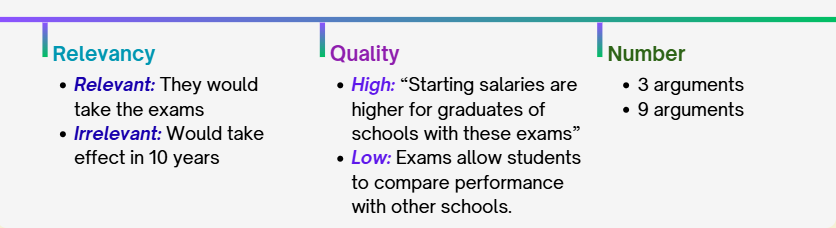
Petty and Cacioppo (1984)
Students read arguments in favor of mandatory comprehensive exams
Students would be required to pass the exams before graduation
How was it delivered?
One-on-one: generally best
Video: TV/Video is the second best because it has both auditory and visual cues
Auditory: Podcast/radio is next because it has auditory cues
Written: Generally least persuasive unless the issue is highly complex
Resisting Persuasion
Attitude Inoculation: Vaccine approach; technique for increasing individuals’ resistance to an argument by first giving them weak, easily defeated versions of it
Process: Pre-exposure builds long-lasting resilience
Threat: warning is given that the established attitude is about to be challenged to motivate one’s defense
Refutational preemption: person is exposed to a weak version of a counterargument and arguments that refute it
Active defense: person must engage in the process of generating their own counterarguments, thereby strengthening commitment to the original belief
Forewarning: Alarm approach; explicit alert that position on a topic is about to be challenged
Mechanism: creates a threat to the current attitude, which prompts us to become more vigilant and motivated to defend our position
Outcome: component of inoculation, but may not be sufficient to create lasting resistance compared to full inoculation
Boomerang effect: unintended negative attitude change/action that is opposite of what one is being persuaded to do
Stockpile: if people do not have properly physical/ cognitive/ social resources available, they are more easily persuaded
Application: Cults
AKA New Religious Movements
Distinctive rituals/beliefs related to its devotion to a higher power or person
Isolation from the surrounding culture
Charismatic leaders
Why follow a cult?
Attitudes follow behaviors
The more compliant we are, the more accepting we are of behaviors/messages/attitudes
Foot-in-the-Door: recruitment involves small steps (dinner, conversation, signing, etc) leading to larger steps (eg, longer retreats, donations)
Persuasion
seemingly trustworthy/ expert leaders
Delivery of message/channel
Audience
Zimbardo’s theory on cults:
Joining: people don’t join cults; they join groups which promise instant friendship, identity, security, or organization
Values: Cults reflect society’s “default values” and fills in its missing functions
Distortion: “If you don’t stand for something, you’ll fall for anything.” Those in transitional phases of life or who have problems trusting others are susceptible
Social Facilitation, Social-Loafing, and Deindividuation (Modules 17-19)
Co-actors: co-participants working individually on a non-competitive activity
Triplett (1897):
Bicycle racers had better times in competition than in practice/alone
Children wound fishing reels faster when around other children
Social facilitation: when performance improves in the presence of others on simple tasks but worsens on complex tasks
Social Inhibition: when performance worsens in the presence of others
Parents inviting everyone to your piano recital when you’ve just learned to play
Zajonc’s (1965) Drive Theory
The mere presence of other people is arousing
Arousal polarizes dominant response; the response is most likely to be performed in a given situation
If the dominant response is correct, the presence of others will facilitate performance
If the dominant response is incorrect, the presence of others will inhibit performance
“Roach Study” The cockroach maze, Bas Kakaerlaken Labyrinth
Baron’s (1986) Distraction Conflict Theory
Information processing model:
Conflict produced simultaneously while paying attention to others (co-actors) and a task
Spectators demand the attention needed to complete tasks, so we become aroused
Arousal enhances the tendency to perform a dominant response
Evaluation-Apprehension: concern over being judged by others
Cottrell (1968): The mere presence of blindfolded people did not boost well-practiced responses
Consideration
Arousal is higher when being evaluated by high-status others
can perform better if the co-actor is better than you- but only by a little (ex, gym set up)
Types of Tasks
Additive: contributions of each member are combined into a single product
Sum of individual efforts
more members = the better
Disjunctive: group product is selected from most successful member’s performance
more members = the better
Conjunctive: Cgroup succeeds only if each member is successful
limited by performance of least competent member
More members can hurt
Compensatory: contribution of each member is averaged together to form a single outcome
Groups are more efficient than individuals
Social loafing: the tendency for some group members to “free ride” and let others do most of the work in group (additive) projects
Free riders: people who benefit from the group but give little in return
Bad apple effect: one social loafer can cause other people to loaf as well (eg, brainstorming research)
Illusion of group effectivity: false belief that groups can stimulate creativity (eg, brainstorming research)
Ringelmann effect: tug-of-war study (groups of 3 pulled 85% of expected capacity; groups of 8 pulled 37% of effective capacity)
Diffusion of responsibility: when responsibility is shared among all group members, individuals feel less responsible than when alone (eg, Williams, Harkins, and Latane (1981) clapping study)
People loaf less when:
personal efforts are identifiable
The task is challenging, appealing, and involving
working with friends vs. strangers
They have a collectivist orientation
rewarded for group success
equally competent members helping
Groups and Leaders (Modules 20 & 21)
Aggregate: a collection of people in the same place at the same time with minimal interaction/shared identity
clower of cats
snuggle of sloths
Group: 2+ people who
interact directly/indirectly
are interdependent
have a stable relationship
structured interactions
perceive themselves as a group (entitativity)
Social identity theory: self-concept comes from membership in social groups
Functional: form to achieve specific tasks or satisfy utilitarian needs
Interpersonal attraction: Form because of attraction, social support, or emotional bonds
Fundamental Interpersonal Relations Orientation (FIRO): relationship between psychological needs and group formation. Three needs:
Inclusion: desire to be part of a group and to be accepted by a group
Control: guide the groups by organizing/maintaining processes
Affection: Establish/maintain open, positive relations with others
Needs affect behavior in 2 ways:
Shape how we treat people
shape how we want others to treat us
Development
Forming: team acquaints and establishes ground rules. Formalities are preserved, and members are treated as strangers
Storming: members start to communicate their feelings, but still view themselves as individuals rather than part of the team. They resist control by group leaders and show hostility
Norming: people feel part of the team and realize that they can achieve work if they accept other viewpoints
Performing: the team works in an open and trusting atmosphere where flexibility is the key and hierarchy is of little importance
Adjourning: The team conducts an assessment of the year and implements a plan for transitioning roles and recognizing members’ contributions
Functions
Roles: functions that individuals in specific positions are expected to perform
Status/Hierarchy: relative position/rank within the group
Norms: implicit/explicit rules that regulate behavior
Cohesiveness: forces acting upon members to remain part of the group
Types of Norms:
Prescriptive norms: tell members what to do
Proscriptive norms: tell members what not to do
Role stress: incompatible expectations within or between roles
Cohesiveness:
Interpersonal: members enjoy being with each other
Tasks: commitment to the task
Factors: attraction, facing external threats/competition, histories of success, small, cultural differences
Group Polarization: group discussion enhances/ strengthens initial views
Risky shift: groups make riskier judgments than individuals
Social comparison: discussion illustrates norms
Beofre: Believe we hold more extreme views than others
During: realize we’re average
Result? Shift
Persuasive argument: during discussion, members are convinced of the correctness of orginial views. Learn new arguments that favor their view
Groupthink: Group decision making characterized by greater desir among members to be harmonious/unanimous than generate/criticically evaluate alternative viewpoints
Antecedent Conditions
Time pressure and stress
High cohesiveness and social identity
Isolation from other sources of information
Directive, authoriative leadership
Guardrails
encourage members to challenge ideas/ present objections
use subgroups
seeks ideas from outside the team
invite outside experts
avoid expressing management’s opinions on desired outcomes
assign devil’s advocate
hold second chance meeting
Majority Influence: beliefs held by the larger number of individuals in a group
Minority influence: beliefs held by a smaller number of individuals in the group. When numerical minorities persuade the larger group of their views
hold steadily to their views (minority slowness effect)
originally held majority position
are willing to compromise a but
have at least some support from others
appear to have little personal stake
present views as compatible with group
face a group that wants a accurate decision
Dynamical Systems: a system (e.g., group) made up of many interacting elements (e.g., people) that change and evolves over time
computer simulations help us understand complex systems
Social impact theory: influence an individual experiences from others depends on strength (power), immediacy (prozimity), and number (SIN)
Leadership: process by which certain group members motivate and guide the group
Costs:
time investment
responsibility for others
criticism and complaints
Benefits:
recognition for group success
higher social status
higher salaries
Need for power: Desire to win prestige, status, and influence over others
Expert: superior skills, knowledge, or expertise in an area (e.g., surgeons)
Coercive: based on ability of one indivisual to force another to comply through threats, punishment, or other sanctions (e.g., parental punishment)
Legitimate: authority from position within an organization, enabling them to influence others through status (e.g., CEO)
Referent: ability to attract others/build loyalty through interpersonal relationships, charisma, identification (e.g., sports jerseys)
Rewards: provide incentives to encourage desired behavior (e.g., extra credit)
Who gets to lead?
Need for power: Desire to win prestige, status, and influence over others
Need for achievement: desire to do something well for its pwn sake
Other traits: ambitious and energetic
Voids at the top create poddibilities for those who are motivated
groups choose leaders who meet current group needs
Groups also choose those wo “look like” leaders:
high expertise
self-confidence
high participation
tall
Types of Leadership
Personallity/great-person: natural leaders have personality factors that make them effecrtive
Task: directive style )organize work, set standards, goal focused)
Social/people-oriented: democractic style (teamwork, mediate conflict, offer support)
Charismatic: combine charm, interpersonal connection, persuasiveness, support/validate group norms but have vision for what group could be
Transactional: work with subordinates so they undertsnad requirements
Transformational: changes motivations, outlooks, and behaviors of followers enabling the group to better reach their goals
Transformational
Idealized influence/charisma: communicating joint mission and dedication to followers; willing to sacrifice personal goal fro the group
Intellectual stimulation: creating openness to new ways of thinking and bigger picture that connects different views
Inspirational and convinces followes they have the ability to accomplish more than was previously thought possible; sets example; shows optimism
Individualized consideration in recognizing individual sthrenths/weaknessess; shows interest in their wellbeing, supports efforts
Effectiveness
Contingency model of leadership effetiveness: no single leadership style is effective in all situations. Success depends on matching a leader’s style to the right situational
Determinded by:
leader-member relations: level of rust/ consifence in leader
task structure: clarity od task requirements
position power: leader’s level of power/support from organization, ability to punish/reward