Science - E&E CHAPTER6 (Global systems)
Earth’s Spheres (6.1)
The Biosphere contains the Lithosphere, Atmosphere and Hydrosphere.
Earthquakes
Affects the Biosphere, Lithosphere, and Hydrosphere
Earthquakes move around parts of the lithosphere which can cause large cracks to appear or land to increase in height.
This movement may cause landslides or mudslides. This destruction of ecosystems (biosphere) causes many habitats to be lost like forests and vegetation.
Mudslide: A rapid downhill movement of a mixture of water, rock, and soil.
Landslide: The movement of rock, earth, or debris down a slope.
The Christchurch earthquakes of 2011 had a liquefaction factor.
Liquefaction: Liquefaction is the process by which a solid behaves like a liquid due to an increase in temperature or pressure, losing its rigid structure.
In saturated soils, water fills the pores between particles
Earthquake compresses soil, putting water under pressure
Pressure squeezes water out, causing water and soil particles to bubble up
Flow over the surface like a liquid
When shaking stops, pressure is released, soil becomes solid
Anything caught in the liquid is trapped when soil solidifies
Effects on the Hydrosphere include:
Tsunamis (underwater earthquakes)
Change the course of rivers (land earthwuakes)
Cause landslides which can block rivers and make lakes
Destroy dams and release huge amounts of water in a huge flood down the valley
Example of tsunamies: South-East Asia on Boxing Day 2004 and Japan in 2011
Since Japan 2011 the Pacific Nations updated tsunami warning systems and put in contingency plans.
Modelling of Earth’s Crust and predicting tsunami severities
Volcanic Eruptions
Short-term Effects include:
Heavy Rain Formation
Ash particles act as nuclei for water vapor condensation
Water vapor condenses around ash particles to form rain droplets
Lightning Formation
Collision of ash and air particles generates charge
Charged particles are forced apart
Atmosphere develops negative and positive charges
Voltage difference leads to electric charge flow
Flow of charge results in lightning
Long-term Effects include:
Long term cooling effect of volcanic eruptions
Mt Tambora eruption in 1815 causing 'year without summer'
Krakatau eruption in 1883 leading to global temperature drop. Sulfur dioxide from explosion caused acid rain (water + sulfur dioxide → sulfurous acid)
Formation of new islands
Hawaii, Indonesia, Galapagos, Japan
Undersea volcanic eruption creating new island off Iceland
Lava burns ecosystems, toxic gases and ash suffocate.
Delay in regrowth due to hot lava (germination)
Tropical Cyclones
Effects on the spheres:
Sphere | Effects |
|---|---|
Biosphere |
|
Lithosphere |
|
Hydrosphere |
|
Atmosphere |
|
For example, the Murray-Darling River system and Cooper Creek begin in Queensland but flow through other states. Rainfall from a tropical cyclone in Queensland flows down these rivers causing floods in regions hundreds of kilometres away.
Nitrogen Cycle
Key Terms
Nitrification: the biological oxidation of ammonia or ammonium to nitrite and then to nitrate by nitrifying bacteria.
Nitrifying bacteria: microorganisms that carry out the nitrification process.
Nitrogen Fixing Bacteria: bacteria that convert atmospheric nitrogen into a form plants can use.
Denitrifying Bacteria: micro organisms that convert nitrates back into nitrogen gas.
Denitrification: the process of converting nitrates into nitrogen gas by denitrifying bacteria. Legumes: plants that have the ability to fix nitrogen in their roots with the help of symbiotic nitrogen-fixing bacteria.
Nitrogen cycle is crucial for living organisms as nitrogen is essential for proteins.
Nitrogen in Air: Air contains 78% nitrogen, but most organisms cannot use nitrogen in its gaseous form.
Plants: Obtain nitrogen compounds from the soil to synthesize proteins.
Animals: Consumers that acquire nitrogen by consuming plants or other animals.
Bacteria:
Decomposers: Convert nitrogen into ammonia and nitrates, making it available to plants.
Nitrogen-fixing bacteria: Also convert nitrogen into forms usable by plants.
Denitrifying bacteria: Releases back into the atmosphere.
Cycle Summary: The image below illustrates the stages of the nitrogen cycle.
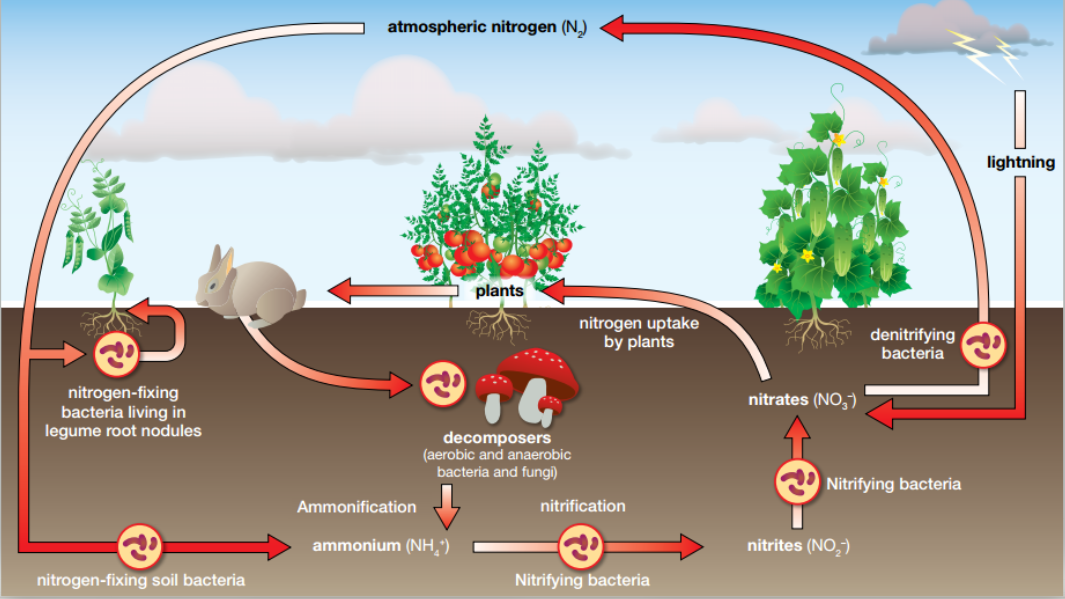 Nitrification Cycle Steps:
Nitrogen-fixing bacteria absorb nitrogen gas into the soil, turns it into ammonium via nitrogen-fixation
Nitrifying bacteria converts ammonium into nitrites then to nitrates via nitrification.
These bacteria like freely in soil and nodules of roots of legumes.Nitrates are absorbed by plants through roots for proteins.
Animals consuming the plant take in the nitrogen from the plan for proteins.
Some nitrates aren’t absorbed; they are turned back into atmospheric nitrogen via denitrification because of denitrifying bacteria
Also lightning can make atmospheric nitrogen straight to nitrates.
Carbon Cycle
Part of the carbohydrates, fats, proteins, vitamins and DNA found in cells, tissues and organs
Found in the atmosphere as CO2
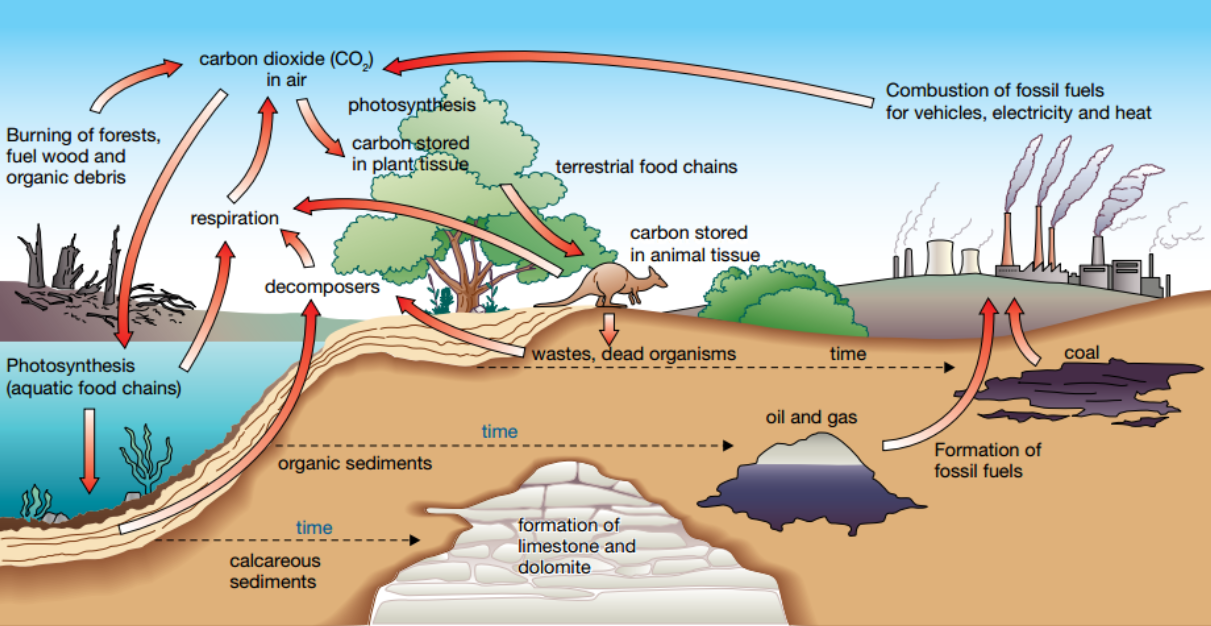
Used in photosynthesis and respiration. Photosynthesis incorporates carbon into living things and respiration releases carbon back into the atmosphere.
Photosynthesis balanced chemical equation:
Respiration balanced chemical equation:


Organisms release carbon into the soil through wastes like faeces, urine, and fallen leaves.
Decomposer organisms use these wastes as food and release carbon dioxide through respiration.
Fossils are preserved remains of once-living organisms, and fossil fuels like coal and oil contain carbon from ancient plants and animals.
Burning fossil fuels and wood releases carbon dioxide into the atmosphere when oxygen is plentiful.
In oxygen-limited conditions, carbon is released as soot and carbon monoxide gas.
Calcium carbonate (CaCO3) in limestone is Earth's largest long-term carbon store, formed from marine organisms' shells.
Below is a representation of the carbon cycle:
Water Cycle
Evaporation
Water from oceans, lakes, and rivers is heated by the sun and turns into water vapor.
Condensation
Water vapor cools and condenses into clouds in the atmosphere.
Precipitation
Water droplets in clouds combine and fall to the Earth as rain, snow, sleet, or hail.
Surface Run-off
Excess water flows over the land surface into rivers, lakes, and oceans.
Collection
Water collects in bodies of water, underground aquifers, and reservoirs.
Transpiration
Plants release water vapor through their leaves back into the atmosphere.
Natural Influences on Climate (6.2)
Weather and Climate
Key Vocabulary:
Weather: the day-to-day conditions of the atmosphere in a specific location, including temperature, precipitation, humidity, and wind.
Climate: the long-term averages of weather conditions of typically 30 years.
Weather is short-term and can change rapidly, while climate is long-term and more stable.
Weather is specific to a particular location and time, while climate refers to broader patterns over a region and extended period.
Influences on Climate
Influence on Climate | How | When | Positive effects | Niggative effects |
|---|---|---|---|---|
Sun | Ultimate source of energy and keeps planet warm enough for life | All Day | - provides global cooling - photosynthesis - Energy | - Infrared radiation = global warming - Melts ice caps, raises ocean levels |
Earth’s Surface | Reflects suns heat into atmosphere | All day | -Icecaps reflect light | - Uneven heat distribution |
Ocean Currents | Water circulation | Sometimes | - Thermohayline circulation | - La nina |
Orientation of Earth | Causes water & air circulation | 24/7 | - Seasons | Uneven heat distribution |
Atmospheric gases | Reflect/trap heat, Allows incoming solar radiation to pass. | All the time | - Ozone = Global cooling (reflect i.radiation) | - Greehouse gases trap heat |
Greenhouse gases
Enhanced Greenhouse Effect:
Definition: Increased trapping of heat in the Earth's atmosphere due to human activities, leading to global warming.
(Natural) Greenhouse Effect:
Definition: Natural process where gases in the atmosphere trap heat from the sun, warming the Earth.
Solar Energy and Atmosphere
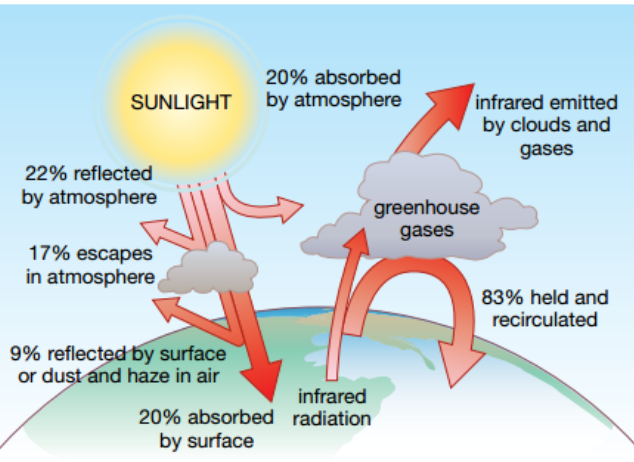
• Sun's energy is short-wave radiation, absorbed by clouds and Earth's surface.
• Nitrogen and oxygen, the main gases in Earth's atmosphere, do not affect solar radiation.
• Other gases absorb and re-emit long-wave radiation (heat).
• Some of this heat is radiated back to Earth's surface.Greenhouse gases: water vapor, carbon dioxide, methane, nitrous oxide, and ozone
Greenhouse Heat Up Effect
• Greenhouses heat up due to short-wave solar radiation absorbed by air, soil, and objects.
• Long-wave radiation, which cannot pass through glass, causes internal temperature increase.
• Without greenhouse protection, days and nights would be hotter and colder.
• Earth's average temperature would be -18°C without greenhouse effect, affecting weather conditions, plant growth, and animal survival.
Earth Orientation
Earth's rotation influences global air and water circulation. (dragsthem around as the earth spins)
Temperature is a major factor affecting ocean water circulation.
Global ocean temperature variations significantly affect Australia's climate.
Ocean Currents
Ocean currents are continuous movements of ocean water, affecting Earth's climate.
Causes include wind, temperature, salinity variations, Earth's rotation, and the gravitational pull of the Sun and Moon.
Surface currents are caused by wind, pushing surface water towards land.
These currents form circular patterns, called gyres, in major ocean basins, forming clockwise and anticlockwise directions due to Earth's rotation.
Deep currents originate at the poles, carrying extremely cold water along the bottom.
Currents and Climate
Surface and deeper currents interact, forming the thermohaline circulation.
This slow, 1600-year-long circulation is also known as the global conveyor belt.
The global conveyor belt distributes heat globally, affecting Earth's climates.
Gulf Stream
• Part of the global conveyor belt, causing western Europe to be warmer in winter.
• Flows from the warm Caribbean Sea, feeding into North Atlantic Drift and Norwegian currents.
• Feeds into Labrador and Greenland seas.
• Cold Arctic winds cool the water, increasing its density.
• Denser water sinks, creating a deep current that flows south to Antarctica.
Global warming
Australia was joined to Gondwanna 62 million years ago
Experienced a warmer, wetter climate
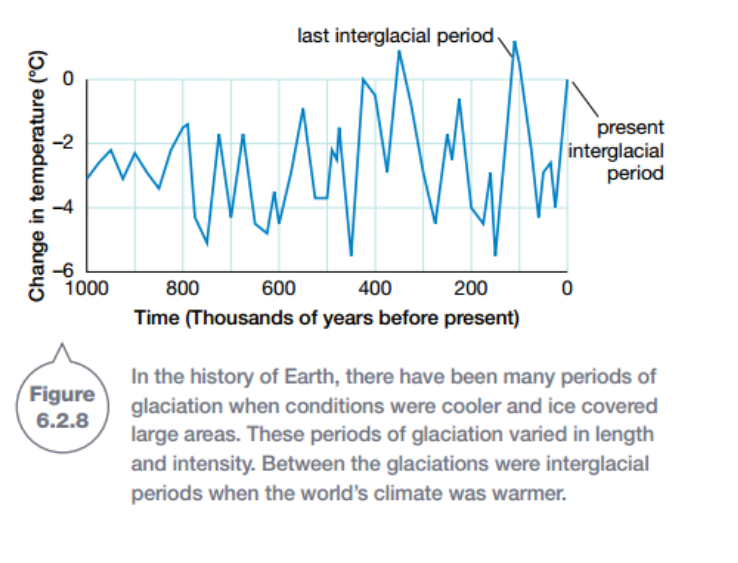
Ice age = Ice caps at poles expand = Sea levels fall.
This is why it was possible to walk from Victoria to tasmania
During interglacials ice caps melt, raising sea levels and flooding coastal lands.
Evidence for climate change
Glaciers
Advances during global warming, retreats during global cooling
Scored rocks on the sides of valleys due to debris of rocks being dragged along with glaciers are evidence for the presence of a past glacier in the area.
Ice Cores
Have accumulated layers of snow that can date back to hundreds of thousands of years ago
Can be analysed for its physical and chemical properties
Reveals link between temperature and variations in global sea level
Also reveals amount of carbon dioxide varied in the past
Antarctic Ice Cores Study:
• Strong link between snowfall in eastern Antarctica and drought in south-west Western Australia.
• Ice cores reveal increased snowfall in eastern Antarctica
• Winter rainfall in south-west Western Australia decreased
• Climate change alters the Antarctic Circumpolar Current's path, causing warm, moist air to be directed towards Antarctica, resulting in snowfall.
• Cold, dry air directed towards Australia results in reduced rainfall.
Pollen
• Pollen decays slowly and often becomes fossilized.
• Fossil pollen indicates species growth during fossilization.
• Changes in pollen types indicate vegetation and climate changes.
Sea level change
worldwide distribution of sedimentary rocks and the types of fossil found in them are indicators of changes in sea level in the past.
For example, sedimentary rocks in central australia have sea creature fossils.
Human Influence on climate (6.3)
The Earth is warming fr
the intergovernmental panel on climate change (IPCC) said:
increases in global average air and ocean temps
Rising global avg. sea level
Widespread snow and ice melting
The major cause of the enhanced greenhouse effect is the increase in:
Carbon dioxide
Methane
Nitrous gases
Carbon Dioxide in the atmosphere
Yeah so 95% of carbon dioxide would’ve been emitted with or without humans present.
Largest source = natural organic decay in forests or grasslands
Natural carbon is balanced by natural carbon sinks that remove carbon dioxide from the atmosphere
Coal and gas are major carbon sinks, burning them releases the carbon dioxide
Most of Australian homes are powered by coal power stations.
India & China < Australia CO2
Methane
CH4 can trap like 20x more carbon dioxide than CO2.
Found in the organic breakdown of matter
Bacteria in the stomachs of cow and sheep (as they digest cellulose of the grass of the eaten.)
Also from Rice paddies, garbage tips, coal mines and natural gas fields.
Doubled in concentration since industrial revolution.
Permafrost is the layers of the Earth that never rise above the freezing point.
Dead plants/animals in Arctic = Trapped methane in permafrost
Rising temperatures = melting permafrost = release of trapped methane
Stores billions of tonnes of methane
A positive feedback system
+heat = +CH4 + heat = +CH4 ….
Nitrous Oxide
N2O is 300x worse than CO2
almost 18% higher than pre - Industrial Revolution
Produced in car exhausts
Forest burning
nitrogenous fertilisers
Loss of Ice
• Ice's cooling effect on Earth due to its reflective nature.
• Ice acts as a blanket covering ocean water, reducing heat transfer from ocean to atmosphere.
• Less ice adds more heat to the atmosphere.
• Ice's salt content increases as it freezes, causing increased salinity and density.
• Changes in Antarctic ice's entry into deep currents could alter these currents and global climate.
Carbon Dioxide absorption
Surface ocean water absorb CO2 from atmosphere
Cold dense water sinking carries CO2 with it
“Pumps Co2 out of the atmosphere”
Shrinking Antarctica
Antarctic Ice Changes
• In general its losing its ice quickly
• East Antarctica, a land mass similar to Australia, experiences minimal ice loss and snow accumulation.
• West Antarctica, a series of islands, sees a retreating sea ice, enabling glaciers to flow more rapidly, releasing large amounts of ice into the ocean.
Ozone
Dobson Units (DU) and Ozone Layer
• Ozone layer thickness is measured in DU, not 'thickness'.
• A value of less than 220 DU is considered a 'hole'.
• Ozone concentration varies globally, with lowest values in Antarctica during September to October.
Chlorofluorocarbons (CFCs) and Ozone Detruction
• CFCs, developed in the 1920s, were used as coolants, propellants, and industrial cleaners.
• When exposed to high UV radiation, CFCs break down to release chlorine, destroying ozone.
• The destructive power of CFCs was recognized in the 1970s, leading to their ban in the US, Canada, and Norway.
• The Montreal Protocol, a treaty in 1987, halted CFC production.
• Scientists predict ozone layer recovery to pre-1980 concentrations by the middle of the 21st century.
Changing Environments (6.4)
Predictions
By computer models:
Greatest increase in temperature is predicted to be in the northern parts of the northen hemisphere
Smallest increase in temperature is predicted to be in areas near the Antarctic and Far North of Atlantic Ocean
Areas covered by snow will decrease
Amount of sea ice at both poles will decrease
Extreme weather events shall increase
Precipitation shall increase towards the poles but decrease in subtropical areas
Survival
When climates warm, species more to the poles. Cooling moves them to the equator.
Urbanisation and land clearing makes it harder for them to do so.
Climate change and ecosystem destruction lead to a decrease in biodiversity
“More biodiverse, less vulnerable an ecosystem is to change”
Australia is veru biodiverse
Great Barrier Reef
Corals are very sensitive to small changes in temperature. (1 - 1.5°C)
Corals have a symbiotic relationship with photosynthetic protists (unicellular)
Stressed corals expel the protists, losing their colour.
Bleached corals suffer from lack of nutrients and straight up die.
Affects the entire fucking food chain coz its used by many specied for food and shelter
Climate Change Impacts on Kakadu National Park
• Climate change results in changes in fire timing, intensity, rising sea levels, and increased storm activity.
• Kakadu National Park, home to large wetlands supporting diverse bird species, presents a conservation opportunity.
• Rising sea levels and increased storm activity could lead to salt water flooding, causing a loss of saline-tolerant organisms and altering ecosystems.
• Extensive flooding allows weed species and feral animals to invade the wetlands, causing erosion and competition with native wildlife.
Species on the move
• Long-spined sea urchin, a common species in temperate waters of south-eastern Australia, is moving to Tasmania, potentially damaging reef ecosystems and commercial abalone and rock lobster industries.
• Climate change-induced strengthening of the East Australian Current is causing the larvae to move south.
• Kookaburras in the Australian Alps are hunting at higher altitudes, causing a decrease in alpine skink population.
• Swamp wallabies and red-necked wallabies are grazing on herb fields, causing biodiversity loss.
Sea levels and shet
• Geological history shows sea levels have fluctuated over time
• The melting of land ice could cause sea levels to rise by 70m, but no climate change model suggests this.
• Cities on the coast are particularly affected by rising sea levels, as they were previously unaffected by sea levels.
• The rise in sea levels could lead to significant economic impacts, including the displacement of skyscrapers, homes, and businesses.