Work, Energy, and Power Comprehensive Study Guide
Work and Net Work
Fundamental Definition of Work:
Work is defined as the transfer of energy from one object to another (the movement of energy).
Energy movement into an object is designated as positive (.
Energy movement out of an object is designated as negative (.
Work is physically performed on an object when an applied force causes a displacement of that object.
Work is accomplished only when components of a force act parallel to the displacement.
Net Work Formulation:
Net work is the product of net force and displacement along the line of motion:
When related through Newton's second law, where net force equals mass times acceleration (), the relationship can be expressed through the mnemonic formulation:
Component variables include:
= mass
= acceleration
= displacement
Force Applied at an Angle to Displacement:
When the applied force and the resulting displacement are not parallel, only the component of the force acting in the direction of the displacement does work:
Component variables:
= work
= magnitude of the applied force
= magnitude of the displacement
= angle between the applied force vector and the displacement vector

Energy and Kinetic Energy
Nature of Energy and Units:
Energy is defined as the ability to do work.
Work and energy share the same International System of Units (SI), which is the Joule (.
Work serves as the mechanism by which energy is transferred from one object to another; work must be performed to transfer energy between systems.
Kinetic Energy ():
Kinetic energy is the energy of an object resulting from and associated with the object's motion.
Kinetic energy depends strictly on two physical quantities: mass and speed.
Mathematical formula for kinetic energy:
Stated in verbal terms:
Component variables:
= mass of the body
= speed of the body
Work-Kinetic Energy Theorem:
The net work done by all forces acting upon an object is equal to the resulting change in that object's kinetic energy.
Stated concisely:
Expanded formulation:
Component variables:
= net work done on the body
= total change in kinetic energy
= initial speed
= final speed
Potential Energy Forms
General Definition of Potential Energy ():
Potential energy is the energy associated with an object because of the position, shape, or condition of the object.
Gravitational Potential Energy ():
Gravitational potential energy is the potential energy stored within the gravitational fields of interacting bodies.
Gravitational potential energy depends on three parameters:
The mass of the object ()
The free-fall acceleration due to gravity ( near Earth's surface)
The vertical position or height of the object relative to an arbitrary zero reference level ()
Mathematical formula:
Stated in verbal terms:
Non-Gravitational Forms of Potential Energy:
Elastic Potential Energy: The energy stored and available for use when a deformed elastic object returns to its original configuration.
Example: A stretched or compressed rubber band.
Chemical Potential Energy: The energy stored within the chemical bonds of compounds.
Example: Gasoline (gas) and other chemical fuels.
Electrical Potential Energy: The energy stored inside an electrical device or battery.
Example: Electrical charge stored in a battery, or atmospheric electrical discharge such as lightning.
Conservation of Energy and Mechanical Energy
Principles of Conserved Quantities:
Stating that a quantity is conserved means that its total amount remains constant over time.
In an idealized closed system:
Friction dissipates mechanical energy out of the mechanical system, meaning that in frictional environments:
Mechanical Energy ():
Mechanical energy is defined as the sum of kinetic energy and all forms of potential energy associated with an object or a group of interacting objects:
In the absence of friction, mechanical energy is conserved:
Stated in verbal terms:
Non-Conservation in the Presence of Friction:
Mechanical energy is not conserved when friction or dissipative forces are present.
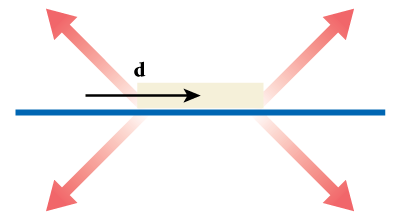
As an object moves across a surface—such as a sanding block sliding along a piece of wood—frictional resistance transforms mechanical energy into thermal energy (heat).
This thermal energy is dissipated directly into both the sliding block and the underlying surface, reducing the remaining mechanical energy of the system.
Power and the Rate of Energy Transfer
Definition of Power ():
Power is a scalar physical quantity that measures the time rate at which work is done or the rate at which energy is transformed, produced, or consumed.
Rate-Based Power Equation:
Power expressed as work divided by the elapsed time interval:
Stated in verbal terms:
Component variables:
= power
= work accomplished or energy transferred
= time interval required to perform the work
Force and Speed Power Formulation:
Power can alternately be calculated directly from the force exerted and the resulting velocity or speed of the object:
Stated in verbal terms:
Component variables:
= force applied along the direction of travel
= instantaneous or constant speed of the object