parks movement: USA
Living Conditions in Cities: 19th Century
In 19th century america, living conditions in cities were no different from England
- Infectious diseases were rife and have been attributed to unsafe water (miasma theory)
- Improper waste management especially with poor drainage
- Unpaved streets
- Poor food handling
- Over-crowded unventilated housing
- Women and children working 6 days a week
- Street cars pulled by animals
- Pollution, animal death, disease, overall horrible living conditions (The Devil in the white city)
Beginning of Change
The situation in the US started to change due to the following strong influences:
- Romantic Period
- Rural Cemetery Movement
- Andrew Jackson Downing
- Parks movement, England
Romantic Period
- Inclination towards the Naturalistic style in the Early National Period became popular across English-Speaking North America
- Influence of Transcendentalism as a philosophy interested in the Stewardship of the land, natural life, and animal life
- The natural landscape of America generating admiration for the natural rural scenery
Transcendentalism
“A philosophical movement which asserts the existence of an ideal spiritual reality that transcends empirical and scientific knowledge”
Rural Cemetery Movement
- Yellow Fever and Smallpox claiming up to 75,000 lives a years in the US in the 19th century
- Dr. Jacob Bigelow was convinced that churchyards used as burial grounds was a menace to public health
- His advocacy resulted in State Legislature dedicated real estate for a “rural cemetery”
- Thus, the building of Mount Auburn Cemetery and the movement
- Cemeteries used for strolling, solitude and families’ picnics
- Completely America invention- - - Influence on the Parks Movement in the US
Mount Auburn Cambridge, MA 1931
- Rural Romantic Cemetery was an American invention of the 19th century
- Out of cities— out of churchyards— into the rural landscape
- Chosen sites usually had natural features like landforms, existing wods, water bodies, or impressive distant views
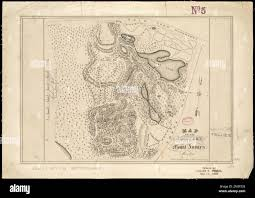
Design Characteristics of Mt. Auburn
- Plan composed of roads and paths fitted into the landform
- Trees & shrubs planted in masses to increase its beauty
- Asymmetrical curvilinear perimeter
Characteristics of Romantic Period
- Romantics statuary, urns and landmarks
- Small ponds
- Romantic style pavilions and structures
- Classical and rustic site furniture
- Rolling ground planes covered in meadow-like grasses and natural vegetation
- Areas given descriptive names like “Laurel Hill” and “Oak Grove”
- Paths and roads named after trees like Elm, Oak, and Juniper
- Design characteristics of Mt. Auburn prevailed in the US— Mt. Auburn became popular
- Improved effect on public health and creating healthful burial places
- Within 7 years, major cities had established similar cemeteries
Andrew Jackson Downing
- First AMerican writer on landscape arch topics
- Editor ; Publisher of The Horticulturist magazine in 1846-52
- From a horticulturist family: Father- nurseryman; brother educated him in plant propagation and the use of plants
- Passion for scenery and persuasive writing
- Contribution to Horticulture, Architecture and Larc
A treatise on the Theory and Practice of Landscape Gardening Adapted to North America (1841)
- Stimulated American’ Interest in home properties and landscape
- Downing’s conviction that human behavior is greatly affected by the environment (Environmental Psychology)
- Downing explained and revised the Naturalistic Style to the American environment and residents
- Two significant conclusions of the book are:
- The “Beautiful” and the Picturesque” are not opposite but points along a visual continuum from simplified naturalistic to real naturalism
- It is important to frame distant views of majestic American landscape and make them part of the design composition
Downing and the Parks Movement
- Downing's place in the history of Larc rests on 2 significant acts of service:
- In 1850, he found and brought Calvert Vaux to America
- Journalism campaign, along with William Cullen Bryant, for a public park in New York. His writing in 1851 was responsible for passing the first Park-Act Legislation that brought the FIRST “country park” to the New World