Midterm Review Guide
Equipment
Explain the use of 5 pieces of equipment, and draw each. Choose ones you have the most trouble remembering.
- Beaker: used to mix, hold, and het chemicals. not for volume
- Graduated cylinder: measures accurate volumes of liquids
- Erlenmeyer/Florence flask: used for mixing/heating. reacting, stirring
- Test tube: used for carrying out reactions
- Test tube holder: holds test tube
- Pipe stem (or clay) triangle: used to hold a crucible while heating
- Crucible and lid: used to hold chemicals while heating to high temperatures
- Ceramic-fibered square: to place under hot apparatus
- Wire gauze: used on an iron ring during heating and cooling (disperses heat)
- Bunsen burner: used to heat materials
- Barrel: where the gas and air are mixed
- Collar: adjust the air intake
- Air vents: air enters here
- The needle: regulates the flow of a gas/flame height
- The nozzle: gas enters the burner
- The base: supports burner
- Ring stand: holds an iron ring or a utility clamp
- Buret: used to withdraw and measure volumes of solutions in titrations
- Volumetric flask: used in the preparation of solutions
- 24 well microtitration plate: used to hold liquids in micro experiment
- Iron ring: attaches to ring stand to hold objects
- Test tube clamp: attaches equipment to the ring stand permenantly
- Mortar and pestle: used to crush solids
- Scoopula/spatula: used to scoop or move solid chemicals
- Triangular file: metal file with three cutting edges
- Rubber connector: to connect parts of apparatus
- Pinch clamp: to clamp a rubber connector
- Test tube rack: holds multiple test tubes
- Wash bottle: washes things with water/alcohol
- Pneumatic trough: to hold water, gas collecting bottles, and delivery tube from gas generator
- Test tube brush: used in cleaning glassware
- Stirring rod: used to transfer residues of solids on glass surfaces. used to stir or mix liquids
- Evaporating dish: used for evaporating liquids
- Glass plate: used to transfer materials (do not heat)
- Watch glass (used to cover a beaker or evaporating dish (can be heated)
- Funnel: used for powering and filtering
- Eye dropper: used to transfer small amounts of liquid (non-disposable)
- Forceps: used to pick up small items
- Funnel support: to support funnels
- Wide-mouth bottle: many uses as a container
- Pipette: used to transfer small amounts of liquid (disposable)
- Stricker: used to light a Bunsen burner
- Beaker tongs: pick up heated beakers
Guidelines to starting a lab
Explain what things (plural) you should do before starting a lab in order to stay safe.
- No rough housing
- Always wear goggles
- Pull back loose hari and remove loose clothing
- Never reach or lean over the fire
Definition of chemistry
What is chemistry, and what is it useful for?
- Chemistry is the study of…
- the structure and composition of matter
- the changes that occur in this composition of matter
- the mechanisms that bring about these changes
- Different kinds of chemistry
- Biochemistry - living things
- Organic chemistry - carbon containing compounds
- Inorganic chemistry - non carbon containing compounds (metals)
- Physcial chemistry - chemistry and energy
- Analytical chemistry - the chemistry of unknowns (forensic chemistry)
- Nuclear chemistry - chemistry of the nucleus
Difference between a chemical property and physical property
What is the difference between a chemical property and a physical property? Give an example of each.
- Physical - characteristic that can be observed or measured without changing the identity of substance
- Chemical - characteristic that relates to a substance’s ability to undergo changes that transform it into different substances
Difference between a chemical change, physical change, and nuclear change
What is the difference between a chemical change, physical, and nuclear change? Give an example of each.
- Physical
- It’s a reversible process
- Identifying properties of the substance remain unchanged
- No atoms or molecules are destroyed, but the spacing between them changes
- Ex: shattering a light bulb, freezing soda, dissolving salt
- Chemical
- Can be either reversible or irreversible provesses
- Different substances with new properties are formed
- Atoms and molecules are rearranged
- Ex: fermenting juice, tarnishing copper, igniting magnesium
- Nuclear
- Most are irreversible change
- Different substance with new properties are formed
- Atoms are destroyed and new ones are made
- Ex: uranium decaying in to plutonium
Nuclear fusion vs. fission
Compare anc contrast nuclear fusion/fission.
- Fusion
- Joining together of nuclei
- Results in larger atoms
- Often needs a “trigger” to start process - requires a lot of energy and high temperature!
- Energy released 3-4 times larger than fission (so about 4,000,000 times that of a chemical reaction)
- Ex: the sun, hydrogen bombs
- Fission
- Splitting apart of nuclei
- Results in two smaller atoms
- Does not normally occur in nature
- Takes little energy to split - releases energy 1,000,000 times greater than a chemical reaction (lower than nuclear fusion)
- Ex: atomic bomb
Types of radioactive decay
What are the types of radioactive decay?
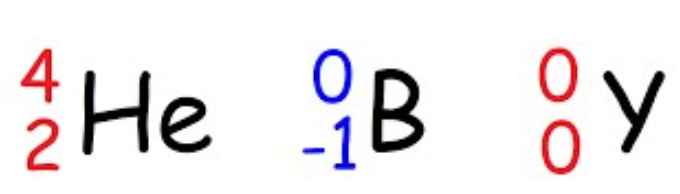
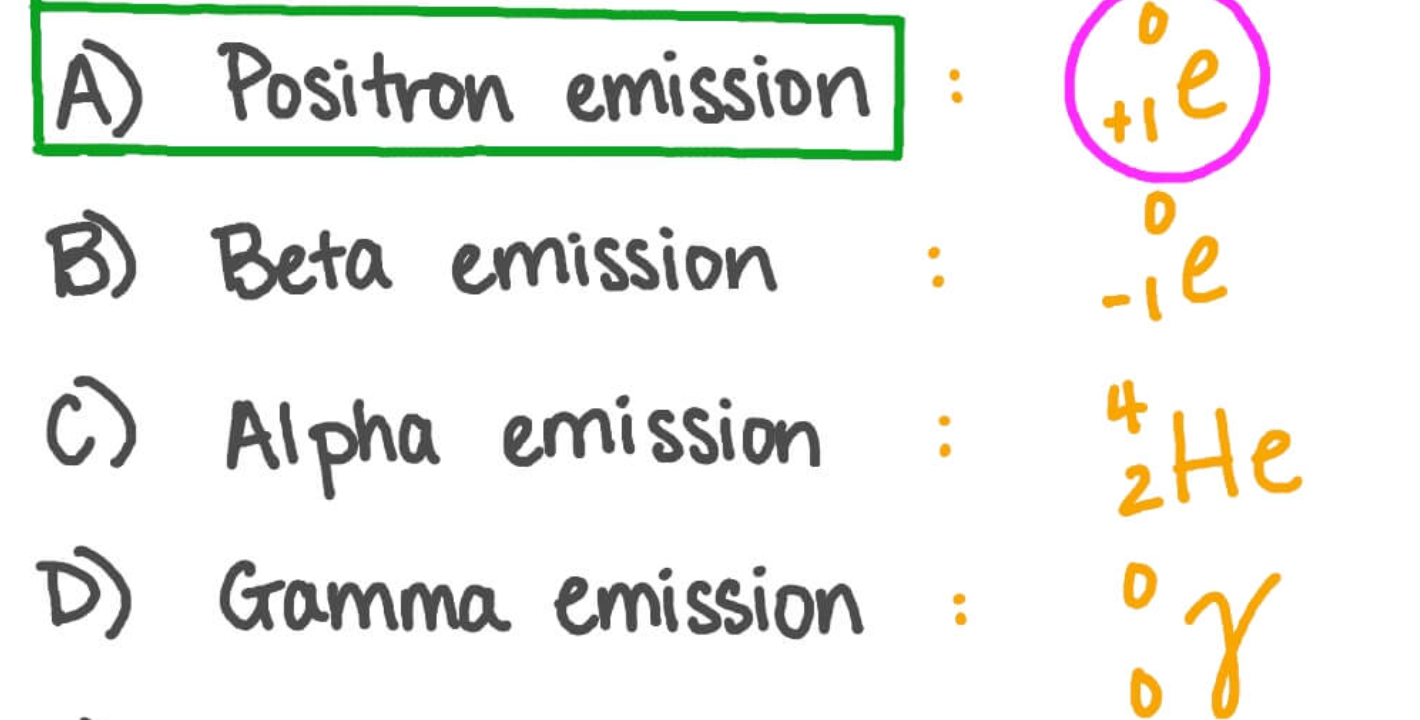
- Alpha
- The loss of an a-particle (a helium nucleus)
- Beta
- The loss of a B-particle (a high energy or fast moving electron)
- Gamma
- This is the loss of a y-ray, which is high-energy radiation that almost always accompanies the loss of a nuclear particle
- Gamma rays are not charger particles like a and B particles
- Gamma rays are electromagnetic radiation with high frequency
- When atoms decay by emitting a or B particles to form a new atom, the nuclei of the new atom formed may still have too much energy to be completely stable
- This excess energy is emitted as gamma rays
- Positron
- Some nuclei decay by emitting a positron, a particle that has the same mass as but an opposite charge to that of an electron
- Neutron
Difference between intensive and extensive properties
What is the difference between intensive and extensive properties? Give examples of each.
- Intensive - does not depend on the amount of matter that is present = independent on amount
- Ex: flammability, magnetism, reactivity, color, viscosity, conductivity, melting point, density
- Extensive - depends on the amount of matter that is present = dependent on amount
- Ex: mass, volume
Difference between homogeneous and heterogenous matter
What is the difference between homogeneous and heterogenous matter? Give an example of each.
- Heterogeneous
- Different from point to point
- Matter that has parts with different properties
- Homogeneous
- Same from point to point
- Matter that has similar properties throughout
Properties of metals, nonmetals, and metalloids
What are the properties of metals? Nonmetals? Metalloids?
- Metals
- Have luster
- Are malleable
- Have high tensile strength
- Conduct thermal and electrical energy
- Nonmetals
- Brittle
- Does not conduct electricity
- Metalloids
- Have properties of both metals/nonmetals (conducts electricity, but not well, etc.) \n
Determining the number of protons, electrons, and neutrons in a neutral atom
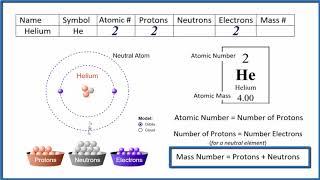
How do you determine the number of protons, electrons and neutrons in a neutral atom?
- Protons = atomic number
- Electrons (if neutral) = Protons
- Neutrons = Atomic Mass - # Protons
Difference between ions and isotopes
What are isotopes? What are ions?
- Isotopes
- Atoms of an element with a unique number of neutron
- Has a unique mass
- Ions
- Are charged atoms
- The # of electrons does not equal the # of protons for an element
Orbitals
What is an orbital and how many electrons can it hold? How many electrons can an “s” subshell/sublevel hold? p? d? f? (Know the quantum number and what each means)
- 3D fuzzy shapes in which electrons can be found
- All orbitals hold 2 e
- S subshell holds 2 electrons, p holds 6, d holds 10, and f holds 14 total
Aufbau Principle, Paili Exclusion Principle, Hund’s Rule
- Aufbau Principle
- “Building up”
- An electron occupies that lowest energy possible
- The levels follow a pattern of increasing energy
- Fill starting at nucleus (Bohr Models)
- P subshell → 3 orbitals
- Fill left to right
- Pauli Exclusion Principle
- No 2 electrons have the same spin if they are in the same orbital
- Hund’s Rule
- Electrons do not pair up until there are no more empty orbitals in that subshell
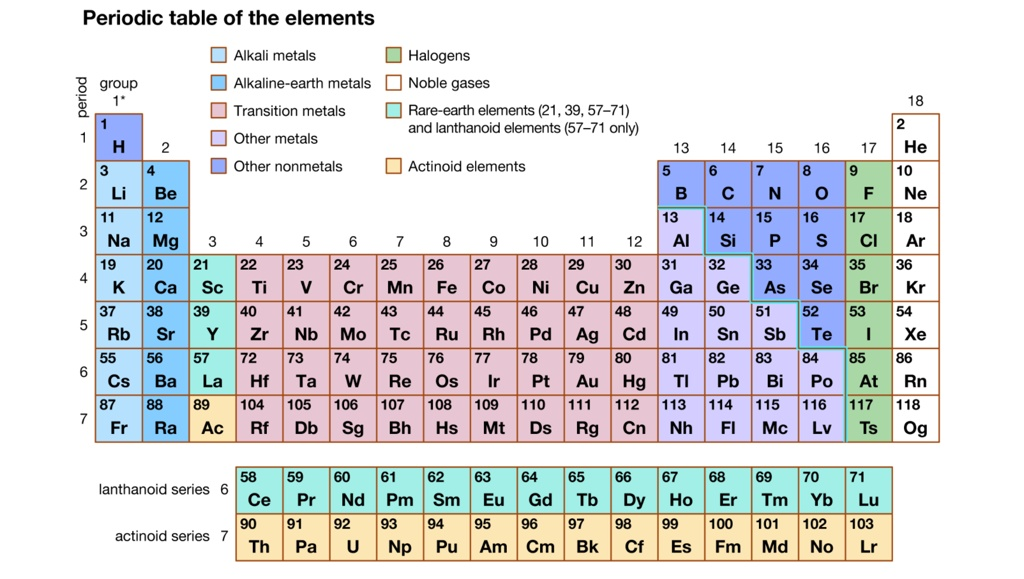
Alkali Metals, Alkali Earth Metals, Halogens, Noble Gases, Transition Metals
Absorption and emmission
- Absorption (take in)
- Energy moves electrons from a ground state to a higher energy state
- Heat, light, electrical, chemical mechanical energy
- Emission (give off)
- Lets electrons fall back down to a lower energy state
- Usually light
- Energy must be absorbed for an electron to move to a higher state (one with a higher n value)
- Energy is emitted when the electron moves to an orbit of lower energy (one with a lower n value)
- The overall change in energy associated with "orbit jumping" is the difference in energy levels between the ending (final) and initial orbits
Ionization energy, electronegativity, electron affinity, atomic radius
What are the trends on the periodic table of atomic radius, electronegativity, and ionization energy?
- Electron Affinity
- Definition
- The energy released when an electron is gained by an atom
- How much energy is released when an electron is added to an atom
- Direction on the table
- Increase across a period
- Decreases down a group
- Explanation as to why it is what it is
- Electronegativity differs from electron affinity because electron affinity is the actual energy released when an atom gains an electron
- Electronegativity
- Definition
- The tendency for an atom to attract bonded electrons to itself
- How attracted electrons are to atoms
- Direction on the table
- Increase across a period
- Decreases down a group
- Explanation as to why it is what it is
- Bigger atoms’ electrons aren’t as tightly held
- Tends to increase over a period because atoms that are closer to the noble gases nearly have a full octet (outer shell of electrons)
- Noble gases are not electronegative
- Ionization Energy
- Definition
- The energy required to remove an electron from an atom
- How much energy is required to take an electron away from an atom
- Direction on the table
- Increases across a period
- Decreases down a group
- Explanation as to why it is what it is
- Increases for successive electrons taken from the same atom (the more you take)
- Atoms on the right side of the table don’t lose electrons easily (they almost have their octet)
- Outer electrons are farther from the nucleus and need less energy to remove
- Atomic Radius Trend
- Definition
- Distance from the nucleus to the cloud
- How big atoms are
- Direction on the table
- Decreases across a period
- Increases down a group
- Explanation as to why it is what it is
- Increased nuclear charge & attraction between the nucleus and electron cloud (shrinks atoms inward)
- The addition of new shells to hold electrons makes atoms bigger
- Helps us understand why some molecules fit together and why other molecules have parts that get too crowded under certain conditions
| Go down a group (top to bottom) | Go across a period (L to R) | |
|---|---|---|
| Metallic Activity/Character | increases | decreases |
| Atomic Radius | increases | decreases |
| Ionization Energy | decreases | increases |
| Ionic Radius | ||
| Electron Affinity | decreases | increases |
| Electronegativity | decreases | increase |
5 major types of chemical reactions
What are the five major types of chemical reactions? Write out the general format for the five types of chemical reactions
- Single displacement
- AB + C = AC + B
- Double displacement
- AB + CD = AC + BD
- Synthesis
- A + B = AB
- Decomposition
- AB = A + B
- Combustion
- Fuel + O2 = CO2 +H2O
Polyatomic ions
Write out the formulas for the polyatomic ions memorized in class.
- Ammonium: NH4 -1
- Cyanide: CN -1
- Hydroxide: OH -1
- Nitrate: NO3 -1
- Carbonate: CO3 -2
- Sulfate: SO4 -2
- Phosphate: PO4 -3
- Chlorate: ClO3 -1
Activity series
What is the activity series, and what is it used for?
- Used to determine if a single displacement reaction will occur
- First, determine if the single element is higher on the scale than its opponent (double)
- If it is, then a single reaction will occur
Sig Figs
- The number of figures that are known with some degree of reliability
- Rules:
- All nonzero digits are significant
- Zeroes between nonzero digits are significant
- Zeroes to the left of the first nonzero digits are not significant; they just indicate the position of the decimal point
- Zeroes to the right of a decimal point in a number are significant
- When a number ends in zeroes that are not to the right of a decimal point, the zeroes are not necessarily significant
Bonds and VSEPR Shapes
- Ionic Bonds
- Made from transferring electrons
- Attraction between electrical charges of cations and anions
- Made using metals and nonmetals
- Elements are very far apart in electronegativities
- Ionic Compounds
- Simplest “particle” for a compound is a formula unit (not a molecule)
- High melting point
- Made of repeating patterns of atoms
- Brittle
- Nonvolatile
- Dissolves in polar (charged) solvents like water
- Molten forms conduct electricity
- Formation of Covalent Bonds
- Covalent bonds are formed when electrons are shared
- Covalent Bonds
- Made from sharing electrons
- Made from nonmetals
- Elements are close in electronegativities
- Covalent Compounds
- Simplest “particle” is a molecule
- Low melting point
- Not brittle (“sticky”)
- Volatile
- Does not conduct electricity
- Dissolves in all kinds of solvents (not just polar)
- Electronegativity
- Tendency of an atom to attract electrons in a compound
- Differences between two elements used to predict bond types
- Elements with a high electronegativity have a strong pull on electrons
- Elements with a low electronegativity have a weak pull on electrons
- Similarities between ionic and covalent bonds
- Made from electrons
- Made using at least one nonmetal
- Are made when atoms satisfy the octet rule
- Polarity
- Unequal attraction of electrons to 1 atom over another in a bond
- Ionic bonds and many covalent bonds are polar
- Calculating the Bond Type
| Bond Type | Electronegativity Difference | Typically |
|---|---|---|
| Ionic | Large (1.7-3.3) | Metal + Nonmetal |
| Covalent (Polar) | Medium (0.3-1.7) | Nonmetal + Nonmetal |
| Covalent (Nonpolar) | Small (0-0.3) | Nonmetal + Nonmetal |
| Metallic | NA | Metals |
- Drawing Covalent Lewis Structures
- Calculate the total number of valence electrons
- For anions, add the number of negative charges from the total
- For cations, subtract the number of positive charges from the total
- Draw your skeleton structure (connect every bonded pair of atoms with a line)
- Using any leftover electrons, satisfy the octet rule for the surrounding atoms
- If there are any remaining electrons, distribute them to the central atom or atoms. If there are fewer than 8 electrons on the central atom, this suggests you need a multiple bond
- 2 fewer = double bond
- 4 fewer = triple bond
- Atoms that form multiple bonds are C, N, O and S
- Checking Structures
- Check the total valence electrons drawn
- Check the octets of each atom in the structure
- Make sure there are no abnormal elements
- VSEPR Theory
- Valence-Shell, Electron Pair Repulsion
- Electron pairs repel each other, and so they want to be as far apart from each other as possible
- Linear (Cl2 or CO2)
- N/A
- Trigonal Planar (BF3)
- 3 shared pair electrons (3 bonds)
- 0 unshared pair electrons)
- Tetrahedral (CH4)
- 4 unshared pair electrons (4 bonds)
- 0 unshared pair electrons
- Trigonal-Pyramidal (PH3)
- 3 unshared pair electrons (3 bonds)
- 1 unshared pair electrons
- Bent (H2O)
- 2 shared pair electrons (2 bonds)
- 2 unshared pair electrons)
- Lone pairs occupy space around the central atom just as bonding pairs do