AP Music Theory Unit 5: Harmony and Voice Leading II: Chord Progressions and Predominant Function
Subdominant (IV or iv) and Supertonic (ii or iiº) Triads
IV chord can prolong tonic via neighbor motion
prolongation
make chord span longer span of time without it sounding
can serve as predominant
chord that goes before the dominant
ii can sub for the IV bc share common tones
usually in 1st inversion (ii6)
in minor, triad is diminished
First Inversion Triads
known as 6 chords
weaker than root position triads
when part writing, double any note expect for the LT or the lowered scale degree 6 in minor
can be used in neighbor progression to improve contour of baseline
neighbor V6 chord must resolve to the I in root position
can be used to prolong chords
iv6 chord used in Phrygian half cadence
Second Inversion Triads
known as 6/4 chords
least stable
usually dissonant bc interval of 4th
must be prepared and resolved
Types of Second Inversion Triads
passing 6/4
connect root position triad w first inversion
can be used to prolong chords
tonic most common
neighbor (pedal) 6/4
bass is static and often sustained
cadential 6/4
prepares a cadence (HC, IAC, PAC)
embellishment of V chord
melodic line is usually 3-2-1
The Leading Tone Triad (viiº6)
written in first inversion
contains a tritone
can sub for the dominant bc share common tones
most common use in a passing progression
can be used in leading tone IAC
The Mediant Triad (iii or III)
based on 3rd scale degree
can sub for I6 bc share CTs
commonly used in progression I-iii-IV-V
LT does not need to be resolved as it has less tension
in minor 7th scale degree is not raised in III chord
The Submediant Triad (vi or VI)
based on 6th scale degree
can sub for tonic and subdominant
often used in descending 3rd progressions
used in deceptive cadences
mediant can be adjacent to the submediant in chord progressions
The Subtonic (VII) Triad
usually in minor
based on lowered 7th scale degree
tends to interact w III as the area. 5th apart
can be used to modulate (Change key) to the relative major
Other Diatonic Sevenths
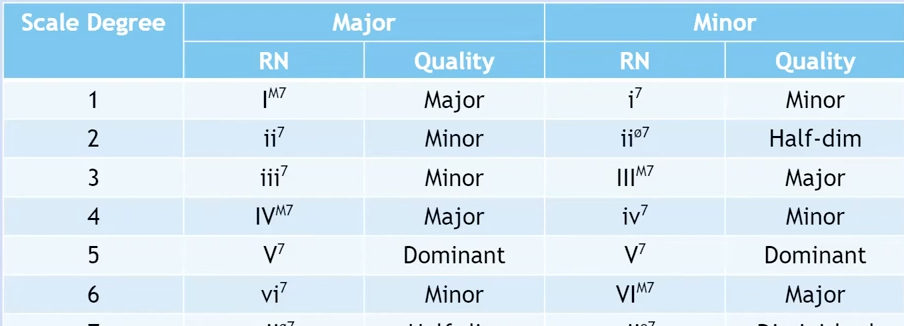
Part-Writing w Diatonic Sevenths
leading tone 7th (viiº7 or viiº7)
can sub for V7
in 3rd inversion, it can go tot he dominant
fully diminished 7th in minor can also be used to modulate
supertonic 7th (ii7 or iiº7)
usually functions as a predominant