BIO - Test One - 2. Structure and functions in living organisms.
The following sub-topics are covered in this section.
(a) Level of organisation
(b) Cell structure
(c) Biological molecule
a ) Level of Organisation
Order of organisations
Organelles → Cells → Tissues → Organs → Organ systems → Organism
b ) Cell Structure
Cell Comparison ( PLANT & ANIMAL )
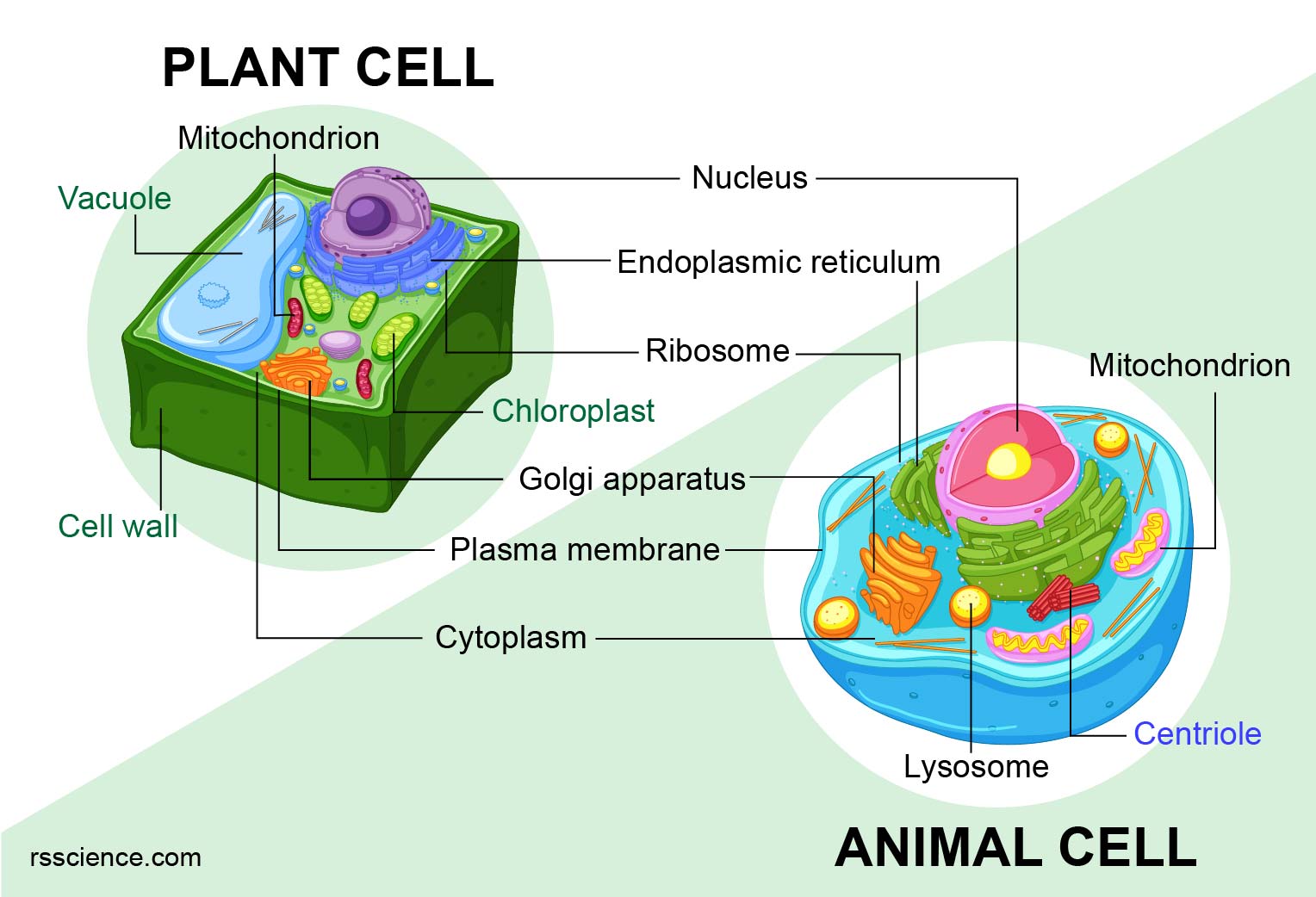
Table ( FUNCTION & DESCRIPTION )
CELL STRUCTURE | DESCRIPTION - FUNCTION |
|---|---|
Nucleus |
|
Cytoplasm |
|
Cell membrane |
|
Cell wall |
|
Mitochondria |
|
Chloroplasts |
|
Ribosomes |
|
Vacuole |
|
Medicine Advantages and Disadvantages ( STEM CELL )
Cells need to differentiate into specialised cells to perform specific functions
They do this by expressing some genes but not others.
Cell specialisation can’t go backward or change directions
Some cells in an embryo are referred to as stem cells → Stem cells from an embryo are referred to as embryonic stem cells.

Stem Cell Therapy - Ethics
Against :
An embryo could go on to become a person but the embryo is destroyed for stem cell use.
People may have religious objections
Fory :
Embryonic stem cells can become any type of cell - this provides a lot of potential in treating disease
Embryos from fertility treatments are destroyed anyways. They could be put to good use
A person in need is more important than an embryo
c ) Biological Molecules
Chemical elements ( CARBOHYDRATES, LIPIDS, PROTEINS )
Carbohydrates, lipids and proteins are all MOLECULES
Carbohydrates - Carbon
Hydrogen
Oxygen
Lipids - Carbon
Hydrogen
Oxygens
Proteins - Carbon
Hydrogen
Oxygen
Nitrogen
Structure ( CARBOHYDRATES, LIPIDS, PROTEINS )
Carbohydrates → Used by the body for respiration to release energy
Starch, Potato, Rice, Pasta
→ Starch is a large storage carbohydrate molecule made by plants
→ Animals store their carbohydrate a glycogen
Structure of carbohydrates :

Lipids → Fats and oils
Fats is used to make cell membranes, insulation, protection of organs and as an energy store
→ Two types of molecules
→ Glycerol and fatty acids
Structure of lipids :

Proteins → All cells contain protein
Grow and repair of tissues
→ Amino acids ( 20 Different → Used to make different proteins )
→ Once chain is formed; folded and twisted to make 3D shapes
Structure of proteins :
Practical ( Investigate food samples ( CARBOHYDRATES, LIPIDS, PROTEINS ) )
“ONLY STARCH CAN HAVE ANYTHING OTHER THAN LIQUID FOOD TESTED”
Food substance | Test | What you do | Positive result |
|---|---|---|---|
Sugar | Benedict's test | Add Benedict's solution and heat in a water bath | Green/yellow /orange/red |
Starch | Iodine test | Add iodine solution | Blue-black |
Protein | Biuret test | Add Biuret reagent | Purple |
Fat/lipid | Emulsion test | Add ethanol, shake, then add water | White/milky emulsion |
Enzymes as Biological catalyst
Enzymes - Biological catalyst
Processes that rely on enzymes:
→ Digestion
→ Respiration
→ Protein synthesis
Enzyme molecule type → PROTEIN ( amino acids )
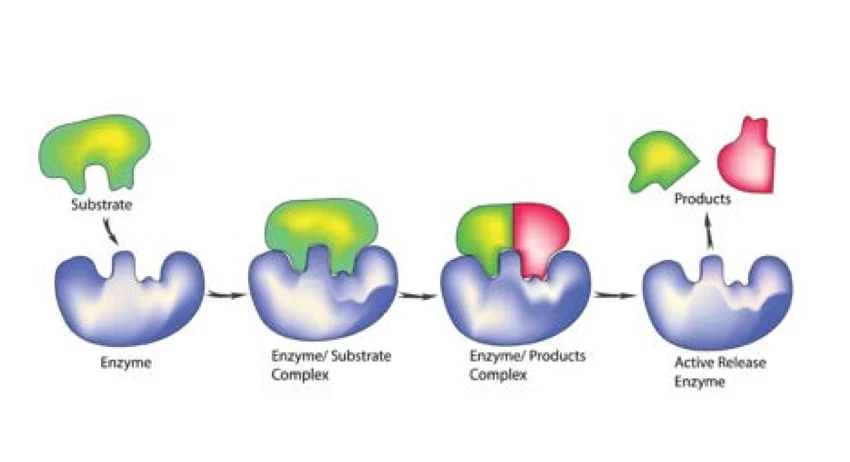
Enzymes have an active site with a unique shape:

→ Enzymes will only bind to a complementary substrate molecule.
→ If you discrupt the 3D enzyme substrate, it is no longer complementery
→ If the shape of the substrate does not match the active site of the enzyme they will not for an enzyme substrate complex
Once the Enzyme-substrate complex is formed, the substrate is broken down into products:
Some enzymes build polymers from monomers
Polymers are a molecule made up of multiple monomers.
2+ Monomers = 1 Polymer
Sometimes the substrate in an enzyme substrate complex is a polymer; so when broken apart the products are monomers.
Monomers can also become polymers using enzymes
Enzymes either put together monomers or take them apart.
The sum of all chemical reactions in a cell or organism is its metabolism
→ The chemical reactions include breaking down molecules and building molecules
Affect of Temperature ( Enzymes )
Too hot → Body temp ( 37 ) = Enzymes denature
→ Shape of active site changes so substrate cant fit
Too cold → Body temp ( 37 ) = Work too slow
→ Shape of active site stays the same
Practical ( Enzyme activity affect by temp )
METHOD :
Put amylase and starch into separate test tubes.
Put the test tubes into a water bath at a chosen temperature.
Wait for them to reach that temperature.
Mix the amylase and starch together.
Start the stopwatch.
Every few seconds, put a drop of the mixture onto iodine solution.
Keep doing this until the iodine stays orange-brown.
Record the time taken.
Repeat this at different temperatures.
Compare the times.
RESULTS :
Temperature | Time for starch to disappear | Enzyme activity |
|---|---|---|
Cold | Long | Slow |
Hotter | Shorter | Faster |
Room temp | Medium / Long | Medium / Slow |
Amylase breaks down starch = NO Starch
→ If amylase is not working = starch = black
→ if it is working = no starch = orange
Effect of pH scale ( Enzymes )
If the enzyme is at the correct pH:
→ Active site denatures
→ Substrate fits
→ Reaction happens quickly
Wrong pH:
→ Active site doesn’t change shape
→ Substrate doesn’t fit
→ Reaction happens slowly
EACH ENZYME HAVE THEIR OWN CORRECT pH
Practical ( Effect of pH scale on enzymes )
METHOD :
Prepare amylase and starch solutions.
Use buffer solutions with different pH values, for example pH 3, 5, 7 and 9.
Mix the amylase with one of the buffer solutions.
Add the starch and start the stopwatch.
Every few seconds, test a drop with iodine solution.
Keep testing until the iodine stays orange-brown.
Record the time taken.
Repeat using the other pH values.
Compare the times.
pH | Time for starch to disappear | Enzyme activity |
|---|---|---|
Very acidic | Long / may not disappear | Slow |
Slightly acidic | Shorter | Faster |
Optimum pH (~7 for amylase) | Shortest | Fastest |
Slightly alkaline | Shorter | Faster |
Very alkaline | Long / may not disappear | Slow |