chapter 11: testing and individual differences
overview
- Francis Galton - a pioneer in the study of human intelligence and testing and initiated the use of surveys for collecting data and developed and applies statistics to its analysis
standardization and norms
- when a test is standardized, it means that the test items have been piloted on a similar population of people who are meant to take the test and that achievement norms have been established
- example: the scholastic achievement test (SAT); when you take the test, there is a section called the experimental section, which is a group of questions that you aren’t assessed on. it helps the ETS (the Educational Testing Service) standardize its future examinations
- people taking the SAT on a specific date are representative of the population of people taking the SAT in general
- this group of people is called the standardization sample
- the psychometricians, the people who make the tests, at ETS, use the performance of the standardization sample on the experimental sections to choose items for future tests
- the purpose of these tests is to distinguish between people, so test questions that everyone answers correctly as well as questions that no one can answer are discarded since they don’t provide information that differentiates between the people taking the test
- the questions on the SAT are arranged in order of difficulty in every section and have been done like that because of the standardization sample
reliability and validity
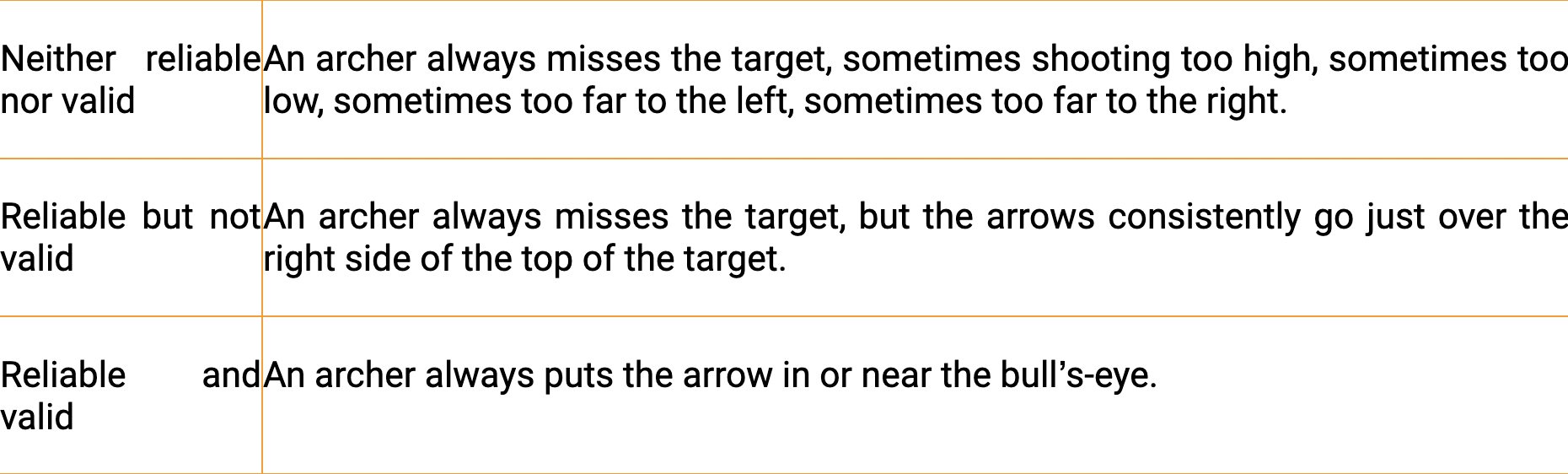
- to have any faith in the meaning of a test score, the test should be both reliable and valid
- reliability - refers to the repeatability or consistency of the test as a means of measurement
- the reliability of a test can be measured in several different ways:
- split-half reliability - involves randomly dividing a test into two different sections and then correlating people’s performance on the two halves
- the closer the correlation coefficient is to +1, the greater the split-half reliability of the test
- equivalent-form reliability - correlation between performance on the different forms of the test
- test-retest reliability - refers to the correlation between a person’s score on one administration of the test with the same person’s score on a subsequent administration of the test
- valid - when a test measures what it is supposed to measure and is often referred to as the accuracy of the test
- example: a personality test is valid if it truly measures an individual’s personality
- a test cannot be valid if it’s not reliable, but a test can be reliable without being valid
- different kinds of validity also exist:
- face validity - refers to a superficial measure of accuracy
- face validity is a type of content validity
- content validity - refers to how well a measure reflects the entire range of material it is supposed to be testing
- there are two types of criterion-related validity: concurrent validity and predictive validity
- concurrent validity - measures how much of a characteristic a person has now
- predictive validity - a measure of future performance
- construct validity - is thought to be the most meaningful kind of validity, the extent to which your test or measure accurately assesses what it's supposed to
types of tests
- the two common types of tests are aptitude tests and achievement tests
- aptitude tests - measure ability or potential
- achievement tests - measure what one has learned or accomplished
- there are also speed and power tests
- speed tests - generally consist of a large number of questions asked in a s short amount of time, the goal is to see how quickly a person can solve problems
- power tests - the goal is to gauge the difficulty level of problems an individual can solve, these can consist of items increasing different levels
- lastly, these tests can be group tests or individual tests
- group tests - administered to a large number of people at a time. instructions are provided to the group, and people are given a certain amount of time to complete the various sections of the test
- individual tests - involve greater interaction between the examiner and examinee
theories of intelligence
- intelligence - is defined as the ability to gather and use information in productive ways
- there is no exact definition of intelligence
- most psychologists differentiate between fluid intelligence and crystallized intelligence
- fluid intelligence - refers to our ability to solve abstract problems and pick up new information and skills
- crystallized intelligence - involves using knowledge accumulated over time
- as adults age, fluid intelligence decreases while crystallized intelligence holds steady and could even be increasing
charles spearman
- one debate is whether intelligence refers to a single ability, a small group of abilities, or a wide variety of abilities
- Charles Spearman - argued that intelligence could be expressed by a single factor and used factor analysis to conclude that underlying the many different specific abilities (S) that people regard as types of intelligence is a single factor that he named (G) for general
howard gardner
- Howard Gardner argues about the idea of multiple intelligences
- three of Gardner’s intelligences (linguistic, logical-mathematical, and spatial) fall within qualities traditionally labeled as intelligence
- to this basic list, he added musical, bodily-kinesthetic, intrapersonal, interpersonal, and naturalist intelligence.
- musical intelligence - involves the ability to play an instrument or to compose a symphony
- bodily-kinesthetic intelligence - the capacity to manipulate objects and use a variety of physical skills
- intrapersonal intelligence - refers to one’s ability to understand oneself
- interpersonal intelligence - corresponds to a person’s ability to get along with and be sensitive to others
- naturalist intelligence - is found in people gifted at recognizing and organizing the things they encounter in the natural environment
daniel goleman
- EQ, or emotional intelligence, corresponds with Gardner’s notions of interpersonal and intrapersonal intelligence
- one of the main advocates for EQ is Daniel Goleman
robert sternberg
- Robert Sternberg is another researcher who proposed Sternberg’s triarchic theory
- this theory states that three types of intelligence exist:
- componential/analytic intelligence - involves the skills traditionally thought of as reflecting intelligence and is involved with most of what we are asked to do in school
- experimental/creative intelligence - focuses on people’s ability to use their knowledge and experiences in new and innovative ways
- contextual/practical intelligence - what we call “street-smart”; are able to apply what they know to real-world situations
intelligence tests
- two widely used individual tests of intelligence are the Stanford-Binet and the Wechsler
- Alfred Binet wanted to design a test that would identify which children needed special attention in schools, so he came up with the concept of mental age
- mental age - an idea that presupposes that intelligence increases as one gets older
- Binet created a test that would identify children who lagged behind most of their peers, were at the same level as their peers, and were ahead of their peers
- he administered questions to a standardization sample and constructed a test that would differentiate between children functioning at different levels
- Louis Terman, a Stanford professor, used this system to create the measure called IQ and the test “Stanford-Binet IQ test”
- IQ stands for intelligence quotient; a person’s IQ score on this test is computed by dividing the person’s mental age by his or her chronological age and multiplying by 100
- David Wechsler used a different way to measure intelligence but it is still known as an IQ test
- there are three different Wechsler tests that exist
- Wechsler adult intelligence scale (WAIS) - used in testing adults
- Wechsler intelligence scale for children (WISC) - used with children between the ages of 6-16
- Wechsler preschool and primary care of intelligence (WPPSI) - can test children as young as 4
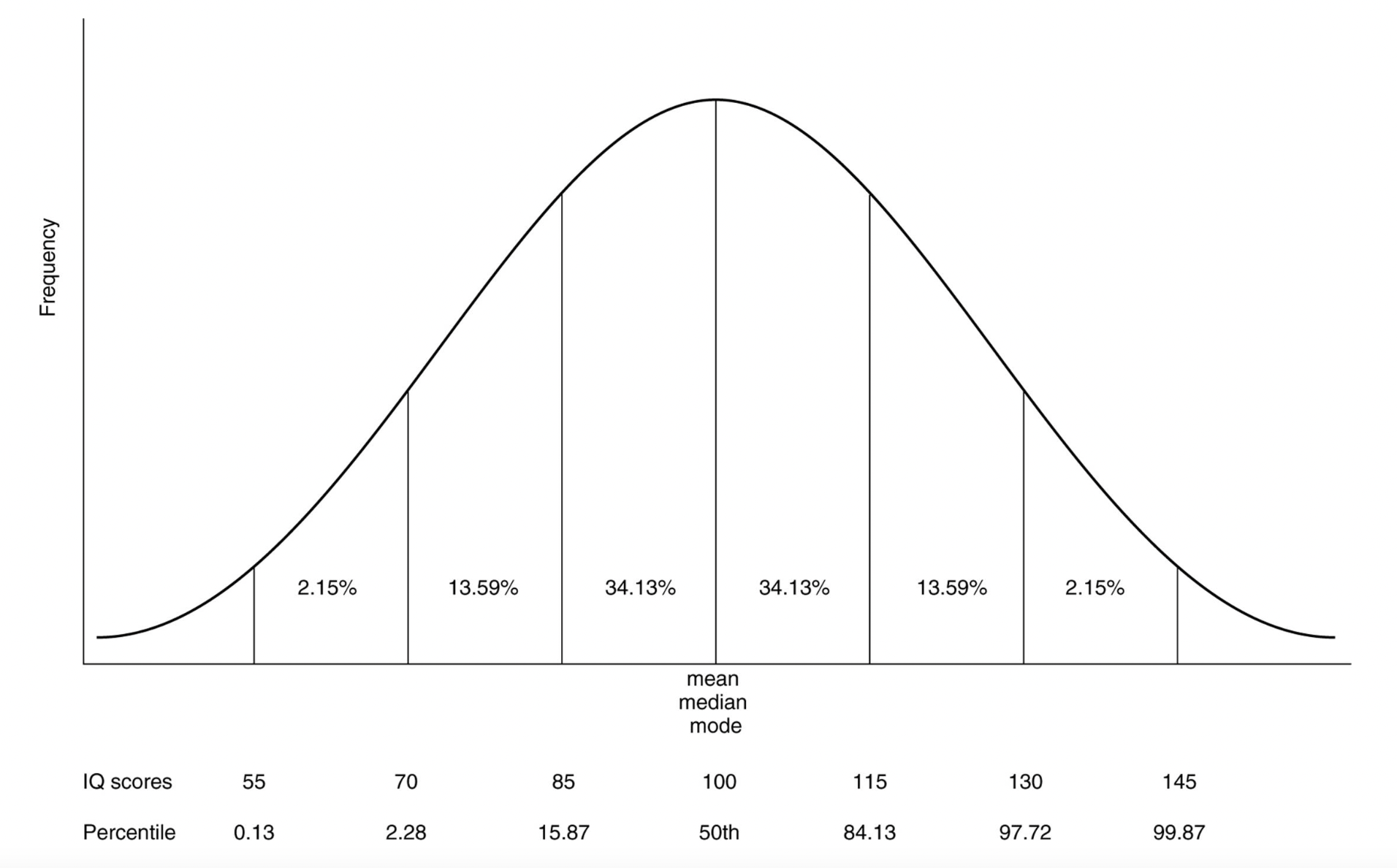
- Wechsler tests yield IQ scores called deviation IQ, and are standardized so that the mean is 100, the standard deviation is 15, and the scores from a normal distribution
bias in testing
- researchers agree that although different races and sexes score differently on these tests, they have the same predictive validity for all groups
- other researchers have argued that both the tests and the college grades are based in a far more fundamental way
- advantages seem to lean towards the white people, middle, and upper class
nature versus nurture: intelligence
- human intelligence is affected by both nature and nurture since research suggests that both genetic and environmental factors play a role in molding intelligence
- an important term researchers use to discuss the effects of nature and nurture is heritability, which is a measure of how much trait’s variation is explained by genetic factors
- heritability can range from 0-1, where 0 indicated that the environment is responsible for differences in the trait and 1 indicates that all of the variation in the trait can be accounted for genetically
- many researchers have studied this issue, their findings are below:
- Flynn effect - performance on intelligence tests increasing steadily throughout the century, suggests that environmental factors play a role in intelligence
- identical twins score more similarly on intelligence tests than fraternal twins, and researchers think this is because identical twins are treated more alike
- research on identical twins separated at birth shows that there are strong correlations between intelligence scores, but researchers that are advocating more of an environmental influence point out that those twins are usually placed into similar environments
- racial differences in IQ scores could provide evidence that intelligence is largely genetically determined. majority of psychologists disagree and argue that these racial differences are explained by differences in environments
- participation in government programs meant to eliminate some of the disadvantages faced by groups going through poverty has been shown to correlate with higher scores on intelligence tests