new deal
introduction
FDR had emergency powers for first 100 days in office for passing laws
New deal 3 R’s — relief, recovery, reform
Emergency banking act reopened trusted banks, gave them loans and put regulations in place
Fireside chats to explain his decisions
3 R’s:
Relief — agencies for temporary, immediate relief
Recovery — help businesses, industry and agriculture to stabilise
Reform — measures to provide permanent stability so it never happens again
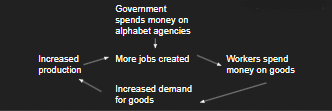
Roosevelt’s first 100 days were about moving towards an active gov to provide immediate relief to people and stability to the economy during great dep. Roosevelt had brain trust of experts to advise him on his policies. Pump-priming was used to stabilise the economy by funding alphabet agencies set up.
The new deal reduced unemployment but WW2 is the actual reason that the economy finally stabilised fully.
new deal alphabet agencies
Agricultural adjustment administration:
Designed to stop overproduction by reducing acres of farmland and introduced subsidies for farmers
Reduced surplus which drove up prices, meant farmers destroyed crops and slaughtered 6m piglets
Cotton prices per pound almost doubled between 1933, some animals fed to unemployed but people didn’t like unnecessary killing
Sharecroppers and the dustbowl fled the south because they didn’t benefit
Supreme court rules unconstitutional in 1936
Civilian conservation corps:
Works programmes for national forest and parks, mostly manual labour for young men 17-24 living on site for $1 mil a day
Gave people jobs and housing, built bridges, roads, planted trees etc (relief and infrastructure reform) but there was segregation on sites and paid very little with most of their pay automatically going to family
Civil works administration:
Led by Harry Hopkins, temporary administration helped 4.2 unemployed through harsh winter in 1933-4
$400 mil budget, built over 400 airports and 200,000 miles of roads
Temporary emergency relief, built infrastructure to encourage future economic growth
Federal emergency relief administration:
Led by Harry Hopkins, budget of $500 mil to provide relief benefits and public works that built 5000 buildings
Threat of withdrawing federal money for reluctant states like Georgia if they refused to take part
Immediate relief, improved infrastructure but budget was too small
National recovery administration:
Issued codes of practice for all industries, ensuring fair competition/wages/hours and banning child labour, plus allowing unions to collectively bargain
$3.3 bil budget, blue eagle sign for compliance, 557 codes of practice in total issued
Some codes were hard to follow, companies like Ford refused, declared unconstitutional by 1935
Considered to be low wages and no improvement to working conditions but claimed to put 2 mil back into work and regulation was necessary as a reform since great dep. happened largely due to lack of regulation
Public works administration:
Created due to NIRA, under control of Harold Ickles
Provided long-term solutions (recovery) with budget of $3.3 bil to aid pump-priming by creating public works
Jobs said to be of no real purpose and hardly any of budget was spent (only 110 million)
Tennessee valley authority:
Tennessee, North Carolina, Virginia etc. and other surrounding states were known for flooding, poor infrastructure and living standards
Network of 20 dams built to control flooding/erosion and increase agricultural production, plus generate electricity from 2% of farms to 75% by 1945
Model for federal and state cooperation
Federal housing administration / homeowners refinancing corporation:
HORC offered new loans/mortgages at low rate of interest for longer periods to help people keep their homes from repossession but only 50% of mortgages were covered
FHA offered small loans for home construction and federal insurance to protect ability to repay mortgages in order to stimulate housing industry
Relief form homelessness but didn’t cover all of mortgage, mainly benefitted white MC as FHA only covered newly bought homes, less than 25% of urban families could afford the avg. mortgage
banking reform
Banks closed for 6 days when FDR entered office
The banks that weren’t operating correctly were not allowed to reopen without making changes, only the ones that could be trusted by people were reopened
Emergency banking act:
National bank holiday 6-9th march in 1933
Used money from RFC to prevent banks collapsing
US treasury investigated and reopened 5000 trusted banks
People were willing to invest again (raised confidence) and solved the problems of the system
Glass-steagall banking act:
Separate commercial and investment banking (reforming what was said to be a major cause of depression)
Created federal deposit insurance corporation guaranteed all bank deposits up to $5000
Allowed people to put money into banks to help system get running again
Federal securities act:
Securities exchange commission regulated all shares transaction and stock exchanges in the US
All new share purchases had to be registered with the FTC
Provided regulation and protection for investors money, plus restored confidence in the stock market
Silver purchases act:
Government purchased all domestically produced silver at artificially high price
Raised prices by increased amount of silver in coinage and increased money supply to encourage economic activity
More money of higher worth and stimulation of economy
Gold reserve act:
This ended private holding and use of gold as money, control over money supply
Devalued US% against rate of gold to make exports cheaper to stimulate trade
opposition to the first new deal
Right-wing:
The rich — didn’t want heavy taxes
Republicans — laissez-faire policies
American liberty league — don’t want regulations on property and business, members including Du pont family
Left wing:
Trade unions — protection for workers (NIRA regulations ignored by employers)
Francis Townsend — 60+ get $200 a month, half a million club members by 1935
Huey Long — governor of Louisana, $5000 allowance for every family paid for by taxation of rich a confiscation of fortunes over $5 mil, 27,000 ‘share our wealth clubs 1935, assassinated in 1935
Father Coughlin — radio show with 35 mil listeners, wanted reforms for the monetary system, ran against Roosevelt but was unsuccessful
second new deal
Reasons why FDR decided to introduced the 2nd new deal:
Europe was recovering faster than USA from great depression
He needed to avoid radical opposition that could be supported by millions
Farmer-labour party that offered minimum hours, public works, taxes
Supreme court overturned new deal legislation and he needed to replace things
He was frustrated with US chamber of commerce for not supporting him in 1935, FDR needed to have small businesses in mind when thinking about recovery
Wagner act 1935 — trade unions:
Right to collective bargain for unions
Individual workplaces given right to join unions
National labour relations board
Excluded agricultural and service workers
Black and Hispanic Americans and women had little benefit
Guffey Synder act 1935 — trade unions:
Set price of coal and banned unfair competition/ practices
Regulated max hours and minimum wage
Declared unconstitutional
Only affected coal industry
Guffey Vinson act 1935 — trade unions:
Kept changes relating to industry (prices, competition, practices) and was consitutional
No labour provisions so unpopular with businesses
Considered socialist
Fair labour standarsd act 1938 — Father Coughlin:
Created min wage and introduced overtime
Prohibits child labour
Increased profits and wages, reduced strikes
700,000 wages increased
Had to work 40+ hours for act to apply and did not cover executives or seasonal workers
Interstate commerce had to be $500,000
Social security act 1935 — Townsend:
Equal contributions from employers and workers to pay for unemployed and elderly benefits
Pensions — $10 to $85 per month
Unemployment — $18 for 16 week
Not comprehensive, excluded those who needed it most (farm workers, domestic servants, self-employed
The revenue act 1935 — Huey Long:
Increased income tax 63-79% on incomes over $5 mil
Increased tax on property and undistributed profits tax to force large companies into stock market to raise investment
Criticisms from rich, incl. William Hearse who was a newspaper owner — FDR called ‘clss traitor’
Raised only $250 mil more a year, not enough in comparison to money spent on new deal projects
Works progress administration 1935:
Public works
2 mil employees 1941 (20% of the w.f)
$52 per month, relief but less than usual
1000 airports, 8000 schools and hospitals built
Not allowed to compete for contracts with private firms or build private houses
Wages greater than other relief schemes but still low
The revenue act 1935:
Relocate 45,000 farming families to Oklahoma, Texas etc (affected by dust bowl)
REA 1935 low interest loans to provdie electricity
1930, 10% of rural communities had electricity, by 1945 it was 40%
roosevelt recession
1936 election made democratic party the majority party. It created new democratic coalition with traditional and new elements of the party as Americans rejected radical solutions to the depression.
Republicans relying on traditional base of support — big business, big farmers, conservatives etc.
Democrats broadened constituency, appealed to small farmers, ethnic blue collar workers, Jews, intellectuals, African Americans
Significant opposition to new deal from socialists
opposition to the second new deal
supreme court
Judiciary reform bill 1937:
FDR wanted to pack the supreme court with nominees that would favour new deal legislation
He wanted 70+ judges to retire
Justice Brandeis, 79, was the most liberal member, so plan backfired
Congressmen feared replacement/retirement and Roosevelt underestimated support of the court — he was seen as dictator
Bill rejected 70-20
However, later on, Justice Van Devanter announced his retirement and court vegan to uphold legislation
More judges retired and FDR replaced with supporters like Felix Frankfurter
other opposition
Wealth inequality:
Wealth and economic power concentrated to small number
Government ownership and sharing out all of USA’s wealth
1937 inauguration — FDR claims ⅓ of USA was still poor
Henry Ford, Rockefellers and Du Ponts
Political competition:
1936 election, socialist candidate Norman Thomas gets 187,000 votes
1936 election, communist candidate Earl Browder receives 79,000
Other parties were not a threat to FDR
Union threat:
1936, 2,000 strikes involving 788,000 workers
1937, 4,470 strikes involving 1.9 mil workers
Dec 1936: autoworkers occupied Cleveland Fisher company factory for 1 month to prevent it opening
Unions led by CIO organised strikes incl. united automobile workers’ union
Anti-capitalism
Socialists and communists wanted to destroy current system that allowed private ownership of property, business, agriculture and industry
how successful was the new deal?
introduction
New deal recovery needed to deal with lowering GDP and rising unemployment levels. It was successful in relief (supporting starving and unemployed) but not in recovery because economy was not the same as in 1929.
Unemployment
1933, 24.9%
1937, 14.3%
ND budget cut in 1937 —> unemployment to 19% (proved it was providing temporary jobs)
200,000 black Americans working under CCC
Roosevelt’s black cabinet to discuss issues, but discrimination still prevalent
Memorial day massacre 1937 — march broken up, left 10 killed
Companies saw trade unions as enemies
Positives of the new deal:
Rural electrification administration bought electricity to 40% of farms (90% by 1950)
Trade union membership increases (1930, 3.4 mil and by 1940, 8.7 mil which was over a quarter of the w.f) and social security act 1935 meant workers were more protected than ever before
WPA helped transform USA by building 2,500 hospitals, 350 and 8,000 parks
1940: 17 year olds graduating high school went from 29% in 1930 to 50% and universities went from 1,400 to 1,7000 due to federal funding
TVA developed infrastructure, provided hydroelectric power for domestic and industrial use
CCC environmental impact, national parks like Yellowstone, planting trees and roads etc.
Negatives of the new deal:
FDR’s decision to focus solutions prolonged global depression and depressed exports
Combined personal income of USA was $72.9 bil in 1939, it had been $85.8 bil in 1929 when the population was 9 mil less
1939: only 1/5 of Americans received gov relief when ¾ of them were out of work in 1933
Roosevelt made sharp cuts to federal expenditure, contribution purchasing power falling from $4.1 bil in 1936 to under $1 bil in 1937
Boondoggle jobs like scaring pigeons offered dubious economic value
Roosevelt recession, industrial production fell 33% and 4 mil lost jobs
Unemployment was never below 14% after 1933, 17.2% in 1939
Farm acreage didn’t increase, only went from 1 bil to 1.05 bil in 10 years
1939: top 5 corporations controlled 84.5% of all income generated by businesses as in 1929
ethnic minorities
Before the new deal:
Native Americans
Dawes severalty act 1887 — assimilation and allotment (tribal units broken up and reservations divided into family sized farms)
Failure for those who weren’t farmers
Allocated land wasn’t suitable for productive farming
138m acres owned in 1887 —> 90m by 1932
1926 department of interior inquiry allotment should be reserved
Difficult to leave poverty-sicken reservations to search for work
Indian reorganisation act 1934 to address problems
Hispanic Americans
Many living in southwest before white Americans had arrived, also widely recruited as seasonal workers to help agriculture
Poorly paid already, during great dep. Hispanic Americans lost their jobs and got deported (so white Americans could take their jobs)
400,000 repatriated
New deal for Native Americans:
Indian reorganisation act 1934:
Tribes reorganise into self-governing bodies with own constitutions, police and legal systems
75 out of 245 tribes vetoed the measures
CCC and PWA available to find jobs but limited effect due to level of poverty
1943 senate enquiry found widespread poverty on reservations
During ww2: 25,000 in fighting forces, Navajo language used to transmit messages and many left reservations to work in war industries
New deal for African Americans:
Positives
Some benefitted from housing provision and job creation schemes
200,000 gained benefits from the CCC
Some sharecroppers were able to own their own land as a result of AAA
New deal boosted trade union movement and black Americans got involved (empowerment)
1936: Gallup poll found 76% of black Americans intended to vote for FDR
Negatives
1931: 31% of black Americans in southern cities unemployed
1940 census: 1 in 20 males employed in a white-collar occupation compared to 1 in 3 white
New deal agencies discriminating against black people, they got no work and received bad treatment/wages (allowed by NRA)
FDR failed to pass laws against lynching
FDR didn’t stop problems or segregation and disenfranchisement
NRA forced many small black-run businesses to shut down
AAA meant 1 mil tenant farmers were evicted
CCC segregated
women
Eleanor Roosevelt
Advised her husband on federal policy and the position of women + ethnic minorities
2 days after inauguration: held a press conference (348 during new deal years)
Received 300,000 letters from the public
‘My day’ newspaper article
300,000 miles across the USA to support the new deal
Asked for more women in gov and female CCC ‘she she she’ camps 1936 that employed 5,000 women
Supported appointment of Mary Bethune, met with NAACP leaders
67% approval rating Gallup poll
Frances Perkins
1933, first woman cabinet member (secretary of labour) until 1945
Established CCC with other departments
Social security act 1935 gave federal aid to elderly and unemployed
Passed federal minimum wage in fair labour standards act 1938
Mary Mcleod Bethune
FDR’s special advisors on minority affairs in 1935
Founded national council of negro women
Chairperson of informal ‘black cabinet’
1936, appointment to director of negro affairs division of NYA until 1944
Campaigned the rights of black Americans to get equal federal aid and pay as white Americans
New deal for women:
Positives
‘She she she’ camps
Distinguished women in politics showed that there were opportunities for some women
Frances Perkins, first female cabinet member
Mary Bethune as representation of black women in gov
Eleanor Roosevelt, successful woman that championed minority rights
Negatives
Women only made up a small percentage of CCC scheme
Bethune and Perkins are isolated examples and do not represnt all women
Women’s lives remained the same in rural areas and receieved little federal help
Eleanor Roosevelt was a rare example, has the fact she came from a wealthy background and was married to the president
1940: 90% of jobs filled by men