Psych Book Notes
Chapter 2: Biology of Mind
Neural & Hormonal System
Gall (German physician)
Phrenology- studying bumps on the skull could reveal a person's mental abilities and their traits
Different parts of the brain control different things
Biological psychologist- scientific study of the links between biological and psychological process
Behavioral neuroscientist
Bio psychologists gave us
Brain is wired by experiences
Nerve cells conduct electricity and communicate with one another sending chemical messages
Specific brain systems serves specific function
Use info given to use to construct of our experiences
Sounds
Sight
Memories
Passion
Systems have subsystems turn into smaller subsystems
Biopsychosocial system - we as humans is this system
Power of Plasticity
Brain formed by experience and genes
Constantly changing
Plasticity- ability to change, especially during childhood, through the use of reorganizing ager damage or by building new pathways based on experiences
Neural Communication
Human & animal operate the same
Neurons
Nerve cell, building blocks of the nervous system
Contain a cell body (Soma), Dendrite, Axon
Cell body
Contains the nucleus
If cell body dies the rest of the neuron goes with it
Like a snake
Dendrite- receive and integrate info passes info through the body to the axon
Listener
Short
Axon- takes the message and gives it the other neurons
Speaker
Long
Covered in a myelin sheath
Fatty tissue that can speed up their impulses
Glial cells
Cells in the nervous system that help to protect neuron
Like a bodyguard or a nurse
More complex brain the increase amount of glia
Neural Impulses (action potential)
Neurons transmit messages when stimulated through a sources
Other neurons
Or our senses
Message sent through firing an impulse
Action potential
Action potential- neural impulses, electrical charges that travel down an axon
Neuron generate impulses through chemical events
Ions are exchanged
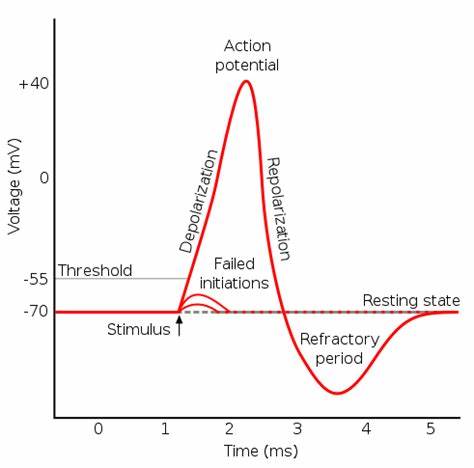
Axons outsides are positive the inside is negative
Axons surface is selectively permeable
Changes when a neuron fires
Axon opens and positive ions flow through and you get depolarization
Inflow of positive ions is the action potential
Neural signals are excitatory or inhibitory
Pushing on the gas (excitatory - excited)
Pushing on the brakes (inhibitory- hibernate)
Excitatory signal pushes past the threshold of inhibitory signal → trigger an action potential that travels to the respective place it goes
Threshold- the level of stimulation required to trigger neural impulse
Neurons get a short break called refractory period
Brief resting pause that occurs after neuron is fired
Action potential can’t be fired until axon gets back to resting state
If there is increase of stimulation above threshold → no intensity increase of the action potential
All or none response- neurons reaction of firing full strength or not firing
How Neurons communicate
Synapse- the junction between the axon tip of the sending neuron and the dendrite or cell body of the receiving neuron
Tiny gap between neurons - synaptic gap
Neurotransmitters allow for communication between neurons
Chemical messenger that cross the synaptic gaps
Travel across the synapse and bind to the receptors sites
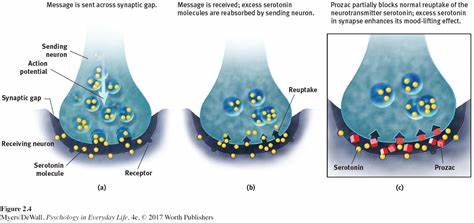
Excess transmitters are broken down or reabsorbed by the sending neuron (reuptake)
Neurotransmitters influence on us
Influence our motion & emotions
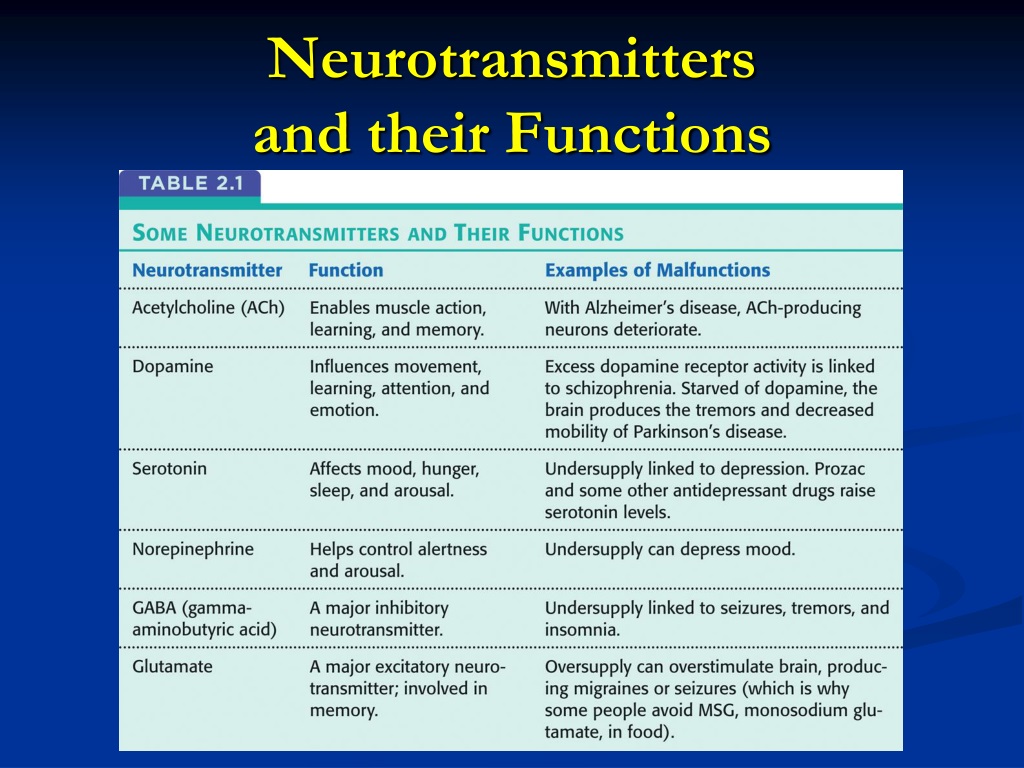
Types of neurotransmitters
Dopamine
Influence
movement, learning, emotions
Serotonin
Affects mood, hunger
Endorphins
Influence perception of pain or pleasure
Body makes natural opiates
Drugs & chemicals effects on neurotransmitters
Drugs like heroin can stop the production of natural opiates
Withdraw from the drug → deprivation of any form of opiates → discomfort
Drugs & chemicals affect brain chemistry
Set off other put down neural firing
Agonist molecules- increases a neurotransmitters action
Can increase production or release of neurotransmitters
Block reuptake
Antagonists molecules - inhibits / blocks neurotransmitters actions
Can occupy receptor sites
Nervous system
Body's speedy, electrochemical communication network consisting of all the nerve cells of the peripheral and central nervous system
Takes in info from the world & body’s tissues
Makes decisions
Send back info & orders to the body’s tissues
Brain & Spinal cord - Central nervous system
Body’s decision maker
Peripheral nervous system - sensory & motor neurons that connect the CNS to the rest of the body
Gathers info for transmitting
Nerves - bundled axons that form neural cables connection the CNS to muscles, glands, and sense organs
Electrical cables
Three types of neurons
Sensory
Carry messages from the body’s tissues & sensory receptors to the brain & spinal cord
Motor
Carry info from the brain & spinal cord to the muscles & glands
Interneurons
Neurons within the brain & spinal cord, communicate internally & process info between sensory inputs & motor outputs
The peripheral nervous system
Somatic & autonomic
Somatic nervous system - division of the peripheral nervous system that controls the skeletal nervous system
Report to the brain on our skeletal system
Autonomic nervous system - controls the glands & muscles of the internal organs
Sympathetic nervous system - arouses the body, using its energy
Expends & arouses energy
When challenged w/ something SNS accelerate heartbeat
Parasympathetic nervous system - calms the body
Converse energy - help to calm you
Central nervous system
Brain enables our humanity
Thinking
Feeling
Neurons work in groups called neural networks
Neurons that fire together wire together
Spinal cord
Two way information chain connects to the PNS (peripheral nervous system)
Neural pathways govern our reflexes - response to stimuli
Spinal reflex pathway
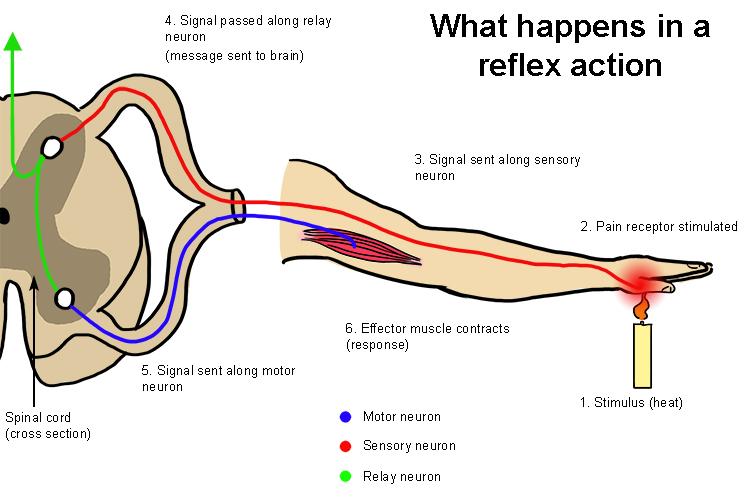
Made up one sensory neuron and one motor neuron
Communicate through an interneuron
Different neural circuits do different things
One enables pain reflex
Touch a flame → neural activity travels by sensory neurons to interneurons in spinal cord → activate motor neurons → hand jerking away from the flame before brain receives and responds to the info
The endocrine system
Body chemical communication system - slower system
Glands that secrete hormones into the bloodstream
Hormones - chemical messengers that are created by endocrine glands
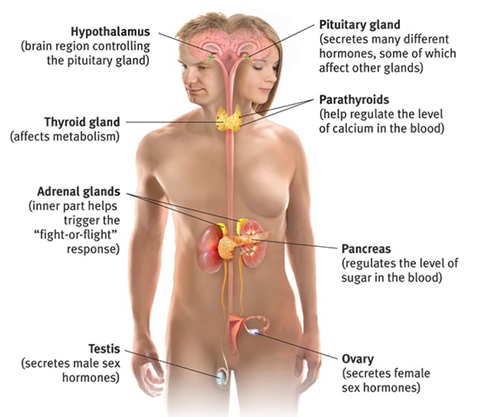
Endocrine system & Nervous system
Both produce molecules that act on receptors elsewhere
Endocrine message are slower and take longer
Have longer lasting affect
Lasting anger even after the cause of the anger is resolved
Nervous system are faster in sending messages
Body has more than one type of gland
Adrenal Glands - glands that sit above the kidney and secret epinephrine and norepinephrine arouse the body in times of stress
Increase heart rate, blood pressure, blood sugar
Provide energy
Pituitary gland - under influence of the hypothalamus, regulates growth and controls the other glands
The ruler of other glands
Most influential
Tools of Discover
Scientist study the brains activity
Damage to one side of the brain can cause numbness or paralysis
Body’s right side is wired to the left side of the brain and vise-versa
Damage to the back of the brain
Blurry vision
Damage to left-front
Speech difficulties
Scientist can lesion tiny clusters of normal or detective brain cells
Lesion - tissues deconstruction, brain lesion is a natural or experimental caused destruction of brain tissue
Types of neural measures
Electroencephalogram - amplified recording of the waves of electrical activity sweeping across the brain’s surface - measure by electrodes placed on the scalp
Listening to the hums like a car engine
Magnetoencephalography (MEG) - brain-imaging technique that measure magnetic field from the brain’s natural electrical activity
Understand how certain task influence brain activity
PET (positron emission tomography) scan - visual display of the brain’s activity that detects where a radioactive form of glucose goes while the brain perform a task
MRI (magnetic resonance imaging) - uses magnetic fields & radio waves to produce computer-generate images of soft tissue
Show brain anatomy
fMRI (functional MRI) - reveals blood flow and brain activity by comparing successive MRI scans
Show brains function as well as structure
Older brain Structures
Amount of capabilities stem from ones brain structure
Sharks - have basic survival skills
Less complex brain
Mice - have emotions and greater memory
More complex brain
Brain stem
Oldest and innermost region
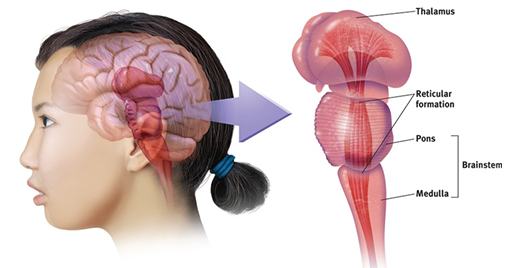
Responsible for automatic survival functions
Medulla is the base of the brain stem
Controls heartbeats and breathing
Pons - coordinate movements and controls sleep
Thalamus - attached to the top of the brainstem
The Thalamus
Sits atop the brain stem
Egg-shaped structure acts as the brain's sensory control center
Receives info from all the sense except smell and brings it higher into the brain
Can receive brain messages → directs to the medulla and then to cerebellum
Reticular Formation
Inside the brain brain - between your ears
Network that extends from the spinal cord up to the thalamus
Control arousal, filters incoming stimuli, relay important info to other brain areas as well as sleep
Cerebellum
The little brain at the rear of the brainstem
Processing sensory input, coordinate movement output & balance, enable nonverbal and memory
Injury to the cerebellum → difficulty walking, balance issues, shaky hands
Limbic system
Neural system comprised of the amygdala, hypothalamus, and hippocampus
Located below the cerebral hemisphere
Associated with emotions and drives
The amygdala
Linked to aggression and fear
Emotions
Those with amygdala lesions → reduced arousal to fear & anger
The Hypothalamus
Small structure
Directs several maintenance activities
Eating, drinking, sexual behavior
Maintain homeostasis
Helps govern the endocrine system through the pituitary gland
Linked to emotion & reward
The Hippocampus
Seahorse shaped structure
Processes conscious, explicit memories, and decreases in size & function as we grow
If ever concussed → poor memory
Cerebral Cortex
Body’s ultimate control and information-processing center
The bigger organism you are the bigger cerebral cortex you have
Thin surface layer of interconnected neural cells
Makes us distinguishable from less complex animals
Structure of the cortex
Each hemisphere’s cortex have four lobes separated by fissures
Frontal lobe
Involved with speaking & movement, making plans & judgment
Parietal lobe
Receives sensory input for touch & body position
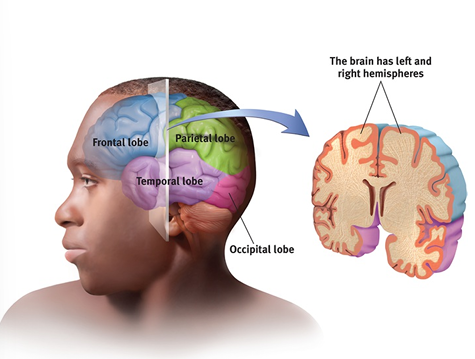
Occipital lobe
Receive information from the visual fields
Temporal lobe
Receive information primarily from the opposite ear
Motor functions
Motor cortex - area at the rear of the frontal lobe that controls voluntary movement
Mapping the motor cortex
Your right side of the brain control the left side of your body
Your left side of the brain controls the right side of your body
Amount of cortex devoted to a body part in the frontal lobe or the parietal lobe is proportioned to body size
Devoted to areas requiring more precise control
Sensory Functions
Somatosensory cortex - area at the front of the parietal lobes that registers & processes body touch and movement sensations
More sensitive the body region → larger the somatosensory cortex area devoted to that region
Lips
Information you see goes to the visual cortex in the occipital lobe
Visual info travels from the occipital lobe to other areas that specialize in task such as identifying words, detecting remtion, recognizing faces
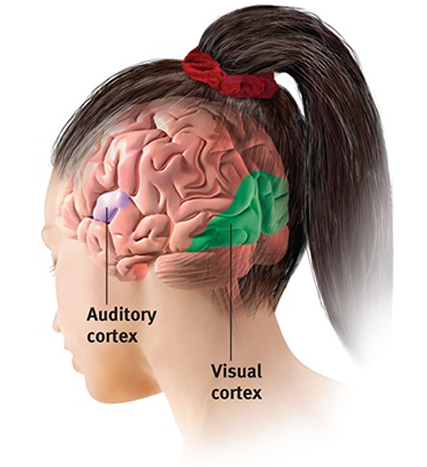
Visual cortex (occipital lobe) → receive info from eyes
Auditory cortex (temporal lobe) → receive info from your ears
Sound info from ears travel a route from one ear to the auditory receiving area above your opposite ear
If hearing phantom ringing in one ear activity in the temporal lobe on the opposite side is active
Association areas
Areas of the cerebral cortex that are not involved with sensory or motor function
Involved in higher mental functions
Learning, remembering, thinking
Found in all four lobes
Prefrontal cortex
Enables judgment, planning, and processing of ne memories
Frontal lobe damages → altered personalities & removal of person's inhibitions, moral judgment unrestrained
Frontal lobe → steer us away from violent actions
Practice questions
RP 1- What do phrenology & biological psychology have in common
Focus on the link between the brain & behavior
RP 2- When a neuron fires an action potential, the info travels through the what order
Dendrites, cell body, axons
RP 3- How does our nervous system allow us to experience the difference between a slap and a tap on the back
Stronger stimuli cause more neurons to fire and to fire more frequently than with weaker stimuli
RP 4 - What happens in the synaptic gap
Neurons send neurotransmitters across the space
RP 5- What is reuptake? What two other things can happen to the excess neurotransmitters after a neuron reacts
Can be reabsorbed by sending neuron or broken down by enzymes
RP 6 - Serotonin, dopamine, and endorphins are all chemical messengers called
Neurotransmitters
RP 7 - Curare poisoning paralyzes its victims by blocking ACh receptors involved in muscle movements. Morphine mimics endorphin actions. Which is an agonist, and which is an antagonist?
Morphine is an agonist; curare is an antagonist
RP 8 - Match the neuron type to its description. Type 1. Motor neurons 2. Sensory neurons 3. Interneurons Description a. carry incoming messages from sensory receptors to the CNS. b. communicate within the CNS and process information between incoming and outgoing messages. c. carry outgoing messages from the CNS to muscles and glands
1. C, 2. A, 3. B
RP 9 - What bodily changes does your ANS direct before and after you give an important speech
ANS sympathetic division arouses you. Accelerate your heartbeat and after ANS parasympathetic division reserves those effects
RP 10 - Why is the pituitary gland called the “master gland”
Responding to singlands from the hypothalamus, it releases hormones that trigger other glands to secrete hormones which then includes the brain and our behavior
RP 11 - How are the nervous system & endocrine similar and different
Similar that they produce messages to send throughout the body, differ in that the speed in which they do send those messages
RP 12 - Match the scanning technique with the correct description. Technique 1. fMRI scan 2. PET scan 3. MRI scan Description a. tracks radioactive glucose to reveal brain activity b. tracks successive images of brain tissue to show brain function. c. uses magnetic fields and radio waves to show brain anatomy
1. b, 2. a, 3. C.
RP 13 - The ____ is a crossover point where nerves from the left side of the brain are most linked to the rise of the the body
Brainstem
RP 14 - What brain region would damage be most likely to disrupt (1) your ability to skip rope? (2) disrupt ability to hear? (3) leave you in a coma (4) cut off the very breath & heartbeat of life
1. Cerebellum 2. Thalamus 3. Reticular formation, 4. Medulla
RP 15 - Electrical stimulation of a cat’s amygdala provokes angry reactions. Which autonomic nervous system division is activated by such stimulation?
Sympathetic nervous system
RP 16 - What are the three key structures of the limbic system, and their functions
Amygdala (involved in aggression and fear response), Hypothalamus (bodily maintenance, pleasurable rewards, control of hormonal system), Hippocampus (process memory of facts & events)
RP 17 - Which area of the human brain is most similar to that of less complex animals? Which part of the human brain distinguishes us most from less complex animals
The brainstem; the cerebral cortex
Rp 18 - Why is it hard to try to move your right hand in one direction and your right foot in the opposite direction? Why is it easier to move your left foot opposite to your right hand?
The right limbs are both controlled by the half of the brain. Left brain. Opposite sides of the brain control your left and right limbs; the movements don’t interfere with the brain's control.
RP 19 - Our brain’s ____ cortex registers and processes body touch and movement sensations. The ____ cortex controls voluntary movements.
Somatosensory: motor
Defining Consciousness
Our subjective awareness of ourselves and our environment
Allows us to assemble information
Focus our attention when we learn a complex concept or behavior
Different states of consciousness
Allows us to cope with novel situations and act in our long term interest
Promote survival → anticipating how we seem to other and helping us read their minds