Diffusion
Diffusion is a passive method of transport across a cell membrane; passive means that ATP/energy from respiration is not required. Respiratory inhibitors that inhibit ATP production do not affect passive transport methods. In passive transport, movement is from high concentration to low concentration.
Diffusion is the random movement of particles from a region of their high concentration to a region of their low concentration.
Simple diffusion across membranes happens through the phospholipid bilayer and is limited to small, non-polar or lipid-soluble molecules. Oxygen, carbon dioxide and fat-soluble vitamins (A, D, E and K) are examples of molecules that cross membranes by simple diffusion.
The smaller the molecule and the more lipid-soluble it is, the faster the rate of diffusion as shown on the graph.
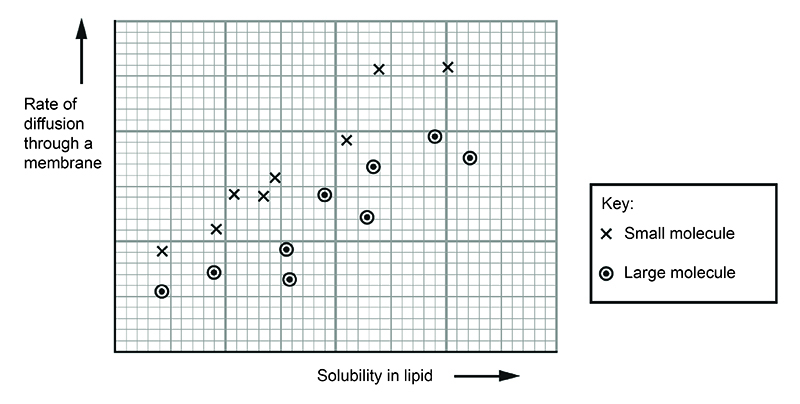
The rate of diffusion is dependent on the following factors:
Surface area of the membrane – a higher surface area gives more places over which diffusion can happen and increases the rate of diffusion. Folds in the cell membrane increase the surface area.
Length of diffusion pathway – the shorter the diffusion pathway, the faster diffusion can happen. Flattened cells, thinner membranes and less layers of cells decrease diffusion pathways.
Steepness of concentration gradient – the larger the difference between the high and low concentrations, the faster diffusion happens. Circulation and ventilation increase concentration gradients.
Temperature – the higher the temperature, the more kinetic energy particles have and the faster they move. This increases the rate of diffusion.
Membrane permeability can be affected by salt concentration, presence of detergents and organic solvents.