L2. The General Principles of Epidemiology/Epizootiology of Parasitic Disease, The Basic Mechanisms of Immunity, the Role of Immunity in Epidemiology
The General Principles of Epizootiology of Parasitic Diseases
Epizootiology:
- the science concerned with the factors involved in the occurence and spread of pathogens of animal diseases
- explains the emergence, expansion, delevopment specificity, course and occurence of parasitosis (the parasitic/aetiological agent/pathogen-induced disease process)
Infection: often used in connection with endoparasites
Infestation: often used in connection with ectoparasites
Contamination: presence of parasite and its developmental forms in the external environment (water, food, soil)
Epizootiologic Triad-Related Concepts
- Infectivity (ability to infect)
- (number of infected / number of susceptible) X 100
- Pathogenicity (ability to cause disease)
- (number with clinical disease / number of infected) X 100
- Virulence (ability to cause death)
- (number of deaths / number with disease) X 100
All are dependent on host factors
Ecological Factors in Infections
- Altered environment
- e.g. air conditioning
- Changes in food production & handling
- e.g. intensive husbandry with antibiotic protection; deep-freeze; fast food industry
- Climate changes
- e.g. global warming
- Deforestation
- Ownership of (exotic) pets
- Air travel & exotic movements
- INCREASED USE OF IMMUNOSUPPRESSIVES / ANTIBIOTICS
Classifications Levels of Disease
Sporadic Level: occasional cases occurring at irregular intivals
Endemic Level: persistent occurrence with a low to moderate level
Epidemic or Outbreak: occurrence clearly in excess of the expected level for a given time period
Pandemic: epidemic spread over several countries or continents, affecting a large number of people
Parasitological Status Expression
- Prevalence (%)
- proportion of infected individuals showing the disease in a group of animals in a certain time period
- (number of infected hosts / number of hosts examined) X 100
- Moderate Intensity
- represents the average number of specimens of the parasite species on/in one infected host
- (total number of parasites of the species in the host sample / number of infected individuals in the hose sample)
- Incidence (%)
- number of new disease cases in the population over a given period
- Morbidity
- the proportion of individuals with disease to a particular group ( or the whole population) to a certain time period
- Mortality
- the number of deaths of individuals with a disease in a particular group ( or the whole population) and in a certain period of time
- Lethality
- the number of deaths of individuals with disease to number of individuals with disease in a particular group
Epizootiology of Parasitoses
- Abundance
- total number of parasites of a given species per test host
- Average abundance
- total number of individuals of the given parasite species on the total number of all tested hosts
- Density
- the number of individuals of a given parasite per unit area, volume or weight of the host organism
- Pre-patented time
- the time interval from the infestation of the parasite to host and beginning of excretion of the propagation stages of the parasite from the host organism
- Incubation time
- time from the infestation of the parasite (pathogen) to the host following the appearance of the initial symptoms of the disease
Life Cycles
Life cycle: ontogenesis, development and reproduction of the parasite, tracking it through the various phases of its life history which will encompass both parasitic and non-parasitic stages
Generalised Stages of Life Cycles
- stage in human/animal host (linking to pathogenesis)
- stage of discharge (diagnostic stage)
- stage developing outside human/animal host (in external environment, intermediate host, or insect host) (linking to transmission)
- stage infecting human/animal (infective stage)
How Parasites Enter Their Hosts
Passive Infection
- faecal-oral contamination with food, water, hands by cysts
- uncooked or undercooked foods
- eating paratenic or intermediate hosts
- inhalation
Active Infection
- penetration of the skin
- inoculation of infective stages by vector
Transmission Mechanisms
Horizontal - between individuals of the same generation
- transmission through contact (e.g. sexual)
- transmission through vectors
- contamination (mechanical)
- inoculation (bite; blood)
Vertical - from one host generation to the following generation
- transplacental
- lactogenous
Iatrogenic - transmission by physician or veterinarian e.g. through contaminated needle
Adverse Effects of Parasites on Hosts - PATHOGENICITY
- Competition for host nutrients
- Destruction of host tissues
- direct damage
1. mechanically, blockade, tissue destruction, compression of organs, destruction of cells
- indirect damage - parasites signal with host reactions
1. loss of nutrients 2. inflammatory response 3. immunopathological effects 4. cytopathogenicity 5. immune responses 6. blood loss 7. toxins e.g. Trypanosoma
- Tissue changes
- Toxins, poisons and excretions
- Mechanical interference
Immunology of Parasitosis
Vertebrates are equipped with two functionally closely related defence systems to fight pathogens
- innate immune system - non-specific
- includes physical and chemical barriers
1. first non-specific line of defence = skin, mucosa 2. secretions = saliva, digestive enzymes, bile acids
- cellular components
1. phagocytes, natural killer cells, T-cells
- earliest effects
1. inflammation: vasodilation, increasing blood flow and vascular permeability 2. phagocytosis: neutrophils and macrophages
- acquired/adaptive immune system - specific
- regulate and control the course of primary infections and protect an organism completely or partially from
1. re-infection (anti-infectious immunity) 2. clinical consequences of an infection (protection from the disease)
- cellular immune reactions: T-lymphocytes
- humoral immune reactions: B-lymphocytes, plasma cells, antibodies
Zoonosis
Zoonotic Disease: any disease which may be passed from animals to people or from people to animals
- approximately 60% of all human pathogens are zoonotic
- 75% of emerging infectious diseases have an animal origin
- growing need for veterinarians and physicians to work together
Causes of Zoonotic Diseases:
- bacteria
- fungi
- viruses
- parasites
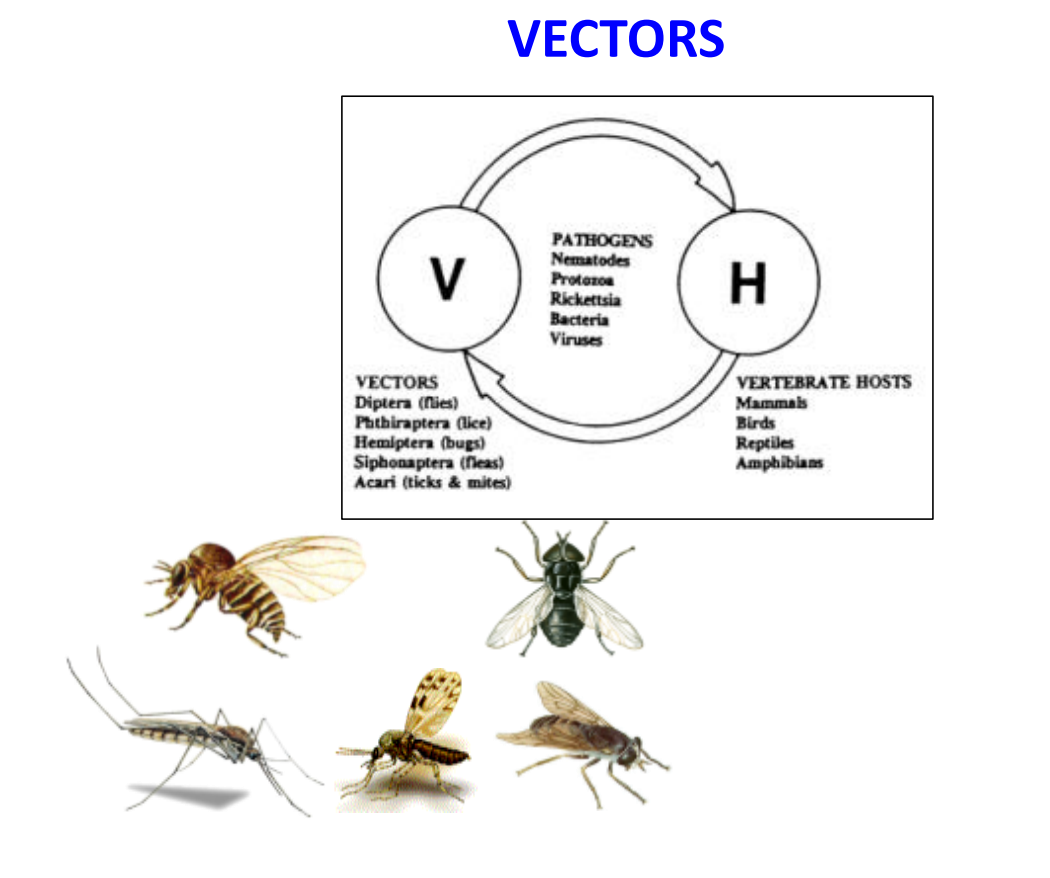
Vector-Borne Parasites
- a vector is an agent which transfers a parasite from one host to another
- typical parasite vectors: flies, fleas, mites, mosquitoes, and other insects
- people become infected when a vector picks up the parasite from an infected animal and infects a human
Water-Borne Parasites
- spread when humans/animals come into contact with water that has been contaminated by an infected animal/human
- common waterborne parasites:
- Giardia
- Cryptosporidium
Faecal-Oral Transmission
- most common way people/animals become infected with zoonotic parasites
- parasites are spread to humans/animals when they ingest the eggs from the faeces of an infected animal
- parasites spread by faecal-oral transmission generally live in the intestinal tract
- hookworms
- carried by dogs and cats
- kids often get infected by playing in sandboxes in which animals have defecated or by putting toys in their mouth which have been on the ground
- roundworms
- (see hookworms above)
- hydatid disease
- after humans consume eggs passed by dogs, the worms can form huge cysts in the body
- toxoplasmosis
Contaminated Meat
- meat can be contaminated with harmful bacteria and can also contain parasitic cysts which may infect people
- common parasites found in meat
- Toxoplasma
- toxoplasmosis is the most commonly transmitted through undercooked meat
- Trichinella
- Taenia
- Gnathostoma
Introduction to Protozoology
General Concepts
- eukaryotic organisms
- generally unicellular
- found in every conceivable damp habitat
- approximately 60,000 living species
- largest is visible to the naked eye
- smallest only seen with an EM
- have all necessary life activities
Protozoa
- most species are free living, but all higher animals are infected with one or more species of protozoa
- infections range from asymptomatic to life-threatening, depending on the species and strain of the parasite and the resistance of the host
Structure
- microscopic, unicellular eukaryotes with relatively complex internal structures and carry out complex metabolic activities
- some protozoa have structures for propulsion or other types of movement
- Basic structure
- cell membrane (glycolax)
- cytoplasm organelles: pseudopodium flagellum, cilium
- nucleus: vesicular or compact
Reproduction
- Asexual
- binary fission - division into two organisms by way of nuclear division and cytokenesis (e.g. flagellates [longitudinal], Ciliates [transverse], sarcodins [random])
- budding - portions of a parent cell differentiates and develop into a new individual
- Sexual
- fusion of gametes
- conjugation
Protozoan Life Styles
- absorb solutes (osmotrophy)
- ingest particles (phagotrophy)
- predation on bacteria or other protozoa
- pinocytosis (fluid uptake)
- photosynthetic (autotrophy)
- combinations (heterotrophy)
free-living vs. symbiosis
Life Cycle Stages
- The stages of parasitic protozoa that actively feed and multiply are frequently called trophozoites; in some protozoa, other terms are used for these stages
- Cysts are stages with a protective membrane or thickened wall. Protozoan cysts that must survive outside the host usually have more resistant walls than cysts that form in tissues