Gravitational Fields
Types of fields:
Electrical — due to charged objects
Magnetic — due to moving charges
Gravitational — due to masses ( The earth doesn’t accelerate towards you because you aren’t massive enough )
A field is a region within which any object with mass experiences a gravitational force
Any object with mass creates a field around it
Any object with a mass placed within the force field will experience a force
The radial lines ( field lines ) around a sphere show the direction a small mass would follow in the field
The density of the field lines corresponds with the field strength
As you move away from the centre, the density decreases so the field strength decreases
With all fields, the forces are exerted at a distance
As field lines meet inside the mass they fade away
The gravitational field at the centre of the Earth is zero
, doesn’t work if you’re moving away from the centre of the Earth
Gravitational Field Strength, , is the force per unit mass on a small test mass placed in a field
the unit is
where is the force acting on a mass, , in the field
It has to be a small test mass so that it has no effect on the field strength of the object
When the field lines are parallel and equidistant from each other, the field is said to be uniform.
In a uniform field, the field strength stays constant. Close to a planet’s surface, gravitational fields are almost uniform
For a point outside a uniform sphere, the mass of the sphere may be considered to be a point mass at its centre
A uniform sphere is one where its mass is distributed evenly
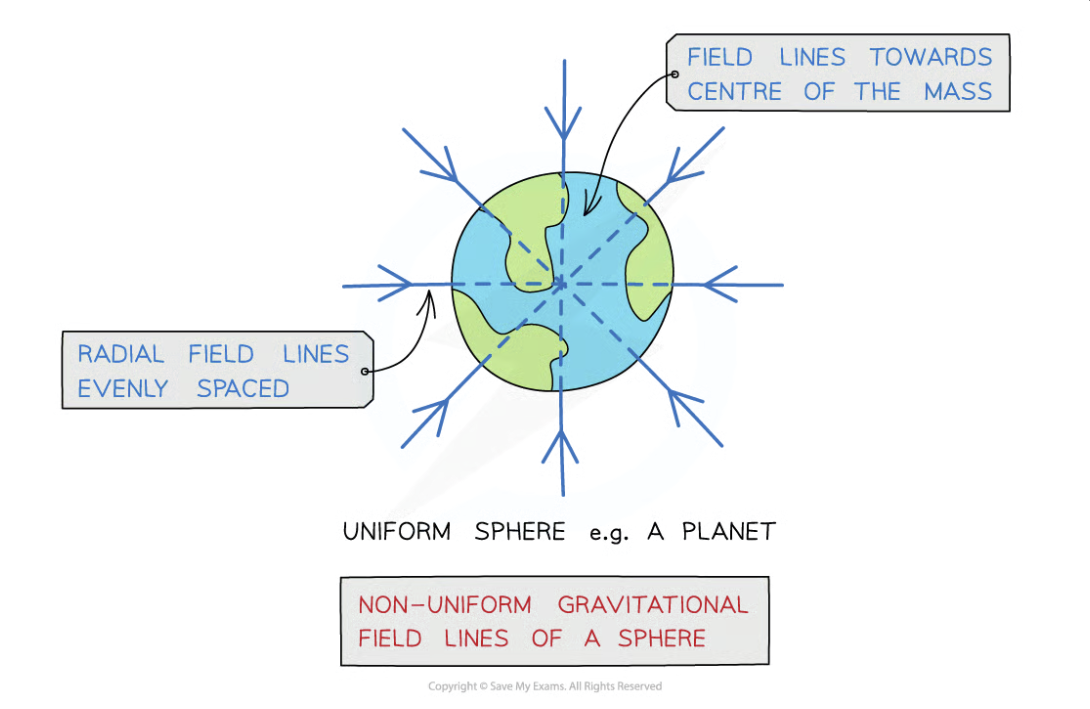
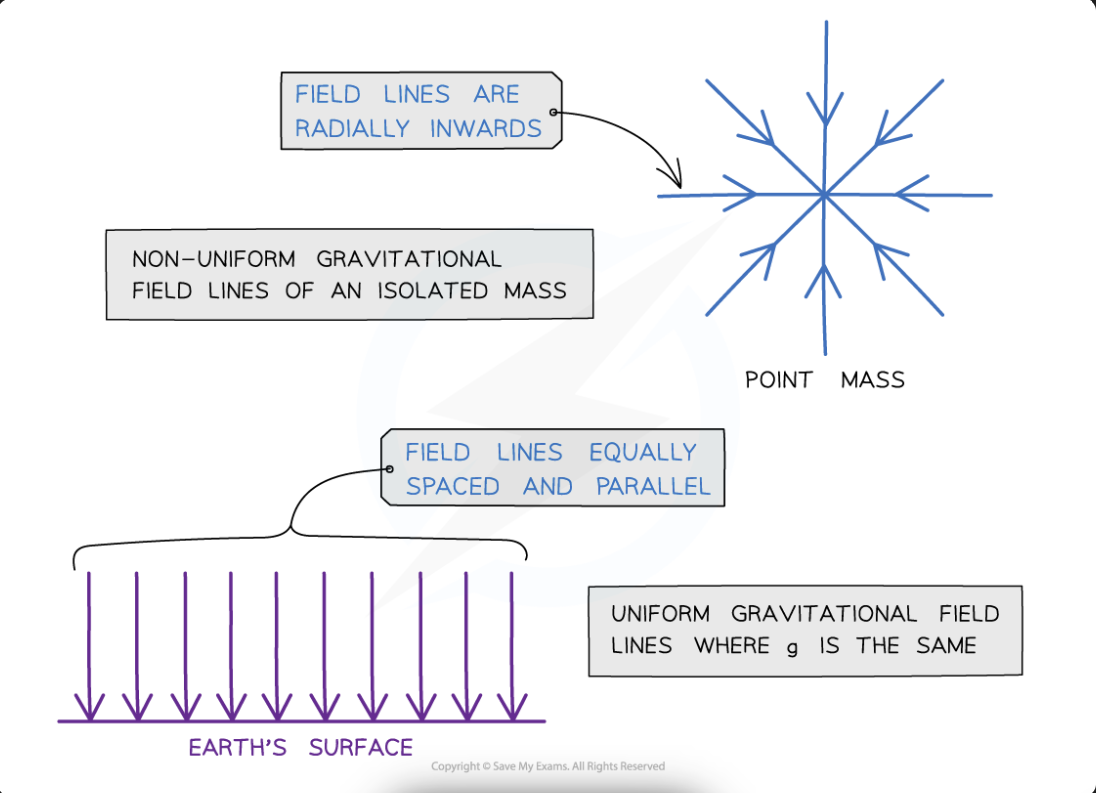
Field lines close to the Earth look like this
This is an example of a uniform field where the strength is the same everywhere — we use this when distances are considered to be relatively small
q1: suggest why is a vector quantity
a1: Because is dependent on how far from the centre of mass you are, which affects the magnitude, and your position relative to the centre, which affects the direction
q2: explain why the direction of the gravitational field strength at any point around a planet is always towards the centre of the planet
a2: Because gravity is an attractive force
q3: describe how a newton meter and a known mass can be used to determine the gravitational field strength at the top of a mountain
a3: you can attach the known mass to the newton meter and record the force reading, and divide that by the known mass, , to find the gravitational field strength, in
Earth’s gravitational field has variation
Matter it not uniformly distributed
Water is less dense than rock
Mountains are further away from the centre
Newton’s law of gravitation states that: The gravitational force F between two masses is proportional to the product of their masses and inversely proportional to the square of their separation, r
for the force between two point masses, M is the mass of the bigger object and m is the mass of the smaller object
is measured from the two centre of masses
doubling either mass, Doubles the force
doubling both masses, Quadruples the force
doubling the separation Quarters the force
G is called the Universal Constant of Gravitation
G =
G is a ‘universal’ constant because it appears to be the same throughout the universe and independent of time, temperature and the medium separating the masses
The equation contains a negative sign to indicate that the force is attractive
, as increases, the gravitational field strength decreases
is not a constant, it is a variable value
Calculating the mass of the Earth
→ =
q: calculate the gravitational field strength due to the Earth at:
the top of Snowdon in Wales (height 1000m) =
the top of Mount Everest (height 10 000m) =
the height of the orbit of the ISS (height 300km) =
q: calculate the gravitational field strength due to the Earth on the Moon and the orbital period
gravitational field strength =
orbital period
The force exerted on the Moon by the Earth, F=mg, where m = the mass of the moon
This force is a centripetal force which =
and so:
but: , where T = the orbital period of the Moon
and so: and
second =29.1 days

When the magnitude of g is plotted against the distance from the centre of a planet, r has two parts:
When r < R (the radius of the planet), g is directly proportional to r [inside the planet]
When r > R, g is inversely proportional to r2 [outside the planet]
It’s assuming the Earth’s mass is uniformly distributed
Gravitational Potential Energy
for mgh, assume that g is a constant [only on the Earth’s surface]
Above the Earth’s surface, the equation is :
work done:
Gravitational Potential is the work done per unit mass to bring an object from infinity to a point in the gravitational field —
infinity refers to the point where the Earth’s gravitational field strength has no effect
r, is the radius + the distance to the point in the gravitational field strength
divide the work done to move from infinity by the mass of the object to find work done per unit mass
the gravitational potential of a point within a gravitational field is equal to the work that must be done per kilogram of mass in bringing the mass from infinity to the point
the gravitational potential at infinity is zero
all other points will have negative potential values
scalar quantity
Work done to move object from infinity to a point at a distance r from the centre of the planet
work done = =
Gravitational potential = work done / mass =
Gravitational Potential Energy [ ] =
Variation of V about the Earth

the distance between the field lines, represented by the dotted lines, are the equipotential surfaces
equipotential surfaces are always perpendicular to the field lines
no work is done against gravity when moving along the equipotential fields since there’s no displacement in the direction of the force
they aren’t equally spaced because the gravitational field strength varies with distance
Gravitational Potential difference and Work
When a mass, is moved through a gravitational potential difference of , the work done is given by : units are
At the surface of the Earth, gravitational potential is =
Potential Gradient
This is the change in potential per metre at a point within a gravitational field.
Near the Earth’s surface, the potential gradient =
q: calculate the gravitational potential at a point from a point mass
a:
q: state the effect on the gravitational potential at a point in a radial field around a point mass if:
the mass of the point mass creating the field doubles —