Topic 10, Climate
1. What are the main factors that influence the amount of precipitation in an area or region?
a. latitude, altitude, distance from large bodies of water
b. latitude, ocean currents, distance from large bodies of water
c. Ocean currents, distance from large bodies of water, prevailing winds
d. Prevailing winds, presence of mountain ranges, seasonal winds
2. Altitude is a more important factor in climate than latitude in mountainous areas. What relationship exists between altitude and other climate factors?
a. An increase in altitude results in higher levels of precipitation.
b. An increase in altitude results in an increase in air pressure.
c. An increase in altitude results in a decrease in temperature.
d. An increase in altitude results in a lessening of wind speed.
3. Jackson lives near the ocean at sea level. In his state, the winters are mild and the summers are cool. This climate is influenced by water currents along his coast that are generally cold and moving toward the equator. What climate zone does Jackson live in?
A. polar
B. tropical rainy
C. temperate marine
D. dry
4. Scientists have noticed that the average temperatures have risen abruptly over the past several decades. This indicates that global warming is occurring at a fast rate. What additional pieces of evidence do scientists use to support the idea that global warming is happening?
a. the amount of greenhouse gases leaving the atmosphere and increases in the amounts of sea ice
b. ocean temperature changes, greenhouse gas concentrations, and harmful emissions reductions
c. greenhouse gas concentrations, decreases in the amounts of sea ice, and increases in the sea levels
d. the greenhouse effect and reduction in sea levels
5. Scientists use a variety of methods to learn about the changing climate of Earth over time.
Which way do scientists NOT use to study the history of Earth's climate?
A. by studying fossils
B. by studying tree rings
C. by studying ice cores
D. by studying green plants
6. What would happen on Earth if there were no greenhouse gases in the atmosphere?
a. The atmosphere would remain the same.
b. The atmosphere would cool and would not support life.
c. The atmosphere would warm and would not support life.
d. The atmosphere would collect more greenhouse gases to support life.
7. Much of the greenhouse gases come from.
A. rising temperatures
B. agricultural activities
C. burning fossil fuels
D. a changing climate
8. The amount of greenhouse gases contributed by humans is called the
A. greenhouse effect
B. carbon footprint
C. photosynthesis
D. carbon dioxide
9 Oscar's family recently put solar panels on their roof to cut down on their use of electricity from the power company. How will alternative energy sources affect Earth's atmosphere?
a. They will increase levels of greenhouse gases in the atmosphere.
b. They will reduce levels of greenhouse gases in the atmosphere.
c. They will increase the use of fossil fuels for economic reasons.
d. They will reduce the amount of energy we consume.
10. What effects are scientists concerned about in relation to global warming?
a. increase in melting of sea ice
b. decreasing sea levels
c. decreases of greenhouse gas concentrations
d. decrease in temperatures
11. If the climate warmed, which of the following would be caused by rising temperatures?
a. decrease in the amount of flooding in coastal areas
b. an increase in the amount of solar energy that gets reflected
c. an increase in sea levels
d. a decrease in sea levels
12. Nick lives in Houston, Texas, in the southern part of the United States. The usual amount of rainfall is 50 inches per year, with an average of 106 days of rain. While winter temperatures are in the mid 40s in degrees Fahrenheit, summer temperatures are generally in the 90s in degrees Fahrenheit. What do these statistics describe?
A. atmosphere
B. circulation
C. weather
D. climate
As Sophia studied a map, she noticed that the Arctic Circle runs through the southern tip of Greenland. In what climate zone is Greenland.
A. polar
B. tropical
C. temperate
D. the gulf stream
Isaac lives near the beach in southern California, where he enjoys the mild weather and often has the opportunity to surf. While surfing one day, he wondered what the water was like on the eastern coast of the United States. Use the map to answer questions 14 and 15.
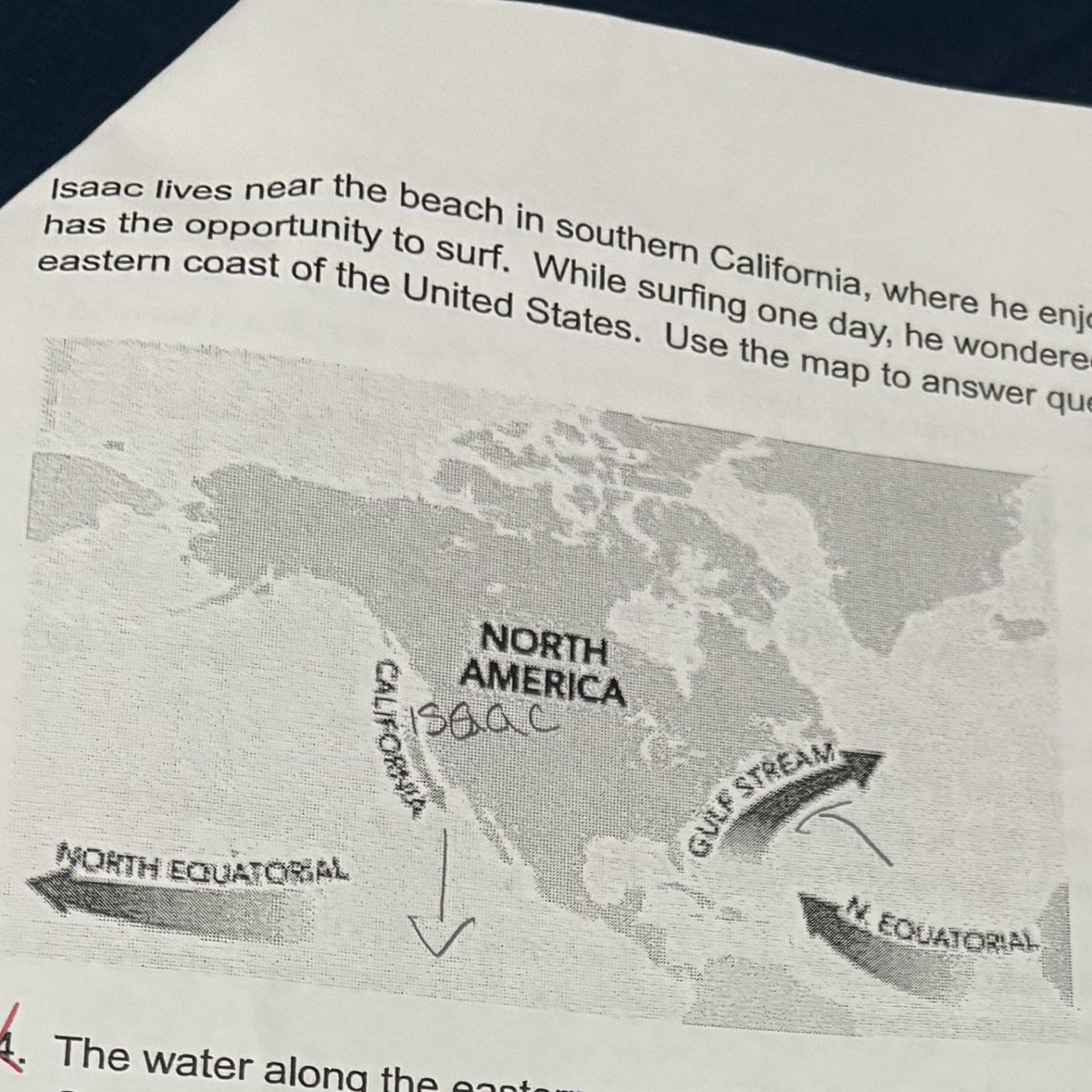
14. The water along the eastern coast of the United States would be ____ than the Pacific Ocean.
a. clearer
b. deeper
c. warmer
d. colder.
15. This is due to the influences of the ___.
a. prevailing westerlies
b. equatorial Current
c. Gulf Stream
d. seasonal monsoons
16. Lily has a greenhouse in her back yard, where she plans to grow tomato plants. The greenhouse effect in Earth's atmosphere works much like a greenhouse that houses plants.
What is the difference between the air inside and the air outside of a greenhouse, and why?
A. The air inside the greenhouse is cooler than the outside air due to the solar energy available outside.
B. The air inside the greenhouse is warmer than the outside air because of the trapped solar energy inside.
C. The air inside the greenhouse is cooler than the outside air due to the cooling effect of having no sunlight during the night.
D. The air inside the greenhouse is warmer than the outside air because sunlight can escape through the glass.
17. Brody was surprised to learn that a warming climate would bring some serious changes, and that organisms would have to adapt or die out. What conditions might result from warming temperatures.
A. new environmental conditions
B. additional salt in oceans
C. reductions in greenhouse gases
D. more ice at the poles
18. In a museum exhibit Mason saw a display of a cross-cut tree sample. He examined the rings, looking for differences in their widths to learn information about the climate at the time the tree was growing. How would a tree ring provide information about past climates?
a. Wide rings indicate a season of changing climate, and narrow rings indicate a season of stable climate.
b. Wide rings indicate a season of slow growth, and narrow rings indicate a season of fast growth.
c. Wide rings indicate a rainy season, and narrow rings indicate a dry season.
d. Wide rings indicate a dry season, and arrow rings indicate a rainy season.
19. Temperatures have been rising gradually around the world over a number of years. Which of the following statements about the effects of rising temperatures is true?
A. Warmer temperatures will not cause extreme changes.
B. Warmer temperatures will change climates almost everywhere but will not affect the polar regions.
C. Warmer temperatures will affect only people living in the center of continental areas.
D. Warmer temperatures will change climates, and rising water from melting glaciers could flood coastal cities.
20. In polar regions, a thin layer of soil supports plant life. The soil below this layer, called permafrost, is frozen year round. How could melting permafrost accelerate global warming?
A. Polar plants would die out, causing an increase in carbon dioxide.
B. Polar sea water would decrease in temperature, causing changes to oceans and air currents.
C. Additional carbon dioxide would enter the atmosphere as decomposing plant matter is exposed
D. Additional water vapor would be released into the atmosphere, changing the climate conditions.
Danielle lives along the coast of South Caroline, and she learned that sea levels are rising due to global warming. However, rising sea levels are only part of the problem. A warming climate is bringing additional problems relating to the atmosphere. Use this statement to answer questions 21 and 22.
21. One cascading effect brought by global warming that affects the atmosphere is that acts as a greenhouse gas.
a. water reflecting off sunlight
b. melting ice
c. more water vapor in the air
d. plant matter in polar regions
22. At the same time ___ allows for more solar heating.
a. less cloud cover
b. loss of reflective ice
c. evaporation
d. an increase in temperature