Bilinguism, Neuropsychology of Language
Definition (#f7aeae)
Important (#edcae9)
Extra (#fffe9d)
Bilinguism:
Language is broad and complex.
It affects ideas, concepts, perception, different sounds.
The more complex the system is, the more advantages than disadvantages.
Especially, if the person speaks 2 languages fluently:
High ability to switch between tasks.
Reduce distractors.
Earns more income.
Reduced onset of dementia.
Advantages of being bilingual:
Brain & cognitive:
Cognitive flexibility.
Improves decision-making skills.
Better problem solving skills.
Academic:
Increased academic performance.
Advanced language courses.
CA seal of bi-literacy.
Economic:
Competitive in the global economy.
Cross-cultural competency:
Awareness and understanding of otehr cultures.
Stronger family and heritage connection:
Bridge builders for their families.
Access to the wisdom of their heritage/culture.
Bilingualism acquisition:
Additive bilingualism:
A 2nd language is acquired in addition to a relatively well-developed first language.
Increases cognitive thinking.
Occurs when a second language or culture is acquired without a loss of the individual’s first language and culture.
Positive self-concept developed.
Subtractive bilingualism:
Elements of a 2nd language replace elements of the first language.
Decreases cognitive thinking.
Occurs when an individual’s first language and culture are replaced by the new language/culture. Usually occurs in a pressurised context.
Negative self-concept developed.
The effects of SES on language acquisition method:
Lower socioeconomic status (SES) may be more likely to be subtractive bilinguals than are children from the middle SES.
Their SES may be a factor in their being hurt rather than helped by their bilingualism.
Factors that influence second language acquisition:
Age: Native-like mastery is harder to acquire after adolescents.
Some aspects of syntax seem to be acquired readily after adolescence.
Some aspects of a second language, such as vocabular comprehension and fluency, seem to be acquired just as well after adolescence as before.
Adults may appear to have a harder time learning second languages because they can retain their native language as their dominant language.
Young children who typically need to attend school in the new language, may have to switch their dominant language.
They learn the new language to a higher level of mastery.
How we study age related language acquisition:
Singleton and Ryan (2004): Assess that the wild children are those who were isolated from any contact with human beings.
They were deprived from usual linguistic interaction until they became mature, failed to learn the language like those who exposed to language at normal age.
Genie was an American girl who was kept in isolation in a closed dark room when she was 20 months old. She was not allowed to make any noises.
At the age of 13 years and 9 months, she was found without learning (no speech). Unable to stand straight. Unable to speak.
After 4 weeks in children’s hospital, she started to respond, and she was curious to live. Gradually learned to speak but very slowly.
Bilingualism: One System or Two
2 hypotheses:
Single-system hypothesis: Suggests that 2 languages are represented in just 1 system or brain region.
Dual-system hypothesis: Suggests that 2 languages are represented somehow in separate systems of the mind.
Suppose a bilingual person has brain damage in a particular part of the brain:
Dual-system hypothesis: The individual would show different degrees of impairment in the 2 languages.
Single-system view: Would suggest roughly equal impairment in the 2 languages.
In studies of language recovery after trauma, sometimes the first language recovers first; sometimes the 2nd language recovers first.
And sometimes recovery is about equal for the 2 languages.
Recovery of one or both languages seems contingent on age of acquisition of the second language and on pre-incident language proficiency, among other factors.
When the 2nd language is acquired:
Peltola et al: Suggests that whether one or two systems are used depends on when and how the second language was learned.
Balanced bilinguals showed more interference than dominant bilinguals.
Suggests that dominant bilinguals may use 2 linguistic systems, while balanced bilinguals may use only 1, potentially leads to interference between the 2 languages.
Neuroscience and bilingualism:
Learning a 2nd language increases the gray matter in the left inferior parietal cortex.
This density is positively correlated with proficiency.
The more proficient a person is in a 2nd language, the denser this area will be.
What about the age of acquisition and the grey matter density:
Correlation exists between age of acquisition and the density in the left inferior parietal cortex; the higher the age of acquisition, the less the density.
Findings suggest this area of the brain benefits from learning a second language and that the earlier this learning occurs, the better it is both for brain density and overall proficiency.
One study examined electromagnetic stimulation via transcranial magnetic stimulation (TMS) of the brains of bilingual speakers.
The researchers found different areas of the brain were active when using the primary versus the secondary language to name items. There was, however, some overlap of active areas for the two languages.
Slips of the tongue:
Studying speech errors helps understand normal language processing.
One way to use language incorrectly is through slips of the tongue—inadvertent linguistic errors in what we say.
Slips of the tongue may occur at any level of linguistic analysis: phonemes, morphemes, or larger units of language.
This lack of correspondence between what is thought and what is said may tell us about how language is produced.
We have a mental plan for what we are going to say. Sometimes, this plan is disrupted when our mechanism for speech production does not cooperate with our cognitive one.
Errors result from intrusions by other thoughts or by stimuli in the environment (background noise).
Types:
Perseveration: The speaker uses a language element that was appropriate earlier in the sentence but that is not appropriate later on. Ex: We sat down to a bounteous beast” instead of “bounteous feast”.
Substitution: The speaker substitutes 1 language element for another. Ex: You may have warned someone to do something “after it is too late,” when you meant “before it is too late.”
Reversal: The speaker switches the position of 2 language elements. Ex: “Flutterfly" became “butterfly”.
Spoonerism: The initial sounds of 2 words are reversed and make 2 entirely different words. Ex: You have hissed all my mystery lectures,” [missed all my history lectures].
Malapropism: 1 word is replaced by another that is similar in sound but different in meaning.Ex: furniture dealers selling “naughty pine” instead of “knotty pine”.
Characteristics of successful covnersations:
Conversations thrive on the basis of a cooperative principle.
Cooperation principles: By which we seek to communicate in ways that make it easy for our listener to understand what we mean.
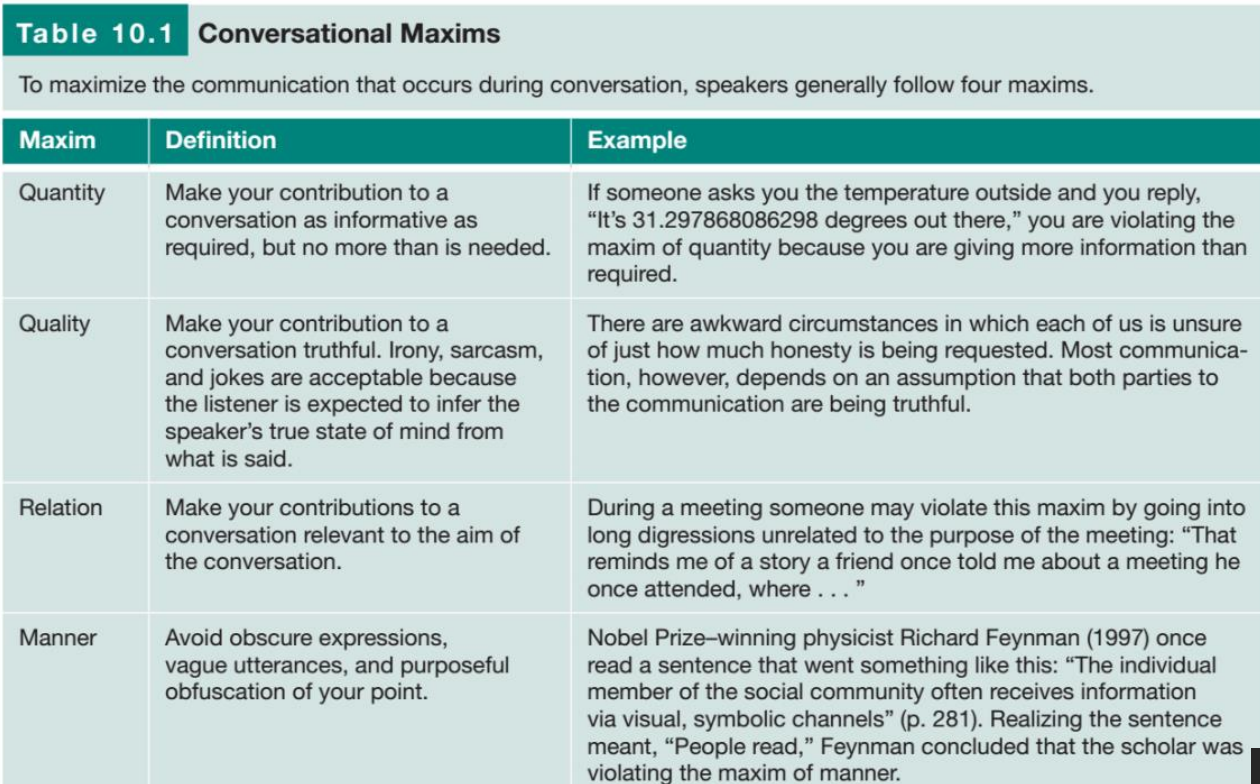
Grice: Successful conversations follow four maxims:
The maxim of quantity
The maxim of quality
The maxim of relation
The maxim of manner
Gender and language use:
Texting:
Girls text differently than boys.
Girls are more elaborative (to boys), boys texts may seem brisk and short to girls.
Talking:
Older adolescent and young adult males prefer to talk about political views, sources of personal pride, and what they like about the other person.
Females in this age group prefer to talk about feelings toward parents, close friends, classes, and their fears.
In general, women seem to disclose more about themselves than do men.
Writing:
Gender differences in written language also have been observed.
A study that analyzed more than 14,000 text files from 70 separate studies found that women used more words that were related to psychological and social processes, whereas men related more to object properties and impersonal topics.
On web forums: Women are more likely to express their emotions, both positive and negative.
These findings, however, are not conclusive.
A study examining blogs noted that the type of blog, more than the gender of the author, dictated the writing style.
Do animals have languages:
Philosopher René Descartes suggested that language is what qualitatively distinguishes human beings from other species.
Non-human animals do communicate in one way or another, but we should emphasize the distinction between communication and language.
Language: An organized means of combining words to communicate.
Communication: Broadly encompasses not only the exchange of thoughts and feelings through language but also nonverbal expression.
Primates (chimpanzees) show promising insights into non-human language.
Jane Goodall:
Considers many chimp vocalizations as clearly communicative, but not necessarily indicative of language.
Communicative vocalizations seems to be small, non productive (new utterances aren’t produced), limited in structure, lacking in structural complexity, and relatively nonarbitrary.
It also is not spontaneously acquired.
The chimps’ communications thus do not satisfy our criteria for a language.
Several researchers have tried to teach chimps language skills. The vocal tract of chimpanzees is different from the one of humans, so they are unable to reproduce the majority of human sounds.
Neuropsychology of language:
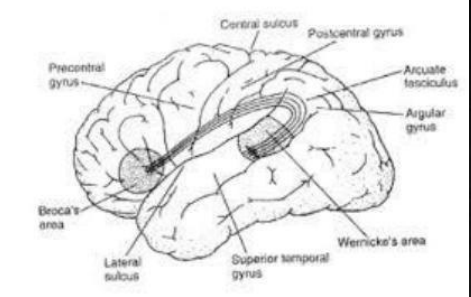
Through studies of patients with brain lesions, researchers have learned a great deal about the relations between particular areas of the brain (the areas of lesions observed in patients) and particular linguistic functions (the observed deficits in the brain-injured patients).
Brain and word recognition:
FMRI studies have found that the middle part of the superior temporal sulcus (STS) responds more strongly to speech sounds than to non-speech sounds.
The response takes place in both sides of the STS, although it’s usually stronger in the left hemisphere.
It does not matter whether words or pseudo-words are presented.
Meaning it’s unlikely that processing of semantic information takes place here.
Brain and semantic processing:
5 brain regions are involved in the storage and retrieval of meaning:
the ventral temporal lobes, including middle and inferior temporal, anterior fusiform, and anterior parahippocampal gyri.
The angular gyrus.
The anterior aspect (pars orbitalis) of the inferior frontal gyrus.
The dorsal prefrontal cortex.
The posterior cingulate gyrus
The activation of these areas takes place mostly in the left hemisphere.
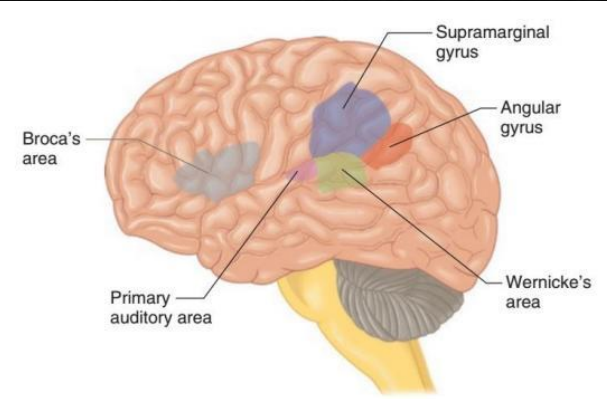
Brain & gender differences in language processing:
Dominance of the left hemisphere is observed for most language users in studies employing brain-imaging techniques like fMRI.
An fMRI study of men and women asked participants to perform one of four tasks:
Indicate whether a pair of letters was identical.
Indicate whether two words have the same meaning.
Indicate whether a pair of words rhymes.
Compare the lengths of two lines (a control task).
Letter-recognition and word-meaning tasks, they showed activation in the left temporal lobe of the brain.
When they were performing the rhyming task, different areas were activated for men versus women.
Only the inferior (lower) frontal region of the left hemisphere was activated for men. More left hemisphere dominant.
The inferior frontal region of both the left and right hemispheres was activated in women. Bilateral activation.
These results suggested that men localized their phonological processing more than did women.
Why does the difference matter:
The brain locations associated with aphasia (loss of speech as a result of brain damage) seemed to differ for men and women.
Most aphasic women showed lesions in the anterior region, although some aphasic women showed lesions in the temporal region.
In contrast, aphasic men showed a more varied pattern of lesions. Aphasic men were more likely to show lesions in posterior regions rather than in anterior regions.
Because women show less lateralization of linguistic function. Women may be better able to compensate for any possible loss of function because of lesions in the left posterior hemisphere through functional offsets in the right posterior hemisphere.
The possibility that there also may be subcortical gender differences in linguistic function.
Brain and language differences:
Aphasia:
Impairment of language functioning caused by damage to the brain.
Types:
Wernicke’s Aphasia:
Wernicke’s aphasia is caused by damage to Wernicke’s area of the brain.
Notable impairment in the understanding of spoken words and sentences.
It also typically involves the production of sentences that have the basic structure of the language spoken but that make no sense.
Treatment for patients with this type of aphasia frequently involves supporting and encouraging nonlanguage communication.
Broca’s aphasia:
Broca’s aphasia is caused by damage to Broca’s area of the brain.
Characterized by the production of agrammatical speech at the same time that verbal comprehension ability is largely preserved.
Global aphasia:
Global aphasia is the combination of highly impaired comprehension and production of speech.
Caused by lesions to both Broca’s and Wernicke’s areas.
Aphasia following a stroke frequently involves damage to both Broca’s and Wernicke’s areas.
In one study, researchers found 32% of aphasias immediately following a stroke involved both Broca’s and Wernicke’s areas.
Anomic aphasia:
Anomic aphasia involves difficulties in naming objects or in retrieving words.
The patient may look at an object and simply be unable to retrieve the word that corresponds to the object.