Genetics Packet 2 Codominance and Incomplete
Codominance, Incomplete Dominance, and Sex Linked Traits
Incomplete Dominance:
Not all dominance follows the same pattern. In mice, for example, if a white mouse and a black mouse mated they could produce a gray mouse. This is an example of incomplete dominance. With Incomplete dominance, a cross between organisms with two different phenotypes produces offspring with a third phenotype that is a blending of the parent’s traits.
It is like mixing paints, Red + White will make pink. Red doesn’t totally block the pink like it would with typical dominance rules, instead there is incomplete dominance, and we end up with something in between.
We can still use the Punnett Square to solve problems involving incomplete dominance. The only difference is that instead of using a capital letter for the dominant trait and a lowercase letter for the recessive trait, the letters we use are both going to be capital (because neither trait dominates the other). So the cross between a red and white plant and a cross between two pink plants would look like this: 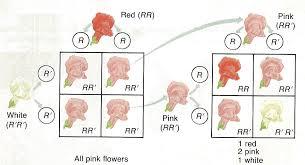


The trick is to recognize when you are dealing with questions involving incomplete dominance. \n It is probably incomplete dominance if you…
- Notice that the offspring are showing a 3rd phenotype. The parents each have one, and the offspring are different from the parents.
- Notice that the trait in the offspring is a blend (mixing) of the parental traits.


Codominance:
Similar to incomplete dominance, codominance also shows a third phenotype in heterozygous organisms. In Codominance, however, in the phenotype of heterozygous organisms the two alleles both appear together. It often appears as if the traits (alleles) are in patches. For example, if rabbit fur was a codominant trait and a homozygous white bunny was crossed with a homozygous black bunny then the offspring would be white with black patches (or black with white patches).
A very common phenotype used in questions about codominance is roan fur in cattle. Cattle can be red (RR = all red hairs), white (WW = all white hairs), or roan (RW = red & white hairs together). Another example of codominance is human blood type AB, in which two types of protein ("A" & "B") appear together on the surface of blood cells.

Incomplete Dominance and Codominance Punnett Squares Practice
- Hair texture in humans is an example of incomplete dominance. S is straight, and C is curly, and SC is wavy. Cross a homozygous straight haired male with a homozygous curly haired female. Don’t forget the legend/key.
What are the genotype and phenotype ratios of the offspring?
- In your own words, what is incomplete dominance?
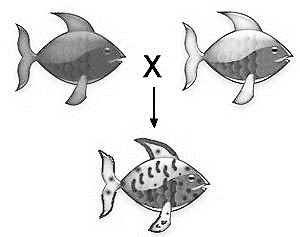
- Are these fish an incomplete dominance or codominance? How do you know?
- Look at the mice to fill in the table below:
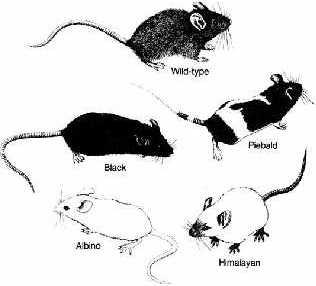
| Mouse | Cross with… | To get offspring that look like… | Describe the type of dominance: |
|---|---|---|---|
| Black | Wild type (gray) | ||
| Black | Piebald (spotted) | ||
| White | Piebald (spotted) |
Blood Typing:
Blood types are controlled by multiple alleles. There are actually three different alleles; A, B, and O that determine a person's blood type. (Although there are three alleles possible, remember that each person only has two alleles for every trait.)
Of the three alleles, A and B show codominance. This means that a person possessing both A and B alleles as their genotype, has AB blood because both alleles are expressed in the phenotype. The O allele however, is recessive to both the A and B allele. Therefore, a person possessing both A and O alleles will have a blood type of A. Likewise, a person with both B and O alleles will be blood type B because B is dominant, and therefore, masks the O allele.
The following table indicates all of the possible allele combinations and genotypes fill in what the phenotypes would be. Note: The "A" and "B" alleles are written as capitalized letters to indicate that they are dominant alleles. However the "o" allele is written as a lower-cased letter to indicate it is recessive.

| Genotype | Phenotype(blood type) |
|---|---|
| AA | |
| Ao | |
| BB | |
| Bo | |
| AB | |
| oo |