PD 1586: PHILIPPINE EIS SYSTEM
PD 1586: Philippine EIS System
Abstract
PD 1586 aims to "attain and maintain a rational and orderly balance between socio-economic growth and environmental protection." - PD1586
Environmental Impact Assessment (EIA)
A tool used by project planners to analyze proposed projects for their potential environmental impact.
A process of identifying, predicting, evaluating, and mitigating the biophysical, social, and other relevant effects of proposed projects before major decisions are made.
Legal Framework of Philippine EIS System
PD 1586: Known as the Philippine Environmental Impact Statement (EIS) System.
Sets forth the legal framework for an integrated approach to environmental management.
Declares Environmentally Critical Projects (ECPs) and projects within Environmentally Critical Areas (ECAs) as projects requiring the submission of an EIS.
States that no person, partnership, or corporation shall undertake or operate any declared ECP or project within an ECA without first securing an Environmental Compliance Certificate (ECC).
Basic DENR policy: "to attain and maintain a rational and orderly balance between economic growth and environmental protection."
Coverage of the EIS (PD 1586): Any undertaking or projects declared as ECPs and projects within ECAs require the submission of an EIS and an ECC before operation.
Policy 594 s. 1977: Established the Administrative System for the EIS.
PD 1151 s. 1977: The Philippine Environmental Policy declared the urgent need for an integrated program for environmental protection.
PD 1152: The Philippine Environmental Code.
PD 1586 (June 11, 1978): Establishing the Philippine Environmental Impact Statement (EIS) System.
DAO 21 s.1992: Further strengthened the implementation of the EIS System and devolved the EIS to the EMB Regional Offices.
DAO 37 s.1996: The Procedural Guidelines for the EIS process.
Introduced the review fund, eligible preparers, the Environmental Guarantee Fund (EGF), Environmental Monitoring Fund (EMF), and Multipartite Monitoring Team (MMT).
A.O. 42 (Malacañang): Rationalizing the implementation of the Philippine EIS System.
AO 42 (November 2, 2002): Rationalizing the implementation of the PEISS and giving authority to the Director and RDs of the EMB to grant or deny the issuance of ECCs.
DAO 2003-30 (June 30, 2003): Implementing Rules and Regulations (IRR) of the Philippine EIS System.
Revised Procedural Manual of DAO 2007-30 (August 2007): Supersedes the Procedural Manual under DENR-EMB MC 2005-01 issued on January 5, 2005.
Terminologies
Carrying Capacity: A measure of the environment's capacity to absorb impacts within recovery thresholds without significant deterioration.
Environment: Surrounding air, water (ground and surface), land, flora, fauna, humans, and their interrelations.
Project or Undertaking: Any activity with varying levels of significance of impact on the environment.
Process Industry: An industry whose project operation stage involves chemical, mechanical, or other processes.
Proponent: Any natural or juridical person intending to implement a project or undertaking.
Stakeholders: Entities affected by the project, including the Proponent, government agencies, LGUs, local communities, NGOs/POs, and other public sectors.
Environmental Impact Assessment Consultant: A professional or group commissioned by the Proponent to prepare the EIS/IEE and related documents.
Environmental Impact Assessment Review Committee (EIARC): A body of independent technical experts organized by the EMB to evaluate the EIS and make recommendations regarding the issuance of an ECC.
Multipartite Monitoring Team (MMT): A community-based multi-sectoral team for monitoring the Proponent's compliance with ECC conditions, EMP, and applicable laws.
EMB Director: The Director of the DENR-EMB at the Central Office.
EMB RD / EMB RO Director: The Director of the DENR-EMB at the Regional Office.
Environmental Compliance Certificate (ECC): A document issued by the DENR-EMB certifying that the proposed project will not cause a significant negative environmental impact and that the proponent has complied with all EIS System requirements.
Certificate of Non-Coverage (CNC): A certification issued by the EMB that the project is not covered by the EIS System (does not require an ECC).
Residual Impacts: Remaining impacts after implementation of preventive and mitigating measures.
Cumulative Impacts: Additive impacts from various sources.
Significant Impacts: Impacts which damage the environment to the point that it loses its capacity to sustain life.
Environmental Guarantee Fund (EGF): A fund set up by the Proponent for immediate clean-up or rehabilitation of areas affected by damages and to compensate affected parties and communities.
Environmental Monitoring Fund (EMF): A fund that a Proponent sets up after an ECC is issued to support the activities of the MMT.
Environmental Impact Assessment (EIA): A process that involves evaluating and predicting the likely impacts of a project on the environment.
Environmental Risk Assessment (ERA): Assessment of risks associated with a project using scientific methods.
Environmental Performance: Capability of Proponents to mitigate environmental impacts of projects or programs.
Public Participation: Open, transparent, gender-sensitive, and community-based public involvement in the EIA process.
Social Acceptability: Acceptability of a project by affected communities based on timely and informed participation in the EIA process.
Scoping: The stage in the EIS System where information and project impact assessment requirements are established.
Procedural Review: Phase in the ECC application review process to check for the completeness the required documents.
Project Description (PD): A document describing the nature , configuration, raw materials, production system, waste generation, and activities of a proposed project.
Environmental Impact Statement (EIS): A document prepared by the Proponent that serves as an application for an ECC.
Initial Environmental Examination (IEE) Report: A document similar to an EIS, but with reduced details and depth of assessment.
Initial Environmental Examination (IEE) Checklist Report: A simplified checklist version of an IEE Report.
Environmental Performance Report and Management Plan (EPRMP): Documentation of the actual cumulative environmental impacts and effectiveness of current measures for operating projects without ECCs.
Programmatic Environmental Impact Statement (PEIS): Documentation of comprehensive studies on environmental baseline conditions of a contiguous area.
Programmatic Environmental Performance Report and Management Plan (PEPRMP): Documentation of actual cumulative environmental impacts of co-located projects with proposals for expansion.
Environmental Management Plan/Program (EMP): Section in the EIS that details the prevention, mitigation, compensation, contingency, and monitoring measures.
Environmental Management Systems (EMS): Refers to the EMB, PEPP, and EMS as provided for under DAO 2003-14.
Philippine EIS System
A positive determination by the DENR-EMB results in an Environmental Compliance Certificate (ECC).
The ECC allows the project to proceed to the next stage of project planning, including acquisition of approvals from other government agencies and LGUs.
The Feasibility Study (FS) stage is the most ideal stage in the project cycle for the EIA study.
EIA documents are ideally prepared before the project has reached a stage of investment or commitment towards implementation.
The study phase of the EIA comprises:
Site Characterization and Prediction of Impacts
Evaluation of the impacts and Proposed Alternatives
Identification and Assessment of Mitigating Measures
Preparation of EIS.
ECP & ECA
Proclamation No. 2146 of Dec. 14, 1981, proclaims certain areas and types of projects as Environmentally Critical and within the scope of the EIS system.
Environmentally Critical Projects (ECPs): Projects with high potential significant impacts.
4 types of ECPs:
Proclamation No. 2146 (1981)
Heavy Industries
Resource Extractive Industries
Infrastructure projects
Proclamation No. 803 (1996)
Golf course projects
Environmentally Critical Areas (ECAs): Areas that are environmentally sensitive.
Declared through Proclamation No. 2146 (1981)
Examples:
National parks, watershed reserves, wildlife preserves, and sanctuaries
Areas set aside as aesthetic potential tourist spots
Areas of unique historic, archeological, or scientific interest
Habitats for endangered or threatened species
Areas traditionally occupied by cultural communities
Areas frequently visited and/or hard-hit by natural calamities
Areas with critical slopes
Areas classified as prime agricultural lands
Recharge areas of aquifers
Water bodies which support wildlife and fishery activities
Mangrove areas
Coral reefs
Salient notes on ECA:
EMB will decide on the relevance of the ECA categories to the project location.
If the agency with jurisdiction on the ECA cannot confirm the ECA status of the project, the "uncertain" status renders the project location as ECA, per EMB convention. The burden of proof lies with the Proponent in proving that the project is located in a NECA.
DENR can only certify ECAS within its own mandate, as follows:
DENR-EMB - Water bodies
PAWB/CENRO/PENRO - NIPAS areas, wildlife habitats and mangrove areas
DENR-MGB - Geologic hazard areas and areas of critical slope
NIPAS - National Protected Areas System as mandated by RA 7586 of 1992
PAWB - Protected Areas & Wildlife Bureau
CENRO - Community Environment & Natural Resources
PENRO - Provincial Environment & Natural Resources
DENR-MGB - Mines and Geosciences Bureau
Project Groupings
Group 1: ECPs in either ECAs or Non-ECAs (Project types declared through PN 2146 & 803)
Group 2: non-ECPs in ECAs (37 listed in this group. These are Heavy industries, Fishery & Logging projects w/ IEE as the highest documentary requirement.)
Group 3: non-ECPs in non-ECAs (All Group II project types outside ECAS)
Group 4: Co-located Projects in either ECA or non-ECA (The nature of the projects is called "programmatic")
Group 5: Unclassified Group
Project Subgroups
A: New Application
B: Existing with ECC but with proposal for modification or Resumption of operation
C: Operating w/o ECC
Summary List of Additional Non-Environmentally-Critical Project (NECP) Types in ECAs Classified under Group II
Agriculture Industry
Buildings, storage facilities and other structures
Chemical Industries
Cottage Industries
Demonstration & Pilot Projects
Environmental enhancement & mitigation projects
Food & related industries
Packaging materials & miscellaneous product industries
Pipeline Projects
Textile, wood and rubber industries
Tourism industry
Transport terminal facilities
Waste management projects
Water supply, irrigation or flood control projects
Treasure hunting in NIPAS areas
Wildlife farming or any related projects a defined by PAWB
Stages of EIA Process
Screening: Determines if the project is within the purview of EIS
Scoping: Scoping is done with the local community through public scoping with the third party, the REVCOM, with the participation of the EMB
EIA Study and Report Preparation: Involves the description of the project, baseline data, impact identification and prediction, evaluation of impact significance, EMP, EMOP
EIA Report Review and Evaluation: Screening, review, and evaluation of the document
Decision Making: Decision resulting in the issuance of an ECC, CNC, or denial letter.
Monitoring, Validation, and Evaluation Audit: Stage assesses the proponent's performance against the ECC
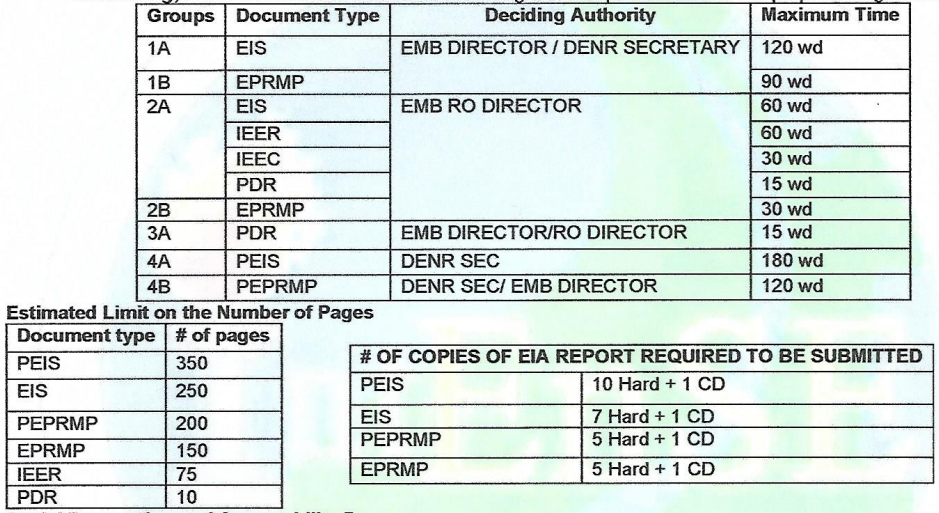
Deciding Authority and Maximum Time
Social Preparation and Acceptability Process
Legal Basis: Sec. 1(d) Article I of DAO 2003-30: The review of the EIS by EMB shall be guided by three (3) general criteria:
(1) that environmental considerations are integrated into the overall project planning,
(2) that the assessment is technically sound and proposed environmental mitigation measures are effective, and
(3) that social acceptability is based on informed public participation"
Public Participation
The EIS process emphasizes the importance of public participation in broadening the responsibilities for environmental protection and in promoting social progress and equity, recognizing that people:
possess intimate knowledge about their environment
have needs and aspirations for socio-economic upliftment
are recipients of benefits and/or environmental stress arising from these projects or undertaking
The goal of public participation in the EIA process: is to enable citizens to take responsibility for environmental protection and management through active involvement in decision making
Essential Elements of Public Participation
Social preparation for the participation of stakeholders.
Identification and full representation of stakeholders and other concerned parties.
Implementation of procedures or protocols that is acceptable to all parties.
Issues or concerns that emerged are stated clearly and made known to all participants
Social Preparation Process
A process required in the conduct of EIA in order for the affected communities to have timely and informed participation.
A two-way process, which involves informing and developing awareness and understanding about the EIA process and the project while generating the communities' perceptions, insights, and suggestions about the project.
This step or process should, ideally, be started prior to the Scoping Process
Monitoring, Validation and Evaluation/Audit
Even after an ECC has been issued, local stakeholders are encouraged to actively participate in project environmental performance validation
Creation of Multipartite Monitoring Team (MMT) System
Summary of Monitoring Reports & Documents
Prepared by | Frequency of Submission | Submitted to | |
|---|---|---|---|
Compliance Monitoring Report (CMR) | Proponent | Semi-annual | Monitoring EMB Office |
Self-Monitoring Report (SMR) | Proponent | Quarterly | Concerned EMB Regional Office |
Compliance Monitoring & Validation Report (CMVR) | MMT | Semi-annual with the Proponent's CMR/SMR | EMB Regional Office |
Compliance Evaluation Report (CER) | EMB Case Handler/Staff | Shall be prepared semi-annually | Documentation by the EMB, with the MMT's CMVR and the Proponent's CMR/SMR as attachments |
For projects without MMT, validation function shall likewise be the responsibility of the EMB RO. The same CER form shall be used as template, but incorporating relevant tables in the CMVR form to be filled-out by the EMB RO itself as basis for the summary evaluation. The Proponent's CMR/SMR shall be attached to the CER.
Major Amendments
Expansion of project area within catchment described in EIA.
Increase in production capacity or auxiliary component of the original project.
Change(s) in process flow or technology
Addition of new product
Integration of ECCs for similar or dissimilar but contiguous projects (NOTE: ITEM #5 IS PROPONENT'S OPTION, NOT EMB'S)
Revision/Reformatting of ECC Conditions
Other amendments deemed "major" at the discretion of the EMB CO/RO Director
Minor Amendments
Typographical error.
Extension of deadlines for submission of post-ECC requirement/s
Extension of ECC validity
Change in company name/ownership
Decrease in land/project area or production capacity
Other amendments deemed "minor" at the discretion of the EMB CO/RO Director
Suspension of ECC
ECCs may be suspended for violation of Proponents to comply with ECC conditions.
ECC suspension DOES NOT necessarily mean the Proponent is absolved of its responsibility in implementing its approved Environmental Management Plan (EMP) (suspension only, not revoked).
PD 1586 DOES NOT preclude the fact that DENR may require the Proponent to institute environmental safeguards/measures to prevent further threat or actual damage to the environment.
Imposition of fines and penalties based on the succeeding guidelines is vested on the Directors of the EMB Central Office or Regional Office upon persons or entities found violating provisions of P.D. 1586 and its Implementing Rules and Regulations.
Cease and Desist Order
The EMB Director or the EMB-RD may issue a Cease and Desist Order (CDO) based on violations under the Philippine EIS System which cannot be attributed to specific environmental laws (e.g. RA 8749, RA 9275, RA 6969, etc) and/or which present grave or irreparable damage to the environment.
Such CDO shall be effective immediately. An appeal or any motion seeking to lift the CDO shall not stay its effectivity.
However, the DENR shall act on such appeal or motion within ten (10) working days from filing.
Prohibited Acts / Scope of Violations
Projects which are Established and/or Operating without an ECC
Projects Violating ECC Conditions, EMP, Rules, and Regulations
Violations in relation to ECC conditions are classified as minor and major offenses.
Misrepresentation in the IEE/EIS or any Other Documents
Major Offenses
Non-implementation of substantive conditions in the ECC, EMP, EMOP and other commitments in the EIA Report and modifications
Exceedance of project limit or area
Significant addition of project component or product without prior approval from EMB
Major change in project process or technology
Other offenses deemed major by EMB CO/RO Director
Minor Offenses
Non-submission or delay in submission of reports/requirements
Transfer of ownership of the project/ECC without prior approval from EMB
Delay or failure to implement ECC conditions which do not have significant impacts on the environment
Non-compliance with other administrative conditions in the ECC
Non-compliance with administrative and technical procedural guidelines in DAO 2003-30
Other offenses deemed minor by EMB CO/RO Director
Assessment and Computation of Fines
Failure to pay a fine imposed by the Secretary, EMB Director, or the RD constitutes an offense separate from the original offense that brought about the imposition of the original fine and may warrant the imposition of another fine, and/or the issuance of a CDO.
For projects operating without an ECC: The sum of P50,000.00 is set as reduced at the discretion of the Secretary, the EMB director, or the RD, considering the circumstances of each case, i.e., the impact of the violation on the environment.
In case of violation of ECC conditions, EMP, or EIS rules and regulations: The sum of P50,000.00 is again set as the maximum amount of fine per violation. Violation of one condition in the ECC is an offense separate and distinct from the violation of another condition. It is possible that a respondent be subjected to a fine of more than P50,000.00 if more than one ECC condition is violated. However, the amount of fine per violation may be accordingly reduced, following the schedule of fines presented in Table 2-3.
PENALTY
CRITERIA | 1st Offense | 2nd Offense | 3rd Offense | 4th Offense |
|---|---|---|---|---|
Minor Offenses | PhP 10,000 | PhP 25,000 | PhP 50,000 | PhP 50,000 plus ECC suspension w/ option of DENR-EMB to cease operations if deemed necessary for EMP but w/ corresponding continued implementation requirement |
Major Offenses | PhP 25,000 | PhP 50,000 | PhP 50,000 plus ECC suspension w/ option of DENR-EMB to cease operations if deemed necessary but wi corresponding continued implementation for EMP |
Misrepresentation in the EIA Reports
This violation shall be subjected to due process and may result in a fine in a fixed maximum amount of P 50,000.00 for every proven misrepresentation.