WGU s3: skeletal system
Osteoblasts - Form bone
Osteocytes - Maintain bone, immune sys part of bone
Osteogenic cell - Create Osteoblasts
OsteoClasts - eat the bone when needed
Compact bone
Spongy bone
trabeculae
CARTILAGE
Hyaline - most common, smooth, strong and flexible(COMBO)
Fibro - TOUGH cartilage, thick bundles of collagen
Elastic - a little stretchy, like the ear lobes
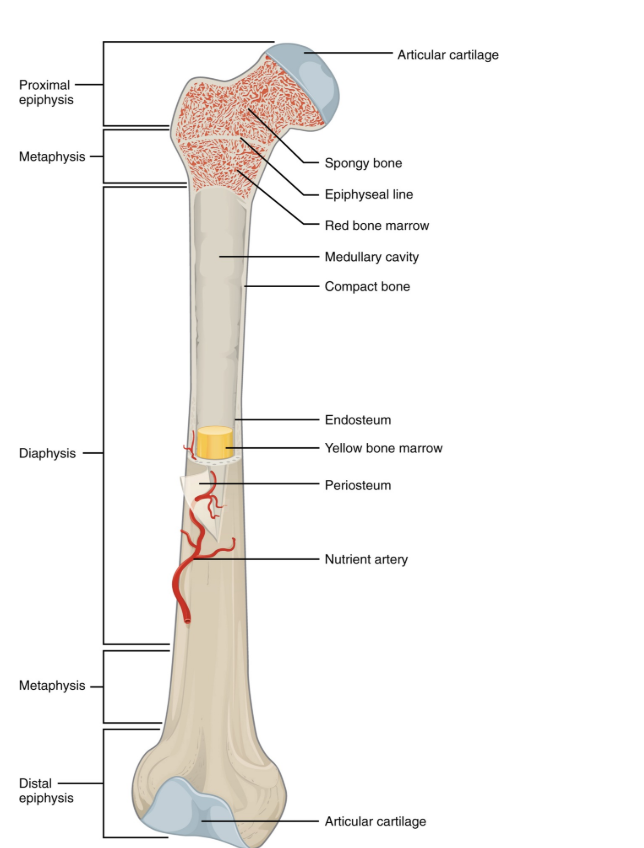
Diaphysis - middle bone
part of diaphysis is the medullary cavity which is filled with yellow marrow
walls are just compact bone
Epiphysis - ends of bone
spongy bone with red marrow
when meet another bone, covered with articular cartilage
Metaphysis^ is the meeting point between those two
Periosteum - membrane covering the bone
Flat bones are just periosteum > compact bone > spongy
Axial and appendicular skeleton
Long bone - Cylinder
Short bone - Cube-like
Flat bone - typically thin and curved
Irregular bone - irregular and complex shape. unlike any other bone
Sesamoid bone - shaped like a sesame seed
Articulation - where two bone surfaces come together
Projection - an area in the bone that projects above the surface of a bone
SKULL
Cranium
Mandible - lower jaw
ORBIT - eyeball socket
Ethmoid bone - upper nasal septum
Vomer bone - lower nasal septum
CRANIUM
Parietal bone - forms top lateral sides of skull
Temporal bone - far lateral sides of skull
Frontal bone - The forehead bone
Occipital bone - the back of the head; concussion for me
Sphenoid bone - complex bone in the central skull(middle of eye socket)
FACIAL(nasal septum/orbit)
Maxillary bone - upper jaw, part of nose, under eye sockets
Palatine bone - bottom of nasal and back of roof of mouth
Zygomatic bone - cheekbone, side of eye
Nasal bone - form bridge of nose
Lacrimal bone - small bone under eye socket that helps with tears and sinus drainage and stuff
MANDIBLE - jaw
PARANASAL SINUSES
Frontal sinus - top above eyes
sphenoid sinus and ethmoid air cells - between eyes
Maxillary sinus- under eye sockets
Hyoid - U shaped throat bone
Vertebral column
-starts as 33 vertebrae, develops into 24
Cervical, thoracic, lumbar, Then the sacrum(pelvis) and Coccyx(bootyhole)
ThorACIC CAGE
sternum looks like suit and tie > Manubrium+body
XIphoid process is that wierd tip of the sternum that sticks out a lil
Ribs
Pectoral GIrdle - shoulder
clavicle - collarbone
Scapula - shoulder blade/uper back
ARM
humerus - upper arm bone
ulna - medial side of forearm, is the bone in the elbow which is called the olecranon process
Radius - thumb side of forearm
HAND
Carpals - wrist and beginning of hand
metacarpals -
Phalanges(phalanx) - fingers and thumb
Pelvic girdle(hip bone/ COXAL bone)
Ilium - That bony hip part
Ischium - the butt part
pubis - the front part where the penis is
LEGGGGGGGG
Femur - the thigh bone (also has the head and neck of femur at 90 degree angle)
Patella - kneecap
tibia - big shin bone(inside of leg)
fibula - small shin bone lateral to tibia(outside of leg)
Foot
tarsals
metatarsals
phalanges
JOINTS - aka an articulation
Fibrous joint - united by fibrous connective tissue - Symphasis
Cartilaginous joint - joined by hyaline or fibrocartilage
Synovial joint - lube fluid
SYNARthrosis - stone cold cant move
Amphiarthrosis - joint with limited mobility
DIARthrosis - full mobility
Elbow and knee - Hinge joints
Shoulder and hip - Ball and SOcket
TYpes of SYNOVIAL Joints
Plane - Gliding movements
Hinge - elbows and knees, single axis
condylar - base of fingers… allows the fourmain movement types
Pivot
ball-and-socket - shoulder and hip
saddle - base of thumb.. joint looks like someone sitting on a saddle
BURSA is the sack that holds synovial fluid
Osteocyte cells are the ones trapped within the bone matrix