Reptile Families
Which of the following is NOT true of reptiles?
a
They have scales
b
They are homeothermic
c
If they have legs, they have claws
d
They have 4 legs or no legs
Which of the following is a morphological difference between Anapsids and Diapsids?
a
Different number of legs
b
Different number of heart chambers
c
Different type of scales
d
Different number of holes in the skull
Snakes with ___________ scales are better at climbing.
a
smooth
b
keeled
c
shedding
d
shell
What's attached to precaudal vertebrae in snakes?
a
rattle
b
skull
c
ribs
d
feet
Members of which group of reptiles sometimes have a parietal eye?
a
lizards
b
turtles
c
venomous snakes
d
non-venomous snakes
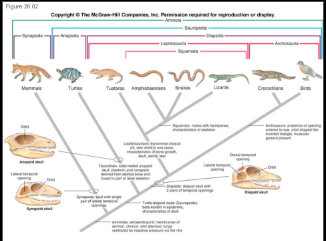
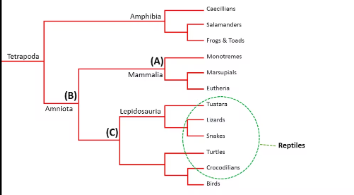
Synapsids and Sauropsids
First amniotes—340MYA
reptiles very different from current reptiles
Two lines diverged soon after
Extant Sauropsids= turtles, reptiles, crocodiles, birds
Extant Synapsids = mammals
Anapsids, Synapsids, and Diapsids
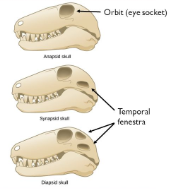
Based on number of temporal openings (fenetra)
jaw muscle attachment
Anapsid: no temporal openings
turtles
Synapsid: single temporal opening
mammals
Diapsid: 2 temporal openings
reptiles including birds
Reptile Classification
Order Testudines
Cheloniidae
Chelydridae
Kinostemidae
Emydidae
Characteristics
shell, modified ribcage
keratin beak
pelvic and pectoral girdles within ribcage
Cheloniidae—Sea Turtles
4 spp. in NC, 7 species worldwide
6 of 7 threatened or endangered, 3 critically endangered
limbs modified into flippers
mostly aquatic
Trionychidae—Softshell Turtles
25 species worldwide, 1 in NC
more than half are at risk, 5 endangered
buried in mud, not baskers
slow moving water with soft bottom
Chelydridae: Snapping Turtles
Big headed turtles—cannot fully retract into shell
3 spp worldwide, 1 in NC
None are at risk
large, mostly aquatic turtles
heavy carapace, reduced plastron
strong jaws
Kinosternidae—Mud and Musk Turtles
25 species worldwide, 4 spp. in NC
most species not at risk
related to snapping turtles
much smaller
fixed or hinged plastrons
Emydidae—Box and Basking Turtles
95 species worldwide, 10 spp. in NC
bog turtle endangered
occupy a wide variety of habitats
most are aquatic
some even are salt-water tolerant
Testudinidae—Tortoises
40-50 species
fully terrestrial, warm climates
domed carapace, herbivores
13 species in US
gopher tortoise is the only tortoise in the Southeast—listed as threatened
Order Crocodylia
only extant members of Archosauria—all dinosaurs and other reptiles of the Mesozoic 245-65MYA
3 families, 23 species worldwide
non-overlapping scales and bony scutes
4-chambered heart with a pore
super acidic stomach
Crocodylidade
3 genera, 14 species worldwide
American Crocodile is endangered
True crocodiles
long, narrow heads
lower jaw teeth outside mouth
Alligatoridae
true alligators—4 genera and 8 species worldwide
American Alligators were listed as endangered in 1967, now they are least concern and even hunted in some places
broad heads
lower jaw teeth inside mouth
Order Squamata
largest order of reptiles, over 7000 species worldwide
lizards, snakes, tuataras
tuataras are the only surviving member of the group that gave rise to all of Squamata
Phrynosomatidae—horned and fence lizards
more than 120 species worldwide, 1 sp. (+1 introduced) in NC (greater diversity in West)
eastern fence lizard is least concern
rough scales
Polychrotidae—Anoles
more than 600 species worldwide, 1 sp. in NC (several others in US, mostly introduced)
Carolina Anole=least concern
granular scales
good climbers
Scincidae—skinks
more than 1000 species worldwide, 5 spp in NC
3 species on our list = least concern
All members of Plestiodon in NC have blue tails as juveniles (Scincella tails are always brown)
short neck
relatively small legs
Viperidae—pit vipers
364 species worldwide, 5 spp in NC, 26 worldwide are vulnerable, at risk, or endangered
All NC members have heat-sensing pits, moveable front fangs, and give live birth
Venom=hemotoxin
Elapidae—cobras, coral snakes, and kraits
1 sp in NC (+2 spp, further west), over 300 species worldwide
Eastern coral snake is least concern
diverse family, but one species very rarely occurs in NC
fixed front fangs, egg-laying
venom = neurotoxin
Colubridae—non venomous snakes
31 spp in NC, almost 2000 species worldwide!
Indigo snake is threatened
egg-layers and live-bearers—ovoviviparous
smooth or keeled scales