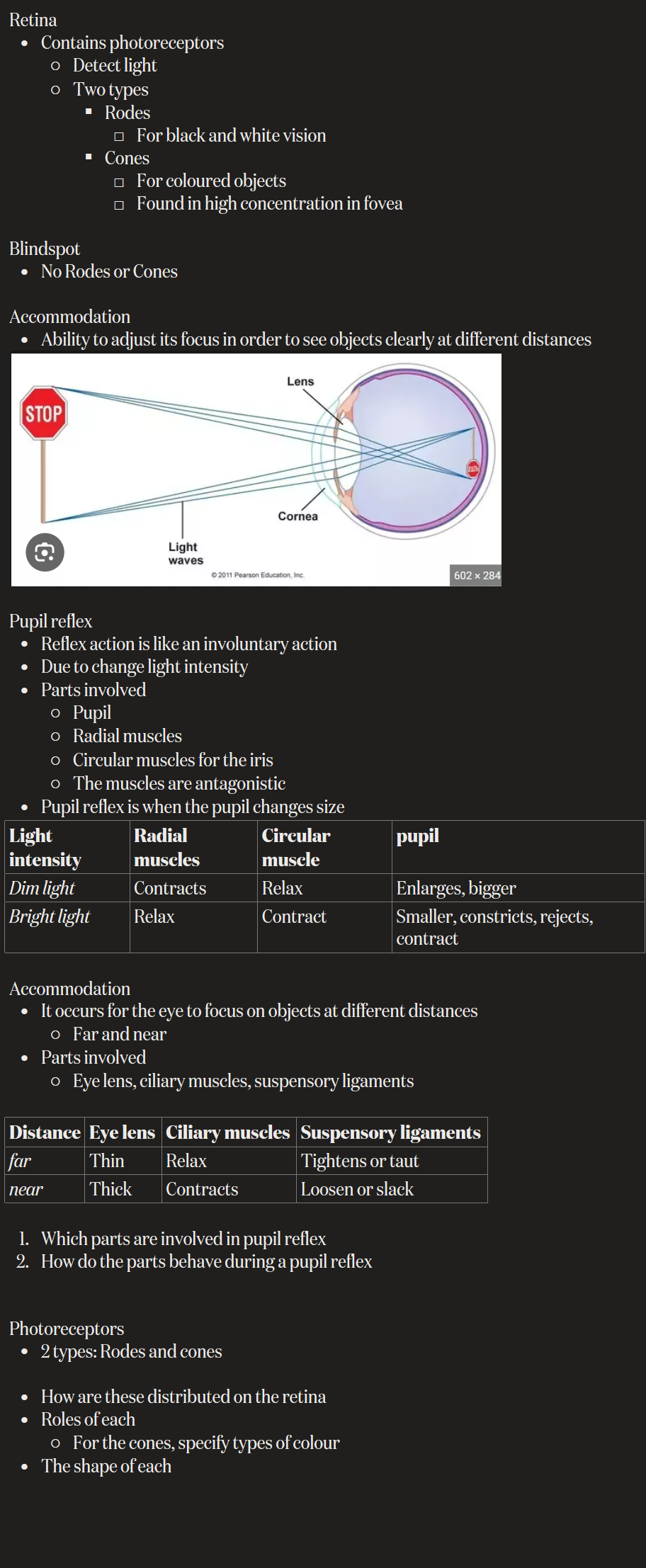
the eye
Retina
Contains photoreceptors
Detect light
Two types
Rodes
For black and white vision
Cones
For coloured objects
Found in high concentration in fovea
Blindspot
No Rodes or Cones
Accommodation
Ability to adjust its focus in order to see objects clearly at different distances
Pupil reflex
Reflex action is like an involuntary action
Due to change light intensity
Parts involved
Pupil
Radial muscles
Circular muscles for the iris
The muscles are antagonistic
Pupil reflex is when the pupil changes size
Light intensity | Radial muscles | Circular muscle | pupil |
Dim light | Contracts | Relax | Enlarges, bigger |
Bright light | Relax | Contract | Smaller, constricts, rejects, contract |
Accommodation
It occurs for the eye to focus on objects at different distances
Far and near
Parts involved
Eye lens, ciliary muscles, suspensory ligaments
Distance | Eye lens | Ciliary muscles | Suspensory ligaments |
far | Thin | Relax | Tightens or taut |
near | Thick | Contracts | Loosen or slack |
Which parts are involved in pupil reflex
How do the parts behave during a pupil reflex
Photoreceptors
2 types: Rodes and cones
How are these distributed on the retina
Roles of each
For the cones, specify types of colour
The shape of each