Impacts of Aging Population & Theories of Aging
Acknowledgement: thanks erikamarie
Impact of Aging Population
Is a universal phenomenon and every object on earth undergoes the process of aging
A process that accumulates changes in organisms or objects over time, human aging involves multidimensional changes on physical, psychological, cultural, and social levels
A cellular and physiologic deterioration and occurs at different rates among individuals
Impact of Aging on Physiology
Changes that occur normally with age, not due to disease
These changes include sensory loss, digestion, circulation, and sexuality.
Sensory loss
Humans receive and process information from the environment through hearing, vision, taste, smell , and touch
30% of people over 60 have hearing impairment
33% of those 75-84 and half of those over 85 have a hearing loss
Hearing loss affects the older person's ability to communicate with others
Vision
Retinas become thinner than usual in aging eyes, the sharpness that should be achieved in viewing objects at a distance is impaired, objects placed at a distance appear blurred.
Red, yellow, orange are easier to see than green
Peripheral vision is reduced, person may need to turn head to see to the sides
Older people ten d to have trouble focusing on near objects
Cataracts, glaucoma and blindness affect about 7% and 15% of older adults
Taste and Smell
Loss is minor and does not seem to occur until age over 70, loss of smell but this is not severe
Skin
It serves as a protective function, with age there is a reduces sensitivities and begins to develop wrinkles and dark spots, oil is not developed as efficient
skin tears easily
loss of lusterless
Hair and nails
Hair is thinner and greyed, nails have a decreased growth rate
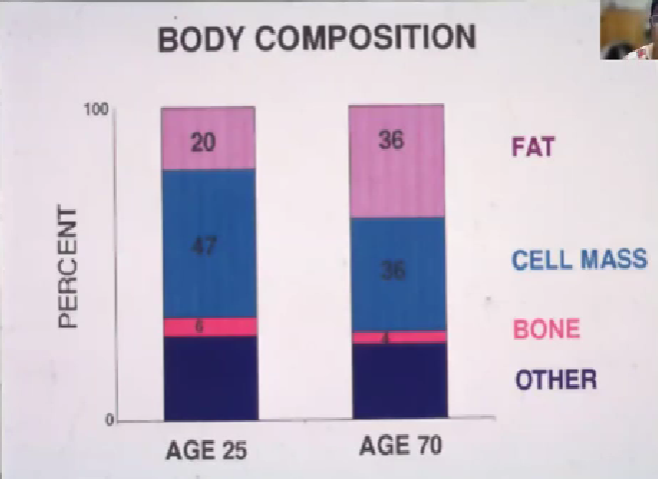
Body composition
Increased fat mass, decreased cell and bone mass
Body composition
Nervous system
There is a neuronal loss in the brain throughout life,
Some brain regions shrink while others remain stable with age
Loss is chiefly GREY MATTER
Changes in sleep cycle
Sense of smell is decreased
Musculoskeletal system
With age, they begin to shrink and lose mass
Less bone mass and strength due to loss of number and size of muscle fibers
Decreased water content of tendons and cordlike tissues that attach to bones
Handgrip strength decreases
Bone demineralization leads to osteoporosis
Heart muscle less able to prepare large quantities of blood for the body
Joints
Joint motion becomes restricted and flexibility decreases with age
Cushioning decrease, joints will have arthritis
Heart
The heart loses some pumping strength and ability
Blood vessels lose their elasticity and the fatty deposition on the artery walls makes the arteries smaller or rather narrows the space for the blood flowing through it
Slight increase in the size of the heart, especially left ventricle, is common. The heart wall thickens so the amount of blood that the chamber can hold may actually decrease
Slight increase in LEFT VENTRICLE in order to compensate for the slight weakened pumping ability however it may inadvertently hold a smaller amount of blood load
In older adults, the heart fills slower thus the atria (the upper chambers of the heart) contribute twice as much to the heart’s filling compared to younger people.
Kidney
Renal blood vessels become smaller and thicker reducing renal blood flow
Decreased renal blood flow from 600ml/min (age 40)to 300ml/min (age80)
Kidneys are reduced in size 20-30% by age 90
Bladder
The muscular ureters, urethra and bladder lose tone and elasticity.
The bladder may retain urine causing incomplete emptying leading to frequent urination
Decline in bladder capacity from about 500-600mL to about 250mL - Less urine can be stored in the bladder
Cause more frequent urination
Gastrointestinal system
Salivary glands produce less saliva reducing cleansing action (xerostomia = dry mouth)
Dysphasia (difficulty swallowing)
Taste sensation diminishes
Decrease in gastric cells (low HCL thus vitamin b12 from food isn’t utilized kaya lagi may supplement)
Decreased production of digestive enzymes
Thinner and weaker intestinal wall
Female reproductive system
Decreased estrogen, uterine size and secretions (dry pussay)
Atrophy of vaginal lining
Male reproductive system
Decreased testosterone levels, sperm count, testicular size
Impact of aging, social-emotion
Social changes that come with life are change in life style, loss of other family members, neighbors and friends.
Main problems are
Social Isolation
Finance
Loneliness
Rejection and loss of purpose
Deterioration in housing standards and poor nutritional level
Retirement, a change in work role alters identity status, financial problem, lack of satisfaction and self esteem
Widowhood is a common event that alters family life for the aged and is the death of a spouse
Loneliness is a subjective, negative feeling related to the person’s own experience of a deficient social relation
Loss of independence, due to retirement and physical disability creates frustration and feelings of uselessness
Changes in roles and relationships
Changes in roles and relationships
parents become grandparents
adult children become caregivers for ageing parents
spouses become widows or widowers
Group membership roles change at
retirement
moving neighborhoods
cessation of social activities due to failing health
Loss of status and decision-making power
Depression is associated with mortality, when feelings of loneliness are present
Religiosity, fear of death, or religious needs increase
Embarrassment and shame at condition (use of diaper, illnesses for incontinence, dependence on others and illness seen as weakness )
Impact of aging on Psychology
Most elderly people seem to be vulnerable to psychological dysfunction when change is experiences
Affective function: mood, emotions such as happiness,
Cognitive function: memory, intelligence
Affective and Cognitive function changes may affect self-esteem
Affective functioning
Influenced by the way an individual views the world and self
A positive self view promotes positive expression
Self esteem the way a person views themself
A positive view of self promotes health and enables the person to cope better with the changes and challenges
Factors contributing to a decrease in self-esteem
Age-related changes and losses that occur with aging
Chronic diseases
Increased dependency
Function impairment
Lack of control over the person environment
Personality
The basic personality does not change as a result aging process
The personality will be consistent with that of earlier years
Depression occurs in 16-65% of elders in the community
Losses can lead to depression
Includes sleep disturbance, lack of interest, feelin guilty, lack of energy, decreased concentration and loss of appetite
Cognitive functioning
Intelligent, learning, attention, and memory are all related to cognitive functioning and how well the mind is able to reason and make sound judgments
Intelligence is mental alertness and includes the ability to learn new material, make wise decisions and deal with stressful situations
Memory is defined as a recall of items learned more than a few minutes earlier or many years earlier
Learning the acquisition of new knowledge or skills
Attention span decrease in vigilance performance, (shorter attention span, can't retain more than 45 mins)
They are more liable to divert attention with irrelevant information and stimuli
Deficits in attention may affect learning and memory
Theories of Aging
Theories are attempts to explain phenomena to give a sense of order and to provide a framework from which one can interpret and simplify the world
the theories of aging have helped both scientists and bedside nurses understand the physical changes of aging
the normal changes of aging are made visible in what is referred to as the aging phenotype
Biological theories of aging
explains senesce or changes in the organism leading ultimately to its death (Campisi, 2013)
advancement in technology allows us to see changes within one of the most basic structures in cells, the mitochondria
the normal changes of aging are made visible in what is referred to as the “aging phenotype”- ways and appearance changes as we accumulate years of life (sagging skin) (Carnes et.al, 2018)
Cellular functioning and aging
Cellular reproduction
Genetic components
DNA
RNA
serves as templates for ensuring that reproduction results in new cells that are exactly the same as the old cells in form and function
Oxidative stress theory
Activity afacs of aging
Free radical theory
Accumulation of damage from free radicals occur faster than the cells can repair themselves
Exposure to pollutants increase the rate of free radicals
vitamins, etc. neutralize the free radicals
natural antioxidants are in fruits, vegetables and a Mediterranean diet (red wine, olive oil)
Immunologic theory of aging
aging is a result of accumulation of damage in the immune system or immunosenescence
decreased ability of the cells to counteract inflammation appears to have a broad effect including the inability of the body to use fever to fight illness
combination of chronic state of inflammation and an increasing number of ROS in the cells appear to be key factors in the aging process and in the development of many health problems common in later life
Aging and DNA
the aging process lead to mutations in the basic DNA that in turn cause the errors in reproduction however it is not conclusive
The length of Telomeres length may affect immunity, longevity and overall health
A telomere may have its own biological clock
the shortening of a telomere results from oxidative stress
premature shortening may occur increasing the individual's risk for any number of disease states and decreased lifespans
the nurse should understand that the exact cause of aging is unknown
Psychosocial, Spiritual, Cognitive aspects of aging,
The importance of life story, reminiscence, life review
First generation theories of aging
the 1940s to 1950s is not based on extensive research and primarily developed as a consequence of face validity, it emerged from personal and professional experience from both scientists and clinicians appearing to be reasonable explanation of aging
Role theory
One of the earliest explanations of how one adjusts to aging where in ones self identity is believed to be based on ones role in society
phenomenon of age norms based on the assumption that chronological age and gender in and of themselves, imply roles
“if only u will act ur age”
Activity theory
Proposed that successful aging was based on the individual's ability to maintain their lifestyle, consistent with western society emphasis on work wealth and productivity and therefore continues to influence the perception of unsuccessful aging
failed to consider social class,education, health and economic and cutural diversity
Second generation theories of aging
Disengagement theory
In contract role and activity theory
contintural course of aging the individual slowly withdraws from their role in society allowing transfer of power to the next generation
Continuity theory
In contrast with role theory but similar to activity theory
Is associated with ones ability to maintain and continue previous behaviors and roles or to find suitable replacements , or that individuals maintain a consistent pattern of behavior over a lifetime (loved being a fuckboy at youth? still a fuckboy as a lolo)
Age-stratification theory
Can be understood by considering the experiences of individuals as members of cohorts with similarities to others in the same group
Young-old
Middle-old
Old-old
Social exchange theory
an economic perspective where in as one ages, they have fewer economic resources to contribute to society,
as one ages, one has fewer economic resources to contribute to society
paucity results in loss of social status, self-esteem ad political power
only those who are able to maintain control of their financial resources have the potential to remain fully participative members of society and anticipate successful aging
Modernization theory
is an attempt to explain the social changes resulted in devaluing the contribution of elders
The status and value of elders are lost when their labors are no longer considered useful, their kinship networks are dispersed and their knowledge is no longer applicable to the current advancements, they are no longer revered simply cause of their age
changes results of advancing technology
Developmental theories
The task of the late stage of life “ego integrity vs self despair”
The last stage of life where one would look back in in their life with ego integrity or despair of how they lived their life
successfully completing phase is looking ack with few regrets
the individual attain wisdom even when confronting death
“Ego integrity is tagged with some regrets, wisdom is balanced with frivolity & letting go is balanced with hanging on”
Gerotranscendence theory
to give the person time for self reflection of the inner self and contemplation of the meaning of life and moving away from material world, the highest goal is Transcendence and a marker of successful aging
Third generation theories of aging
Referred to the second transformation occurring since the 1980s,
the goal of this theory is to understanding the human meanings of social life in the context of everyday life rather than fact explanation
aging is personally interpreted rather than socially or culturally constructed
this level is particularly useful in the application of nursing care and incorporation of recognition of the aging person as unique and valuable
The life story
constructed through reminiscing, journaling, life review, or guided autobiography
the universal appeal of the life story as a vehicle of culture, a demonstration of caring & generational continuity and an easily stimulated activity
Story telling is a complementary & alternative therapy nurse can use with older adults to enhance communication
Reminiscing
Recall of the past, from childhood onward at life’s junctures and transitions, as reminiscing cultivates a sense of security through recounting of comforting memories, belonging through sharing and promotion of self esteem and through confirmation of uniqueness
For the nurse reminiscing is a therapeutic intervention important in assessment and understanding
Goals: Reminiscence
Pleasurable experience increase socialization and connectedness
Provide cognitive stimulation
Improve communication
Facilitate personal growth
Can decrease depression score
Intergenerational reminiscence activities could have benefits for both older and younger individual
Life review
Process that normally occurs in the older person as the realization of his or her approaching death creates a resurgence of unresolved conflicts
Occurs naturally for many persons during period of crisis and transition
More of a formal therapy technique than reminiscence and takes a person through his or her life in a structured and chronological order
life review therapy is important for the older people experiencing depressive symptoms and those facing death
ongoing life review help avoid overwhelming feeling of dispair
Spirituality and aging
Spirituality is the quality of a person derived from social and cultural environment that involves faith, and cultural environment that involve faith, a search from meaning sense of connection with others and a transcendence of self resulting in a sense of inner peace and well being,
Aging leads people closer to death thus spirituality may become more important
Spiritual belief and practices often play a central role in helping older adults cope with life changes and are a source of strength in their lives.
Spirituality
is a broader concept than religion and involves Values, Beliefs and the search for meaningful relationships with a higher power, with nature and with other people it is also a significant factor in understanding healthy aging
spiritual well being may be considered the ability to experience and integrating meaning and purpose in life through connectedness with self and others, art music literature and nature or a greater power than oneself
assessment of spirituality is as important as an assessment of physical and emotional social dimensions,
the client should be assured that religious longings and rituals are important and that opportunities will be made as desired.
simply listening to patients as they express their fears, hopes, & beliefs are important
if the patient is impaired, information about the importance of spirituality & religious beliefs from family members is sufficient, listening to the patients woes is important as it allowed healthy expression of fear and hope.
Interventions
Knowing a person's complexity
responding to what matters to them
Identify and nurture connections
listening to ones being
using presence and silence
fostering meaningful connections
Spirituality
Nurturing the Spirit of the Nurse
spiritual care occurs overtime and within the context of relationship probably the most effective tool at the nurse’s disposal is the use of self.
thinking about what gives your own life meaning and value helps in developing your spiritual self and assists you in being able to offer spiritual support to pc
examples of activities
finding quiet time for medication
keeping your own faith
being with nature
journaling
Practicing compassion for oneself is essential to authentic practice of compassion for others