Week 8 - Solar Energy
Overview
Solar fundamentals
Solar PV
Basic function
Types of PV
Installed capacity in Australia and Globally
Solar Thermal
Types and global installation
Solar radiation
Sun is a big fusion reactor
Fusion is when you have incredibly high temp and pressure strong enough to force hydrogen and tritium atoms together to create helium and releasing energy/ The energy is released is in accordance with E = mc2.
Fission reaction occurs when uranium or plutonium radioactively decays to other elements, releasing huge amounts of energy according to this equation but it is a much simpler reaction to sustain. So current nuclear reactions are fission reactions.
The core of the sun is incredibly hot, the surface of the sun is significantly cooler like 6000 Kelvin.
The amount of energy emitted by the sun can be calculated using the Stefan-Boltzmann law
j= σT4
where the energy is the Boltzmann constant times temperature to the power of four
The amount of energy released by a body and all bodies releases energy in this way, not just hot bodies and is proportional to the temperature to the power of four so is very sensitive to changes in temperature.
Solar fundamentals
Solar radiation originates from the sun and arrives at the Earth at 1360 Wm-2 (top of the atmosphere)
There’s a nice piece of algebra to show this (see Moodle)
Once the radiation propagates through space from the sun when it arrives at the top of the Earth’s atmosphere before it passes through the atmosphere, we get about 1360W/m2. That’s a significant amount of energy.
Averaged over the Earth’s surface (taking into account clouds etc) we get an average of 270 Wm-2 (about 180 Wm-2) in Melbourne
Solar radiation is described as shortwave, around 500nm
Natural Greenhouse Effect
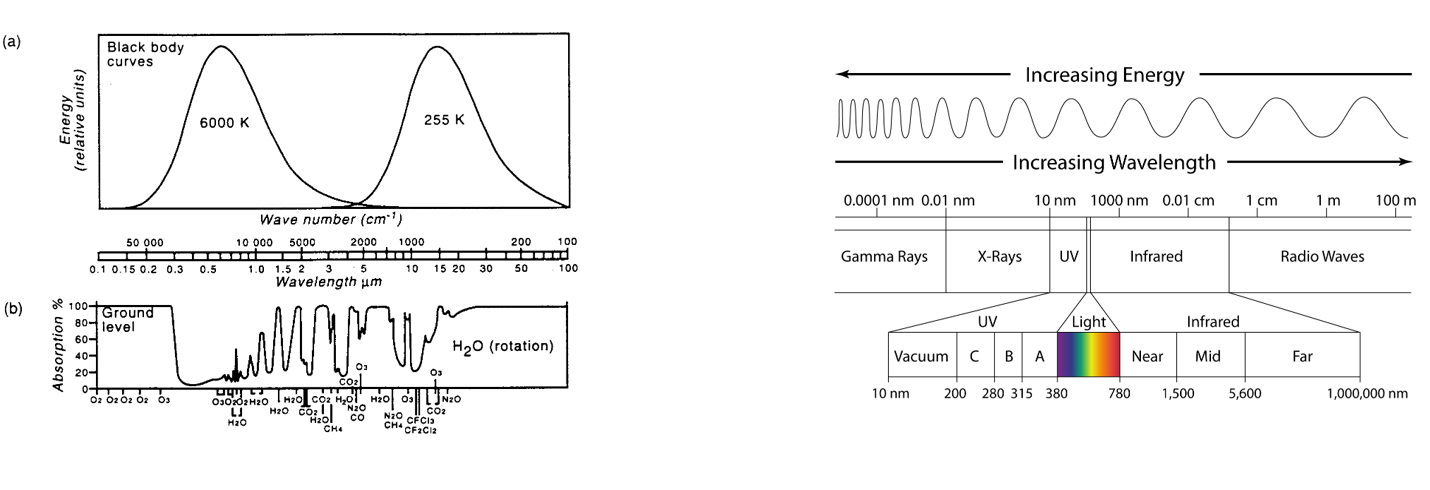
Wavelength of radiation function of the temperature (Wein’s law):
λ = b/T
Solar radiation is centred around 500nm
Terrestrial radiation at 10-15μm
The atmosphere is largely transparent to solar radiation, but absorbs terrestrial longwave radiation
Describing the position of the Sun in the sky
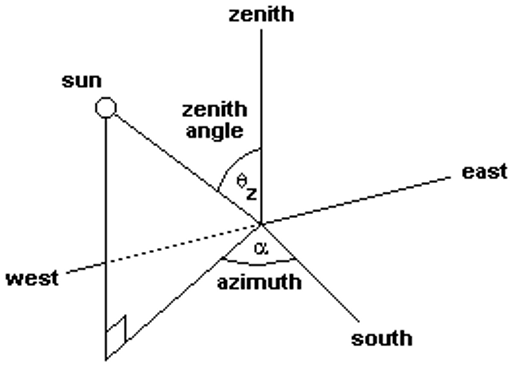
To calculate the clear sky incoming radiation we need:
latitude and longitude
zenith (deviation from vertical)
azimuth angle
depth of the atmosphere
angles of the solar collector
zenith angle
if the sun was directly overhead the zenith angle would be zero
If the sun is on the horizon or just rising or setting then the zenith angle is 90 degrees
azimuth angle
deviation from the south
it can also be north depending on which hemisphere you are and what you define at it
normally in the southern hemisphere we use north as being zero for the azimuth angle
when looking at the west where the sun sets, you’ve got an azimuth of -90 degrees.
when the sun is rising in the east you have an azimuth of positive 90 degrees
The lower the zenith angle, the less atmosphere the radiation has to pass through before it gets to the surface
Not only do you get more watts per square metre because the radiation is perpendicular to the surface but you get more radiation because of less atmosphere
When the sun is very low in the sky on the horizon, you get less watts per square metre because the radiation is coming in at quite an angle compared to the surface. Also radiation is lost through interactions with the much deeper amount of atmosphere the radiation has to pass through.
We also need to know a bit about the angles of our solar collector to know how much radiation its going to collect.
Diffuse and direct radiation
Solar radiation arrives at the Earth’s surface in two forms - direct normal irradiance (DNI) and diffuse horizontal irradiance (DHI)
Total is referred to as Global Horizontal Irradiance (GHI) = DHI + DNI*cos(Z) (where Z is the zenith angle)
PV can utilise both direct and diffuse
Concentrating Solar Thermal only uses the direct
Direct normal irradiance, which is the radiance that is coming directly from the sun. The direct beam that we would look at if we look directly at the sun and we also have the diffuse horizontal irradiance.
The diffused radiance is what we get when the sun that the solar radiation is interacts with the atmosphere, atmospheric particles refract the atmosphere and affect the radiation meaning it comes in from lots of different directions.
If we add the two together we get the global horizontal irradiance
Photovoltaics can utilise both direct and diffuse radiation
But the concentrating solar thermal can only be used for the direct part because its focusing the sun’s radiation onto a focal point
PV panels will work perfectly well on a cloudy day when you’ve got a lot more diffuse radiation and a lot less direct beam but there is less radiation available, but they still will take advantage of that diffuse radiation.
They may operate at 50% of their capacity on a sunny clear day.
Most people will orientate their panels because they want to maximise how much power they produce
Moving towards, systems with your electricity bill, where you tend to pay more for electricity during the peak period (between 4pm and 8pm)
In this case you might want to orient your panels towards the west, towards the setting sun
Things like fixed, variable and feeding tariff can affect the positioning of the solar panels
Solar will always produce power at the same time, all the solar panels will produce power at the same time across the entire city. So all panels will be producing at the same time. When it is dark they’re also all not producing power at the same time. This causes issues for the distribution networks where when all solar panels produce power at the same time it can affect the distribution network. So systems are in place to prevent you from installing too much power at certain times of the day.
Clear Sky Radiation received by a rooftop solar panel in Melbourne


Melbourne solar radiation (Global Horizontal Irradiance) - day to day variability

Average solar radiation across Australia (Wm-2)

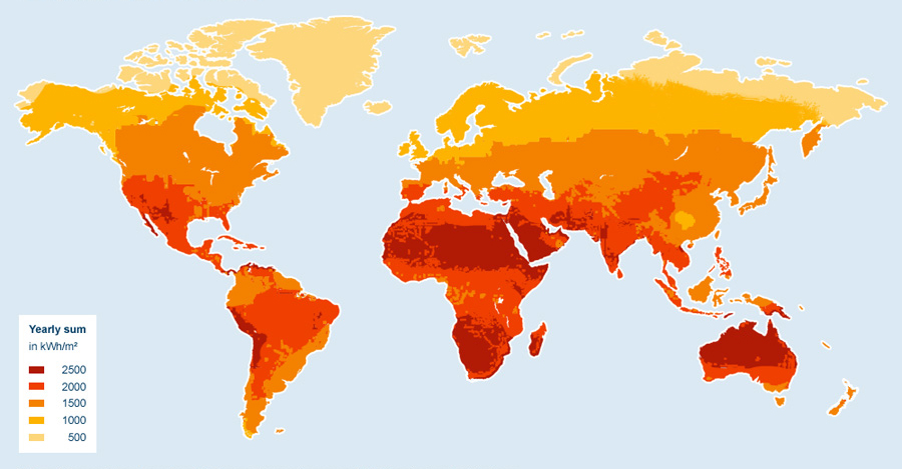
Irradiance higher/closer to the equator
Solar irradiance values differ horizontally because of clouds
when you are close to the ocean and you’ve got prevailing winds coming from the east in the tropics the airflow comes over the coast and you get lots of clouds forming as the air passes over the coast.
as the air moves across the continent, it dries out, and so we get much drier conditions on the west side of the continent and therefore less cloud cover, more solar irradiance.
If we move up into the tropics we are in the Intertropical Convergence zone, where we've got a lot of rising convection, a lot more cloud cover.
Global solar resource
Solar Photovoltaics (PV)
The only technology that converts sunshine directly to electricity
Silicon wafer
Polycrystalline silicon
easier to make, not as energy intensive but not as efficient
Monocrystalline silicon
recently improved dramatically
the efficiency gains from monocrystalline more than offset the additional costs of manufacturing monocrystalline silicion
Converts incoming photons into an electrical current with no moving parts
Thin film (CdTe,CIGS etc)
Organic PV
P-type silicon “doped” with boron or gallium
Deficit in electrons “holes”
N-type doped with phosphorous
Creates free electrons
Creates a dipole/electric field
One way flow of electrons
Silicon is a semi conductor so when a photon of radiation strikes the silicon it can excite an electron into the conduction band and causes current to flow.
Production or polysilicon
Pulverised MG-Si (metallurgical grade silicon) reacted with hydrochloric acid
Si + 3HCl → SiHCl3 + H2
SiHCl3 = Trichlorosilane (TCS) - gaseous
Purified in distillation towers
Chemical vapour deposition process
Pure polysilicon crystalises on a polysilicon ‘starter’
Recycles silicon tetra chloride
Energy cost of ~40 kWh/kg Si
Silicon does largely occur naturally so it needs to manufactured from silicon oxide.
To make metallurgical grade silicon we use a reduction reaction where we create carbon monoxide from fossil fuel and then use that to take the oxygen form the silicon oxide to produce pureish silicon
The silicon needed needs to be extremely pure so you take the metallurgical grade silicon and react it with hydrochloric acid which makes a gas trichloroethylene which can then be purified using distillation towers. We use a chemical vapour deposition process, and that gives us pure polycrystalline silicon that we can make the solar cells out of.
It is possible to recycle the silicon tetrachloride that we’ve reacted to in that purification process. But there’s still a significant energy cost here of about 40 kilowatt hours per kilogram silicon
Polycrystalline to monocrystalline silicon
But if you want to make monocrystalline silicon
And so we take some polysilicon and we melt it in a crucible in what’s known as a Czochralski apparatus
We melt this at very high temperatures, where you add doping materials at this point
We take a seed crystal of silicon and we load it into the melt, and we gradually lift the seed out and we rotate the crucible to draw out a single ingot of silicon
This crystal will have no discontinuities or impurities so it is more efficient.
Takes 30 kilowatt hours to produce

Assembly of a PV module
6 × 10 Cells are sandwiched between two layers of encapsulant, usually EVA (ethylene vinyl acetate)
When heated to ~150 degrees, EVA ‘glues’ the cells and glass layers together
This is known as ‘laminating’
Backing material can be glass or polymer material
if the corners are cutoff then its a monocrystalline silicon
Deployment
Global solar PV installed capacity (GW)

PV deployment in Australia

New capacity in Australia per year (GW)


Other types of solar technology
Concentrating PV
Uses mirrors and/or lenses to focus lots of energy onto a high efficiency solar cell
Small scale hot water
Concentrating solar thermal
Linear Fresnel
Parabolic trough
tower
Solar chimney
Concentrating PV
Uses mirrors to focus sunlight onto highly efficient PV cell
More complex, uses solar tracking
Needs to be cooled
Solar systems (Mildura, mothballed,) and now RayGen
Small scale solar thermal
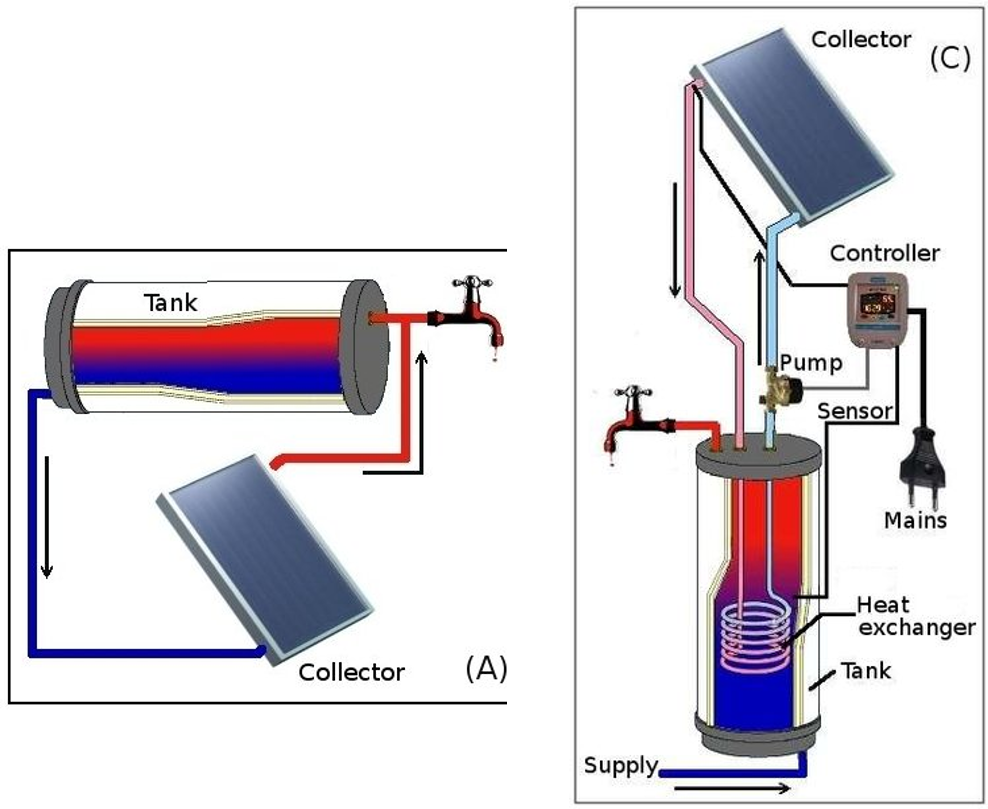
One of the simplest use of solar energy is to directly heat water
Solar collector
Flat plate (Common)
Evacuated tubes (better suited to cold climates)
Gravity or active pump
Linear Fresnel
Tracking mirrors focus sun on lines of working fluid (i.e. oil or water).
Uses boost steam production for fossil powered stations i.e. Liddell (NSW): 9 MW, Kogan Creek (QLD) : 44 MW, [neither operational], Puerto Errado (Spain): 31 MW
Parabolic trough
Similar concept to linear fresnel
sun focused onto tubes carrying working fluid (oil)
focal point narrower
therefore more efficient
and higher temperatures
Heat transfer to generate steam to drive turbine
But curved mirrors more expensive
Dominant technology type for concentrating solar thermal for electricity
Examples
SEGS (Mojave Desert, California) - 354 MW
Solnova (Sanlucar la Mayor, Spain) - 150 MW
Andasol (Guadix, Spain) - 100MW
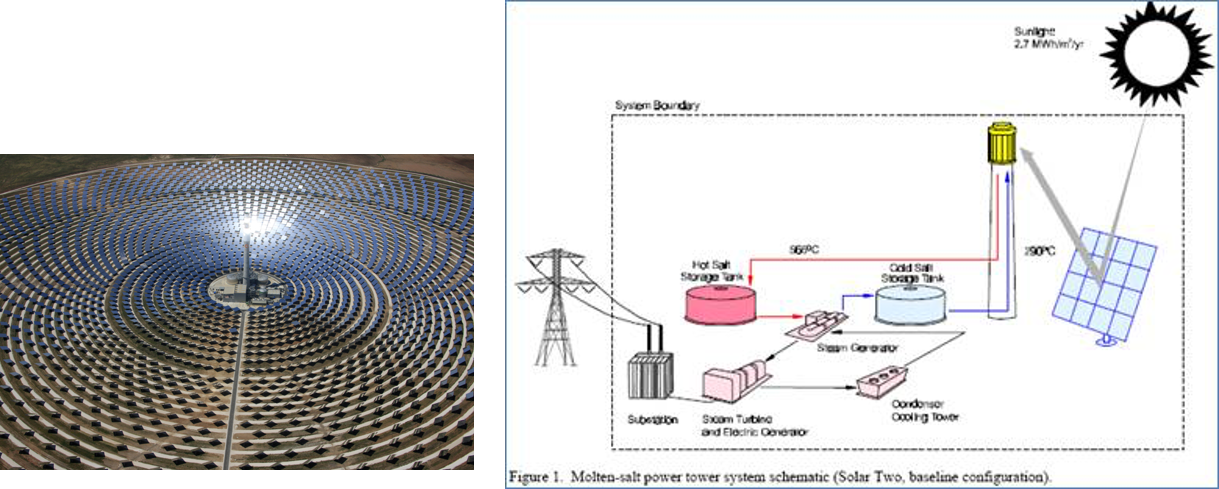
Solar Tower
Large field of solar-tracking mirrors concentrate solar energy onto central tower
Working fluid (water/molten salt) transfers heat to stream to drive a turbine
Energy storage potential
Concentrating solar power (CSP)
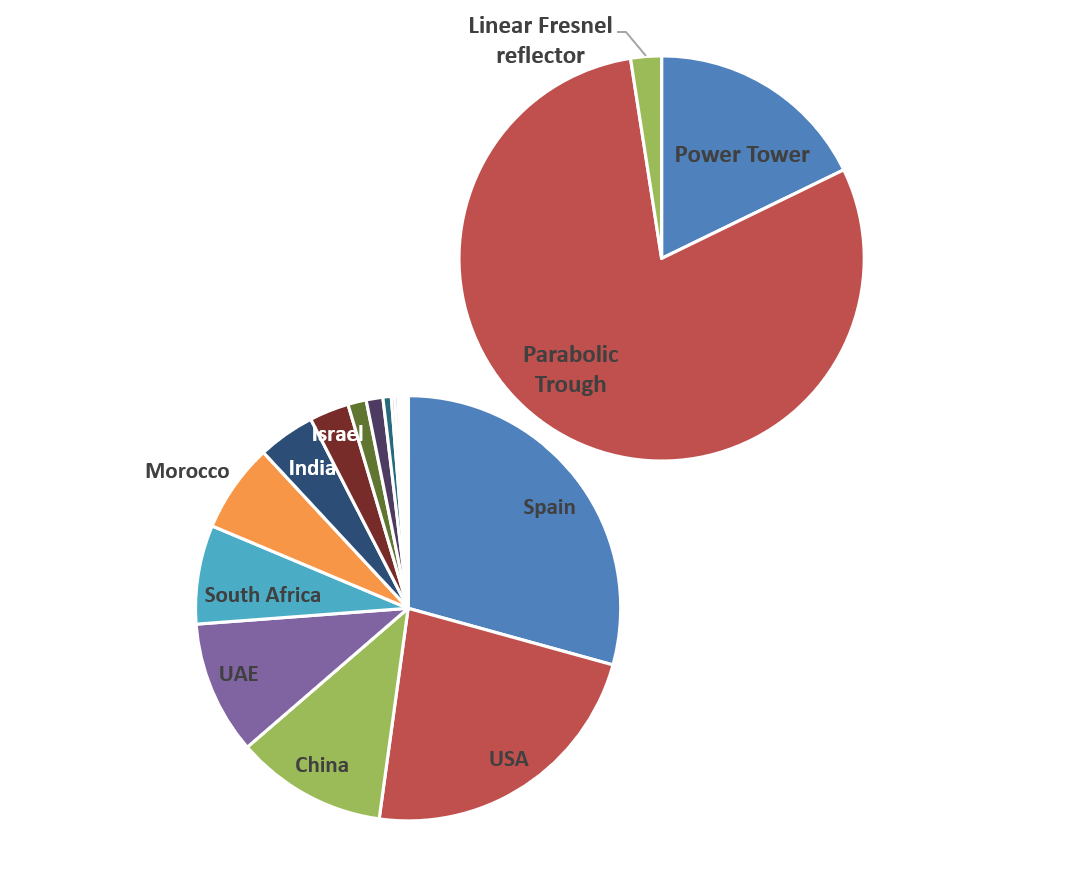
Global deployment currently at around 8GW
Majority of the parabolic trough type
Majority in Spain and the USA
Largest is Ivanpah Solar Power Facility in California - 392 MW solar tower
Sundrop project - South Australia. Growing tomatoes in the desert
Heliostat array to produce fresh water
39MWth (thermal)
Half into heating greenhouse
30% for making water
20% for electricity
Thermal energy storage tanks (water)
Compare solar with other technologies (IRENA)
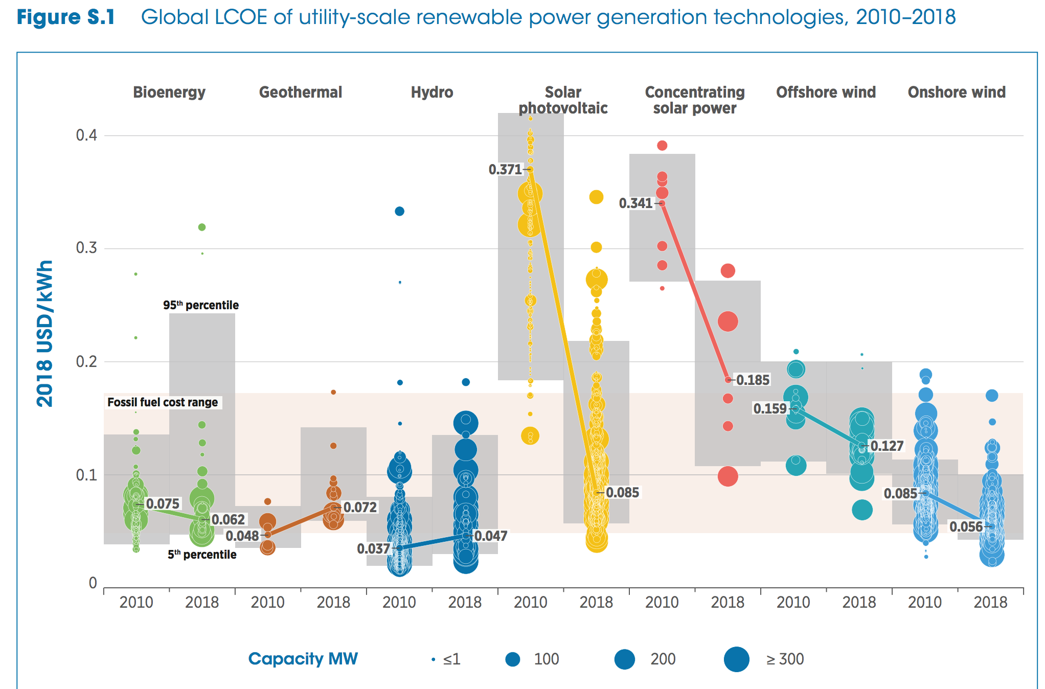
Cost versus value

Summary
Solar radiation is in the short-wave frequency
Solar PV is an elegant technology, converting solar radiation directly into an electrical current
Solar PV prices have come down dramatically
Solar thermal captures the heat of the sun
Can be dispatchable => more valuable (but currently more expensive)
Small amounts of CSP to date, struggling to compete with PV and batteries