11-7-25 Euler Method, Slope Field, Implicit Solution

Euler’s Method

How to use Euler’s Method:

  • Given y=F(x,y),y^\prime = F(x,y),        (xo,yo),(x_o,y_o),        step size h

    • xn=xn1+hx_n = x_{n-1} + h

    • yn=hF(xn1,yn1)+yn1y_n = h\cdot F(x_{n-1},y_{n-1}) + y_{n-1}

Example:

Use Euler’s method with step size 0.1 to estimate y(0.3)y(0.3) where y(x)y(x) is the solution to the initial value problem

  • y=x+yy^\prime = x+y

  • y(0)=1y(0) = 1

Gather)

  • h=0.1h=0.1

  • x=0.3x=0.3

  • xo=0x_o = 0

  • yo=1y_o = 1

  • y=y= ????

Analyze)

Use the formula:

  • x1=xo+h=0+0.1=0.1x_1 = x_o + h = 0 + 0.1 = 0.1

  • y1=hF(xn1,yn1)+yn1=0.1F(0,1)+1y_1 = h \cdot F(x_{n-1},y_{n-1}) + y_{n-1} = 0.1 \cdot F(0,1) + 1

    • F(x,y)F(x,y) is the equation given above (y=x+y)(y^\prime = x+y), so F(x+y)=x+y=0+1=1F(x+y) = x+y = 0+1=1

    • y1=0.11+1=1.1y_1 = 0.1 \cdot 1 + 1 = 1.1

  • x2=x1+h=0.1+0.1=0.2x_2 = x_1 + h = 0.1 + 0.1 = 0.2

  • y2=hF(0.1,1.1)+1.1=0.1(0.1+1.1)+1.1=1.22y_2 = h \cdot F(0.1,1.1) + 1.1 = 0.1 \cdot (0.1 + 1.1) + 1.1 = 1.22

  • x_3 =  x_2 + h = 0.2 + 0.1 = 0.3

  • y2=hF(x2,y2)+y2=0.1(0.2+1.22)+1.22=1.362y_2 = h \cdot F(x_2,y_2) + y_2 = 0.1 \cdot (0.2 + 1.22) + 1.22 = 1.362

Now that have xx at 0.30.3 in the step above, we can approximate y(0.3)y(0.3)

  • y(0.3)y(0.3) is approximately 1.3621.362


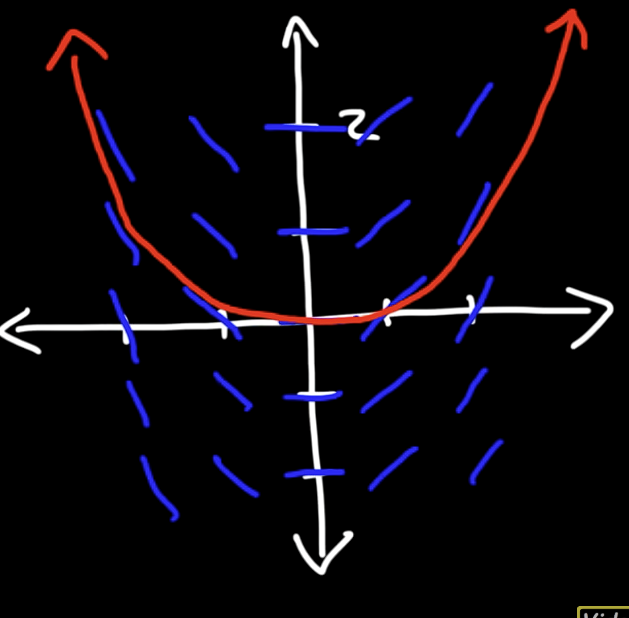
Slope Field

  • Slope symbol: mm

    • When mm =:

    • 0=0 = \rightarrow

    • \infty or 10=\frac 10 = \uparrow

    • -\infty or 10=-\frac 10 = \downarrow

Example:

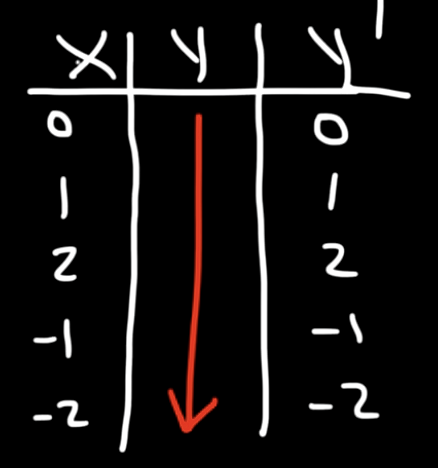
y=xy^\prime = x

Step 1) Make a table of x,y,x,y, and yy^\prime

*In this example, y is crossed out since it is not used in the equation

Who cares, you learned about this in calc I


Example: Given the equation x2+y2=100x² + y² = 100, find dydx.\frac {dy}{dx}. Calculate the slope at the point (6,8)(6,8)

ddx(x2+y2=100)2x+2ydydx=0\frac d{dx} (x²+y²=100) \Rightarrow 2x + 2y \frac {dy}{dx} = 0

2ydydx=2xdydx=2x2y=xy\Rightarrow 2y \frac {dy}{dx} = -2x \Rightarrow \frac {dy}{dx} = -\frac {2x}{2y} = -\frac xy


dydx=68=(32)(42)=34\frac {dy}{dx} = -\frac 68 = -\frac {(3\cdot 2)}{(4\cdot 2)} = -\frac 34

The slope at (6,8)(6,8) is 34-\frac 34 

Example: Given the equation x3+4xy+y2=13x^3 + 4xy + y² = 13, find dydx\frac {dy}{dx} at the point (1,2)(1,2).