Utilitarianism
the fact we’re rational is a big deal
it gives life value, thus making us infinitely valuable
Kan believes in objective moral rules to allow society to live in freedom (not to do anything we want, but to rationally pursue our own ends_
This framework suggests that moral actions are those that promote the greatest good for the greatest number, aligning individual pursuits with the collective well-being of society.
Utilitarianism Historic Background
“Utilitarianism” is an ethical theory developed by British social reformers Jeremy Bentham and John Stuart Mill in the early 19th century
Utilitarianism, as a formulated by Bentham, is a simple ethical theory with one rule: “We are morally required to do whatever produces the greatest total of pleasure minus pain.”
Inspires by this theory, Bentham and Mill advocated for social reform, public health improvements, and extension of political rights to minorities and women
Contemporary utilitarians like Peter Singer argue that this ethical theory has important implications for the morality of our lifestyle choices.
Utilitarianism: definition
Three parts:
Hedonism: a circumstance is good for an individual only insofar as it produces pleasures and happiness, a circumstance is bad for an individual only insofar as it produces pain and unhappiness
Consequentialism: we ar morally required to do what produces the best outcome
Aggregation: an outcome’s goodness or badness equals the sum of that is good for each person minus the sum of what is bad for each person
Utilitarian principles: Hedonism
“Good” for an individual is defines as “that which the individual desires or tries to gain.” “Bad” is defines as “that which the individual desires to avoid or tries to lose.”
We can desire things instrumentally or non-instrumentally
Our ultimate, non-instrumentally or non-instrumentally
Our ultimate, non-instrumental desire:
to gain pleasure and happiness
to avoid or put an end to our pain an differing
The principle of hedonism : a circumstance is good for in individual only insofar as it produces pleasures and happiness [“utility”], a circumstance is bas for an individual only insofar as it produces pain and unhappiness [“negative utility”]
Utilitarian principles: Consequentialism
Morality consists in doing good things; immorality consists in doing bad things (definition).
Utility is good; negative utility is bad (hedonic principle)
Principle of consequentialism: Morality consists in doing what leads to utility and prevents negative utility; we are morally required to do what produces the best outcome
This is a moral principle, it tells us not only what is good or bad circumstantial, but what good or bad actions are.
Utilitarian principles: Aggregation
Everyone’s well-being matters
The more well-being in the world, the better; the less pain in the world, the better
The consequence we should seek to achieve in our actions isn’t jsut our own maximization of well-being, but the maximization of well-being generally
Principle of aggregation: an outsome’s goodness or badness equals the sum of what is good for each person minus the sum of what is bad for each person
An Argument for Utilitarianism
P1: It is good to try to maximize one’s own well-bein and minimize one’s own pain or loss of well-being
P2: Other people experience well-being as well as pain and loss of well-being.
P3: No one has a rational reason to think of their own aversion to pain or attraction to well-being as generally different from others’ respective aversion/attraction toward pain and well-ebing
C1: Therefore, no one has a rational reason to consider their own pain to be generally a worse evil than others’, and no one has a rational reason to consider their own well-being to be a generally better good than others’.
P4: If multiple goods are equally valuable, then we shouldn’t treat one fo them as more valuable, then we shouldn’t treat one of them as more valuable than the others.
C2: Therefore, everyone should act ina. way that maximizes, not just their own well-being, but well-being in general, SImilarly, everyone should act in a way that minimizes, not just their own pain, but pain in general.
Utilitarianism: benefits
Highly intuitive
We commonly justify our actions by pointing to the good they did
We commonly criticize actions by showing that they caused unnecessary harm
We praise virtues that cause well-being to icnrease
Compassion, kindness, benevolence, etc.
We criticize vices, at least in part, because they cause ahrm
Greed, malice, ingratitude, etc.
Mill: a defense of utilitarianism
Problems with utilitarianism:
The problem of calculation - it’s impossible to calculate all the effects of an action
Related issue: won’t our won perceptions color what we think to be “pleasurable” and “painful?”
The problem of sadism - in utilitarianism, wouldn’t it be considered “good” if a sadist harmed another person, as long as the pleasure that the sadist got from the harm was greater than the pain suffered by the other person?
Calculating Utility
“There is not time, previous to action, for calculating and weighing the effects of any line of conduct on the general happiness. This is exactly as if any one were to say that is si impossible to guide our conduct by Christianity, because there is not time, on every occasion on which anything has to be done, to read through the Old and New testaments. The answer to the objection is, that there has been ample time, namely, the whole past duration of the human species. During all that time mankind have been learning by experience the tendencies of actions; on which experience all the prudence, as well as all the morality of life, is dependent.”
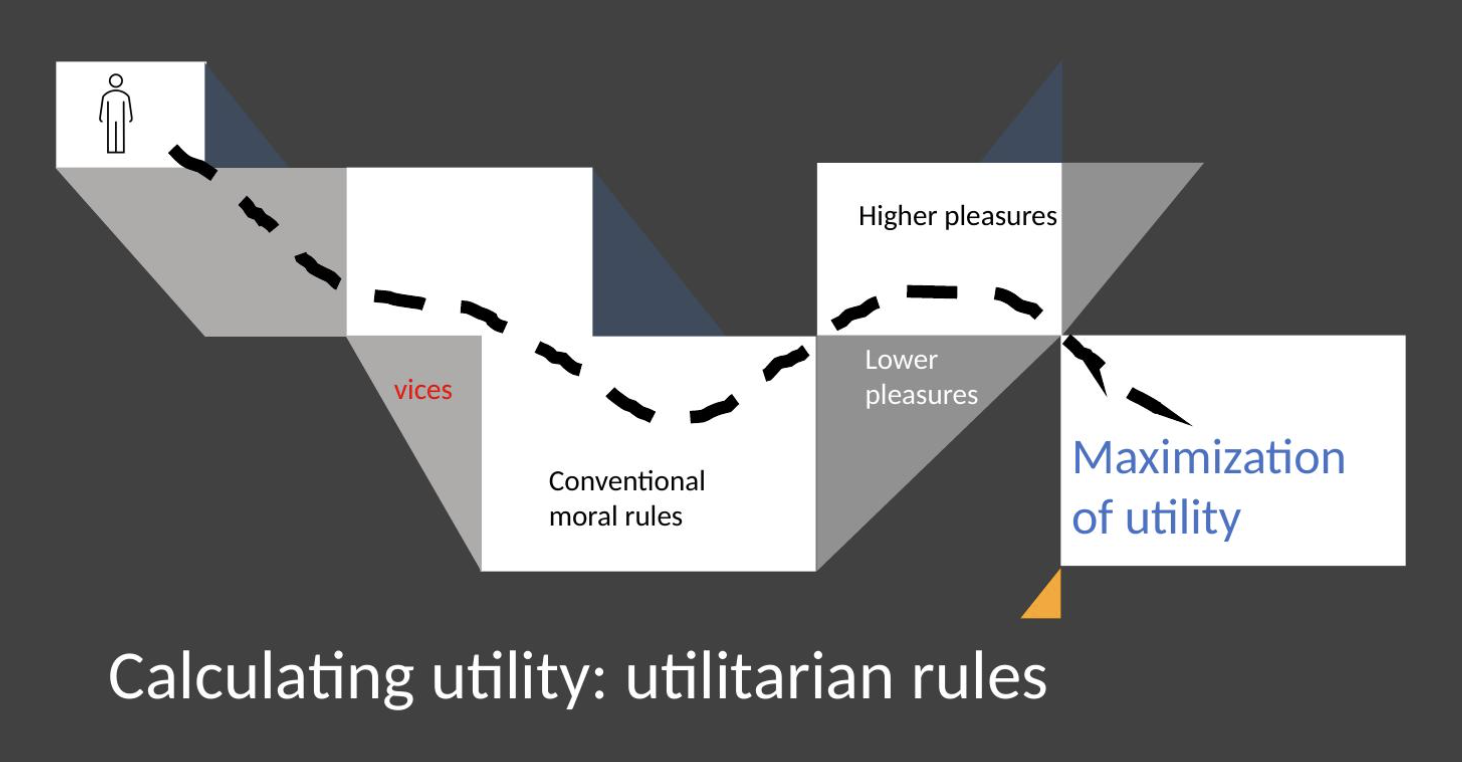
Calculating Utility: Utilitarian rules
We should not rely on the utilitarian calculus to provide guidance in every moral decision we have to make
Rather, we should adopt those conventional rules which, if allowed consistently, would lead ot an increase in overall happiness
SImilarly, we should avoid doing things that, if done by all, would lead to a lessening of overall happiness
Adopting these rules simplifies our calculation and provides generally sound advice
Kinda elitist
The Problem of sadism: higher pleasures as a way of responding?
If higher pleasures are to be preferred to lower pleasures, sadistic pleasures are to be preferred least
We have a responsibility to cultivate our tastes toward the higher, or at least the harmless, pleasures
Therefore, it is wrong to engage in genuinely sadistic pleasures, even if the pleasure generated by such pleasures outweighs, in intensity and duration, the pain generated
The utilitarian theory of punishment
If a society punishes certain actions, and that punishment leads to an increase in total happiness, then that punishment is justified under utilitarianism
The least amount of pain necessary should be inflicted to get the good outcome
Rehabilitation is to be preferred wheneverbpossible
However, any punishment can be considered good - as long as total happiness is increased
How might punishment create happiness?
A problem for the utilitarian theory of punishment?
Take an innocent person, kevin, who has been credibly accused of a terrible crime (say, child abuse). The judge privately knows that Kevin is innocent and that the real criminal is dead.
Assume that putting Kevin in prison will deter offenders and give closure to victims of child abuse
For utilitarians, his punishment is just
But if Kevin is not responsible for the evil actions, how can it be just to punish him?
Deontology and Punishment
Deontology tells us why:
The punishment is unjust because the maxim underlying it is not universalizable. “Put innocent people in prison when it makes society more just and happier” - if we all acted on this principle, this would result in a much less just and happy society!
More importantly, the punishment violates the principle of humanity: it treats the offender as a means to the public good, rather than respecting their dignity as an end in themselves.
Bentham on the Principle of Utility
The primary desire for human beings is to gain pleasure and avoid pain
Even when a human being does something painful, it is because they hope to gain some pleasure or avoid some worse pain.
If an action is “good” overall for a human, it tends to promote their pleasure. If an action is “bad” overall for a human, it tends to promote their pain
A community is just a collection of humans
Therefore, if an action is “good” for a community, then it tends to maximize pleasure in the community, and if an action is “bad” for a community, it tends to create more pain.
How to be a utilitarian
Sum up all the values of all the pleasures on the one side, and those of all the pains on the other. The balance, if it be one the side of pleasure, will give the good tendency of the act upon the whole, with respect to the interests of that individual person; if on the side of pain, the bad tendency of it upon the whole.
Take an account of the number of persons whose interests appear to be concerned; and repeat the above process with respect to each. Sum up the numbers expressive fo the degrees of good tendency, which the act has, with respect to each individual, in reguard to whom the tendency of it is good upin the whole: do this again with respect to each individual, in reguars to whom the tendency of it is bad upon the whole. Take the balance which if on the side of please, will give the general good tendency of the act, with respect to the total number or community of individuals concernes; if on the side of pain, the general evil tendency, with respect to the same community.
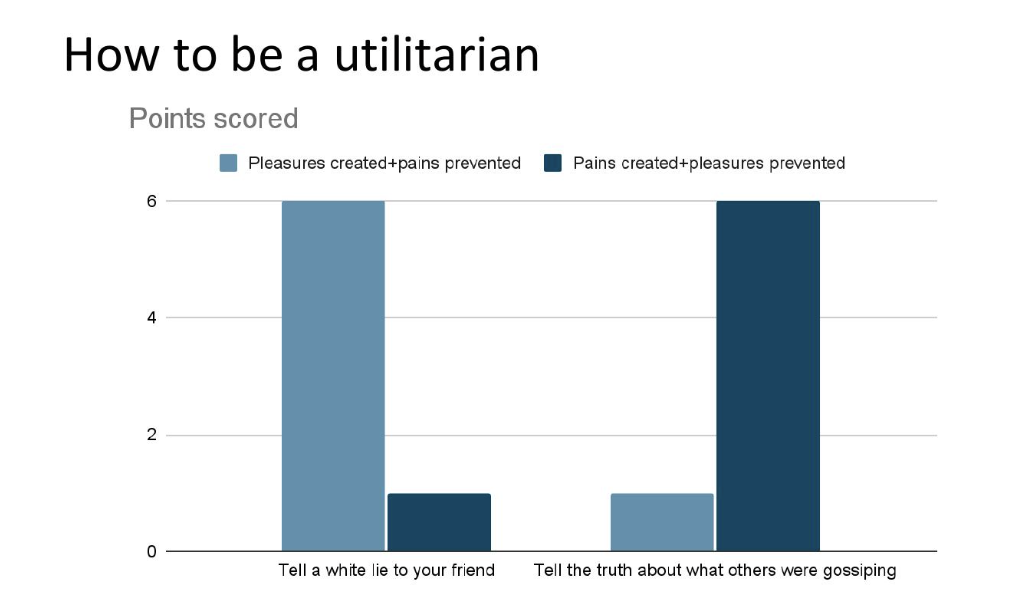
The science of creating the best outcome
the problem of the friend problem
closeness to the friend being gossiped about
you can address the group
you can tell your friend if they would want to hear it but it does depend on the person
Would the friend prefer to know
sometimes what a person woould prefer isn’t what’s best for them
Utilitarianism in Practice
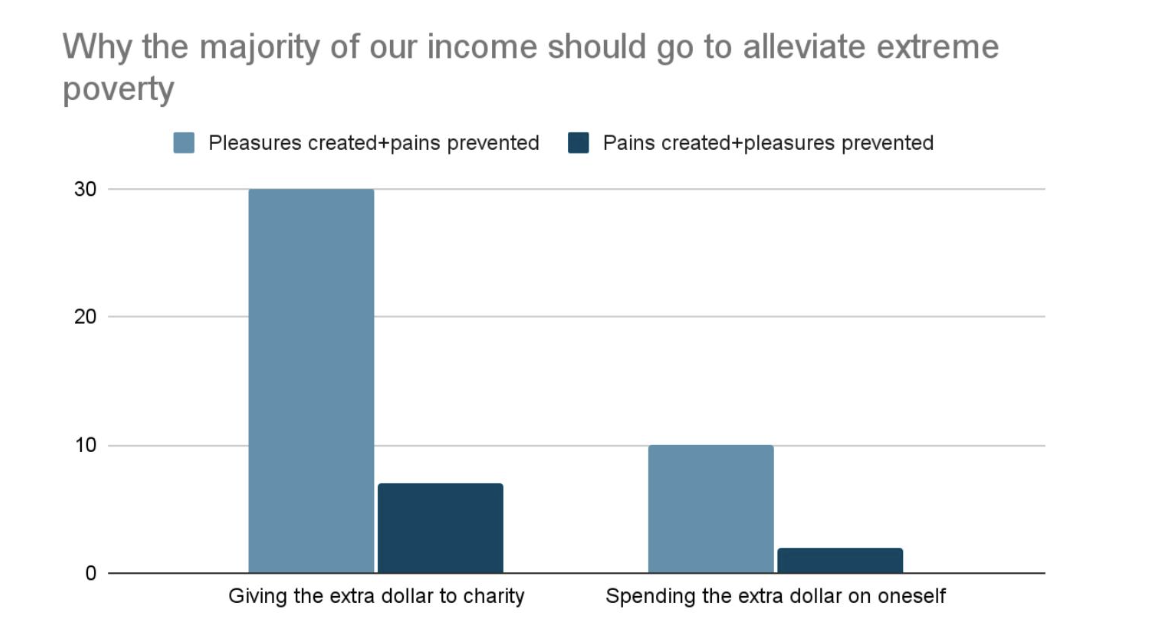
The moral imperative to alleviate suffering
If you were to see a little boy drowning, then you would be obligated to rush into the water to save him, even at the sacrifice of your clothes/comfort
A starving child’s life in another country is no less important than the life of such a little boy
Therefore, you are obligated to do what you can save the lives of starving children, even if it means sacrificing personal comfort.
Singer on utilitarianism and “charity”
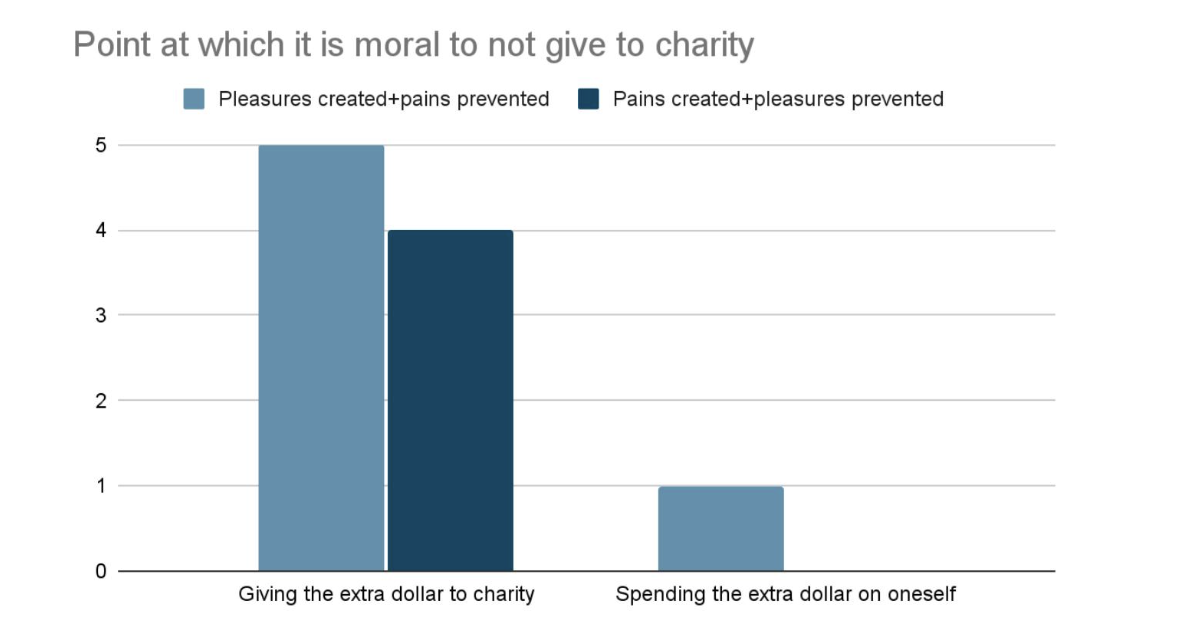
If we have an obligation to give money to alleviate extreme poverty, why don’t we think of ourselves as having this obligation?
Singer’s hypothesis:
Society’s norms don’t exist to tell us what is moral. They exist soley to maintain a tolerable social existence.
Some social norms are also moral norms, but not all moral norms are social norms
“We ought to give until we reach the level of marginal utility - that is, the level at which, by giving more, I would cause as much suffering to myself or my dependents as I would relieve by my gift. This would mean, of course, that one owuld reduce oneslef to very near the material circumstances of a Bengali refugee.” Is this a plausible moral conclusion?