multi store model of memory
Atkinson and Shiffrin 1968
describes the process of memory in three stages: sensory memory, short-term memory, and long-term memory.
linear model (info flows through system 1 direction)
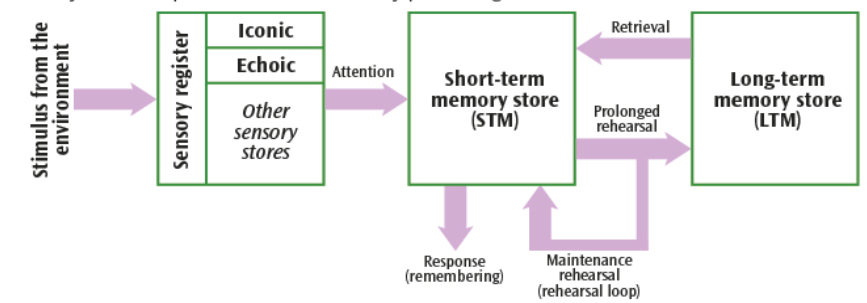
Sensory register
Capacity: Limited to what the senses can perceive at any moment.
Duration: 0.5 seconds (Sperling)
Coding: sense specific → iconic memory (code visual info) + echoic memory (code auditory info)
Sperling
participants shown 12 items (digits/letters)
asked to write down all items or row indicated after a tone
recall worse when asked to write down all digits (around 42% recalled) than when asked to write down one row (around 75% recalled)
suggests the info had decayed in iconic sensory register before all written down, indicating very short duration
Short term memory
Capacity: 7±2 items (Miller's Law) → supported w Jacobs’ digit span test → Miller suggested this could be improved by chunking
Duration: 18 seconds without rehearsal (Peterson and Peterson)
Coding: acoustically
Jacobs digit span test (1887)
participants shown sequences of digits to repeat back in same order
length of the digit sequence increased progressively until participant can no longer accurately recall digits.
found that the average digit span was around 5-9 digits → supports Miller's Law
valid study bc replicated in more controlled studies (Bop and Verhaeghen 2005)
Peterson and Peterson
24 students
participants shown trigram (3 letters)
asked to count backward by threes from given number for varying intervals (3, 6, 9, 12, 15, 18 seconds) to prevent rehearsal of trigram
After each interval, asked to recall trigram
found after 3 seconds, recall around 80%
after 18 seconds, it dropped to about 10%
concluded duration of STM decreases without rehearsal (eg disrupted by interference like counting)
without rehearsal, duration around 18 seconds
however, artificial stimuli→ memorising trigrams not everyday use of memory → lack external validity
Long term memory
Capacity: unlimited
Duration: lifetime (Bahrick)
Encoding: semantically (meaning)
if we want to recall information from LTM, need to be transferred back to STM by retrieval
Bahrick 1975
investigate how well ppl can remember faces + names of classmates in high school over long periods of time
392 American participants aged between 17-74
used high school yearbooks
recall tested by:
photo recognition test → matching faces to names using 50 photos including some from participants high school yearbook
free recall test → writing down as many names remembered from graduating class
photo recognition test findings
Participants tested within 15 years of graduation → about 90% accurate in photo recognition.
After 48 years, recall declined to about 70% for photo recognition
free recall test findings
Free recall was less accurate than recognition
about 60% after 15 years, dropping to 30% after 48 years
shows LTM may last up to a lifetime
high external validity → tested meaningful memories
Evaluation of the Multi-Store Model Of Memory
Strengths:
Research support : Baddley (1996) → STM and LTM coded differently
gave 4 groups different lists of words to remember:
→ Group 1: acoustically similar (cat, cab, can)
→ Group 2: acoustically dissimilar (pit, few, cow)
→ Group 3: semantically similar (great, large, big)
→ Group 4: semantically dissimilar (good, huge, hot)
When asked to recall immediately (recall from STM) did worse w acoustically similar words
When asked to recall after time interval (retreive from LTM + recall) did worse w semantically similar words
Findings suggest info is coded acoustically in STM and semantically in LTM
however later research evidence suggest STM + LTM being unitary stores too simplistic as we have diff types of LTM (episodic, semantic, procedural) and STM
however, artificial stimuli→ words may have no personal meaning to participants → MSMM not valid model of how we use memory in everyday lives
Research support : Case of HM → STM and LTM are separate and independent
after surgical procedure, removing hippocampus from both sides of brain to help with severe epilepsy, patient HM experienced amnesia
→ His memory assessed 1955, he thought it was 1953
→ When STM tested → scored high
→ When LTM tested → scored badly and never improved
suggests STM and LTM are separate and independent as HM damaged one of these stores with the other remaining unaffected, validating framework of memory proposed by Atkinson and Shiffrin
however, case study → individual experience → cant generalise or repeat
Weaknesses:
Case of KF → suggests there could be another STM store for non verbal sounds
had amnesia
STM bad when digits read out to him but fine when he read digits to himself
suggests there could be another STM store for non verbal sounds
goes against MSMM → MSMM says there are only unitary stores that process diff types of info
Emphasis of rehearsal
MSMM says the more is info rehearsed, more likely to transfer to LTM (prolonged rehearsal)
Craik + Watkins → suggest type of rehearsal more important than amount : maintenance rehearsal and elaborative rehearsal
maintenance rehearsal → repeating info to keep it in STM → if rehearsed long enough, passes into LTM
elaborative rehearsal → link new knowledge to existing knowledge → means info can be transferred to LTM without prolonged rehearsal
MSMM does not fully explain how long term storage achieved
The cognitive experiments testing aspects of MSMM r artificial
eg use meaningless digits (Jacobs) and words (Baddley)
lacks external validity
results collected in lab environment may not be generalisable to naturalistic situations
lack mundane realism as experimental tasks arent good representations of how ppl use memory in real life scenarios