rocks
ROCK CYCLE AND IGNEOUS ROCKS
Rock vs. Mineral:
Rocks are aggregates of one or more minerals or biochemical components (such as plants or fossils)
A mineral is a naturally occurring, inorganic crystalline solid with a fixed chemical formula.
Minerals have a set of diagnostic physical properties that can be used to identify the minerals, for example: hardness, cleavage, fracture, magnetism, color, luster.
Examples of minerals are quartz, feldspar, mica, amphibole, pyroxene, olivine, calcite, and halite.
The Rock Cycle:
The rock cycle (figure 2) is a summary of rock forming processes that occur within the Earth and on the Earth’s surface.
The three main rock types illustrated in the rock cycle (igneous, sedimentary, and metamorphic) form through very specific geologic conditions.
Furthermore, through specific processes such as weathering, lithification, metamorphism, melting, or crystallization, one type of rock can alter into another. In other words, rocks are recycled and formed into other rocks.
They are connected by the many geologic processes such as weathering, burial and melting. The rock cycle does not proceed in one direction. Each rock type is created and recycled by the various processes (see arrows) that connect them. Notice the conditions that create sediment occur on the earth’s surface while the conditions necessary to create both Igneous and Metamorphic rocks occur within the earth.
IDENTIFYING ROCKS:
IGNEOUS ROCKS:
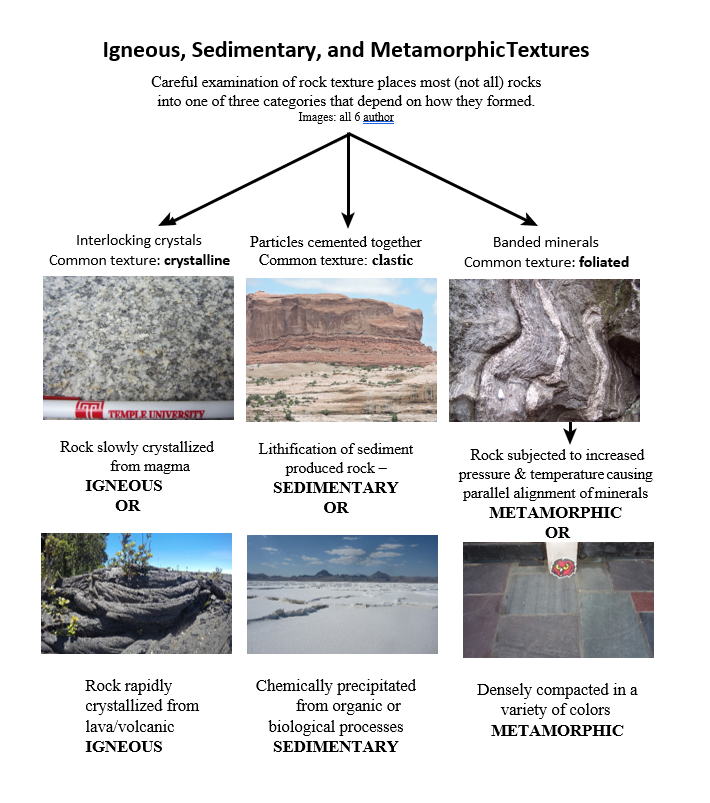
Igneous rocks form from magma (molten rock) that has either cooled slowly underground (Granite) or cooled quickly at the surface after a volcanic eruption (Basalt). As a result of a variety of cooling environments Igneous rocks have a variety of textures and grain sizes.
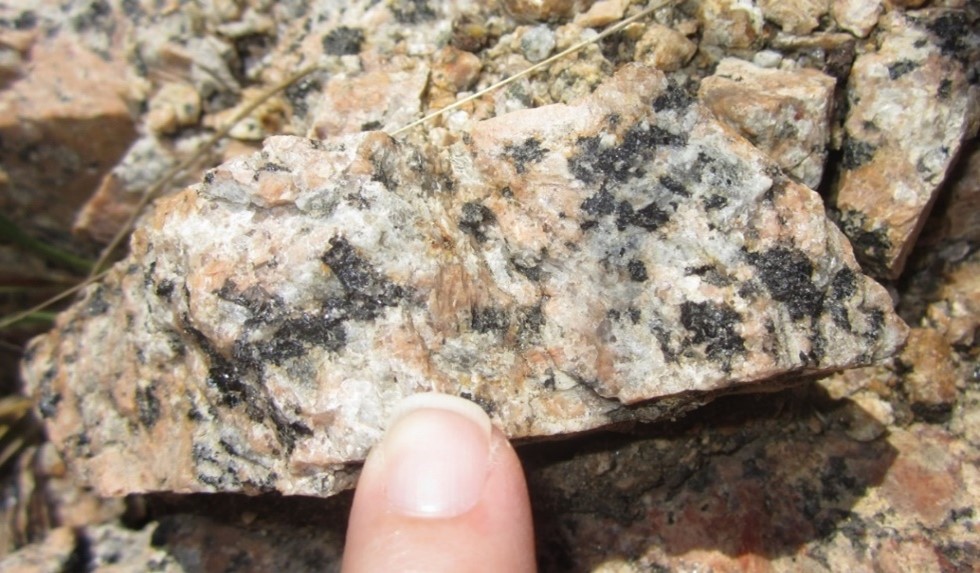 Slowly cooled large crystalline grains of Granite.
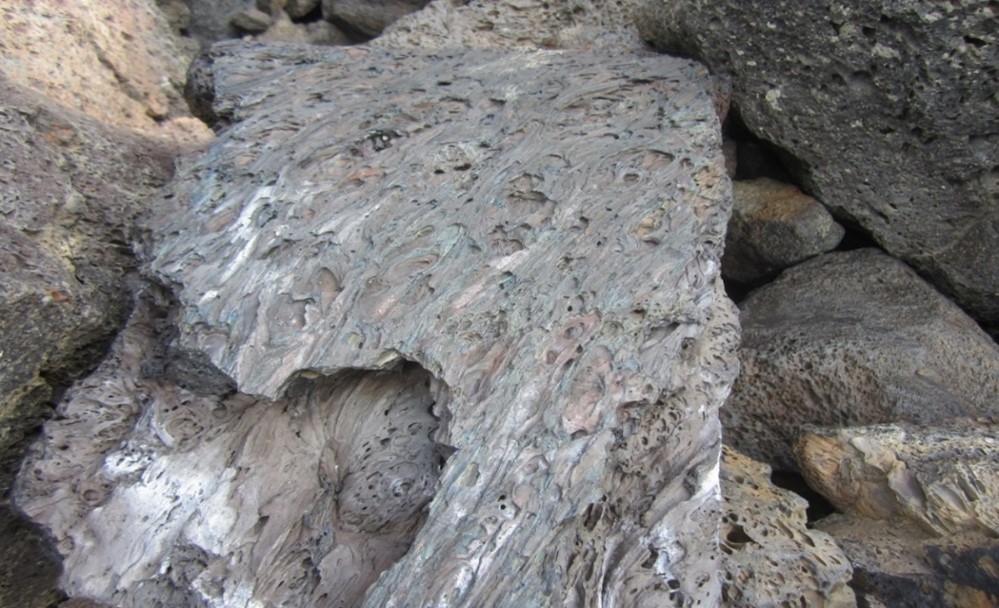 Volcanic Basalt showing stretched vesicular texture formed from volcanic eruption and the release of gases as the lava cools on the surface very quickly.
 The distinguishing feature of most igneous rocks is the large (visible) interlocking/crystalline arrangement of their mineral grains OR the fine grained-ashy texture indicative of a volcanic eruption.
When molten rock, (magma) cools slowly deep inside the Earth the grains can grow large or visible to the unaided eye.
When molten rock, (lava) erupts on the surface it may produce a very fine-grained (not visible to the unaided eye) vesicular, ashy or glassy texture.
SEDIMENTARY ROCKS
Sedimentary rocks, such as Sandstone, form when the weathered products (silt/sand/pebbles) of other rocks accumulate at the surface and are then buried by other sediments. The sediment produced by surface weathering is transported by erosional agents such as wind, water or glaciers and deposited in new locations, such as lakes, beaches, and deltas (figure 6).
The transportation and deposition of the sediment can leave distinctive layers that can aid in the identification of sedimentary rocks.
Fossils and organic material (shells) can also accumulate in sedimentary rocks. If the rock looks like it is made up of bits of silt or sand or fossils or has depositional layers it may be a sedimentary rock (figures 7 & 8).
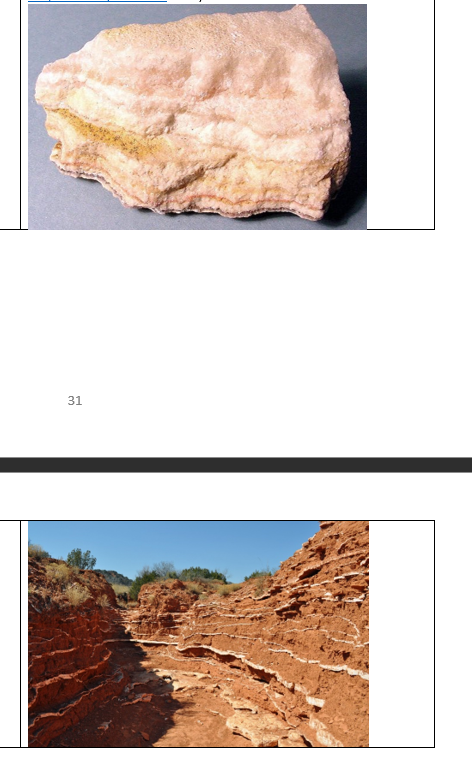
Many sedimentary rocks form in marine environments such as lakes and the oceans. Evaporation of the water can leave deposits of the formerly dissolved elements such as minerals like gypsum and halite
METAMORPHIC:
Metamorphic rocks form when either igneous, sedimentary, or metamorphic rocks are heated and squeezed to the point where some of their preexisting minerals become unstable and new minerals form to create a different type of rock.
Forces such as heat and pressure often create a unique banding texture as the rock is being folded and reformed (Figure 10). This texture is called foliation and looks a lot like layers.
Also, certain unique minerals may form during the heating and pressure process such as the micas and possibly garnets.
These new minerals are known as Index minerals and can indicate the range of temperature and pressure needed to form the new metamorphic rock. Plate tectonic forces are the primary mechanism leading to metamorphism.
IGNEOUS ROCKS:
Molten rock underground is called magma, and molten rock that erupts at the surface is called lava. Lava and pyroclastic ash are associated with surface volcanoes. Cooling of magma and lava produces igneous rocks
Magmas can flow easily or sluggishly, and this characteristic is described as their viscosity (resistance to flow). High viscosity (or viscous) magmas resist flow and move slowly. Low viscosity magmas have low resistance to flow and move easily
Viscosity is controlled by the magma’s chemical composition, fluid vs. mineral content, and temperature. For example, magma viscosity increases as it cools (the magma thickens). Think of the viscosity of a magma or lava as its thickness.
Igneous Rock Classification
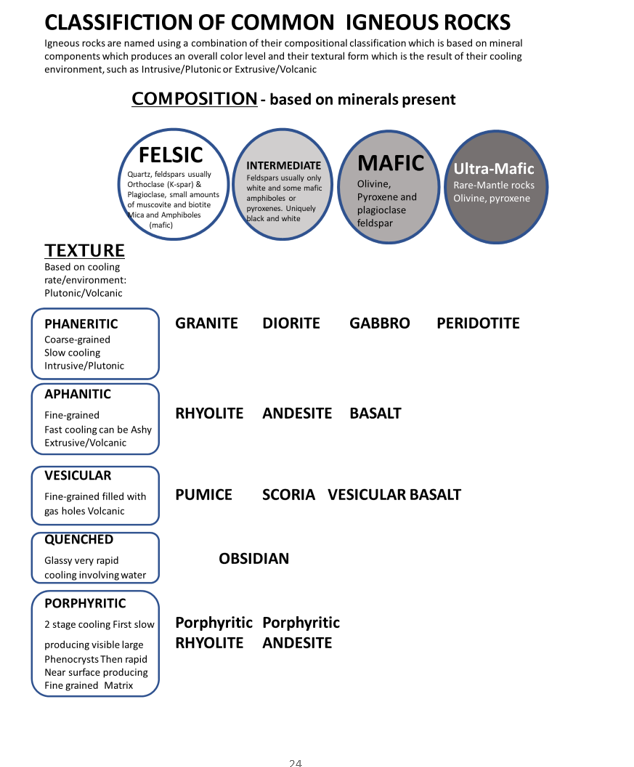
Igneous rocks are typically classified by TWO features:
their texture (crystal size and arrangement)
The texture of an igneous rock reflects its cooling history.
chemical composition (minerals present).
The composition of igneous rock, to a large degree, reflects its plate tectonic setting during formation as seen in the distinct minerals grouped together.
Igneous Textures
The texture of an igneous rock reflects how the magma cooled and crystallized to form minerals. The size of the crystals depends on the cooling rate:
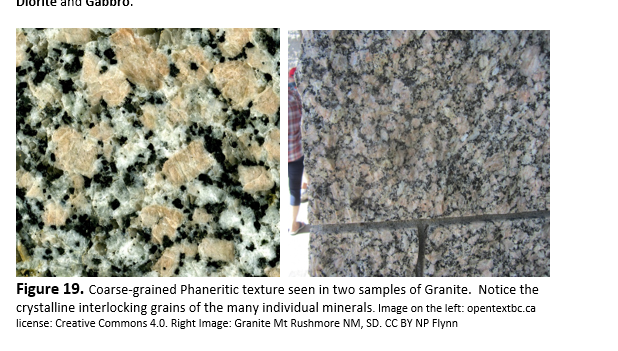
Coarse-grained textures (Phaneritic) indicate slow cooling (tens of thousands of years) underground.
Interlocking crystals (typically 1-10 mm) that can be seen with the naked eye. Great thickness of overlying rock insulated the magma, so that it cooled slowly to form large crystals. Igneous rocks exhibiting this texture cooled deep underground
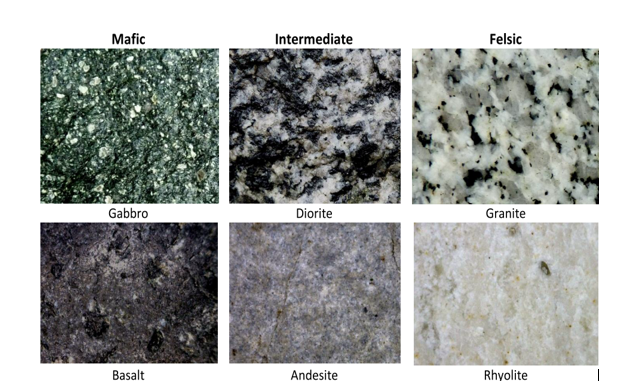
Examples of common Phaneritic – course-grained igneous rocks include: Granite, Diorite and Gabbro.
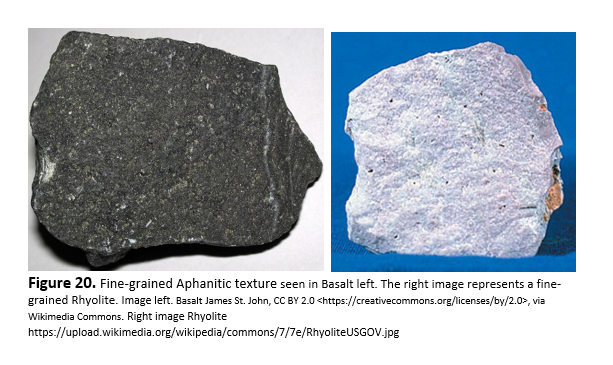
Fine-grained (Aphanitic), pyroclastic (Ashy), Vesicular and glassy (Quenched) textures indicate fast cooling (days to hours or minutes) on the Earth’s surface and produces a wide variety of appearances.
Small interlocking crystals (typically <1 mm), which are too small to see with the naked eye (a microscope is necessary). This fine-grained texture can cause the rock to look very uniform in color.
Most fine-grained igneous rocks cooled at the Earth’s surface after being erupted from a volcano, producing ashy material. Fine-grained textures can also result from shallow intrusions, or if magma is injected into fractures in cooler rock. These injections are called dikes or sills
Examples of fined-grained aphanitic igneous rocks include: Rhyolite, Andesite and Basalt
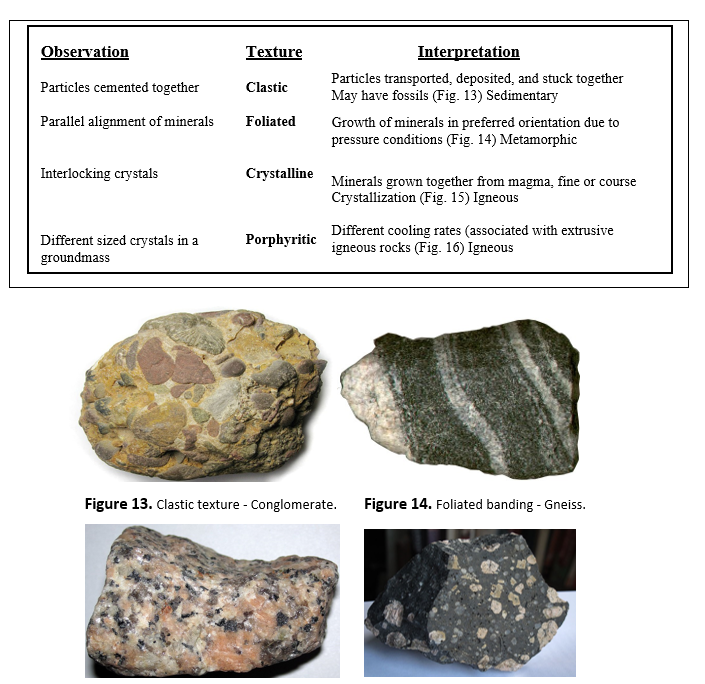
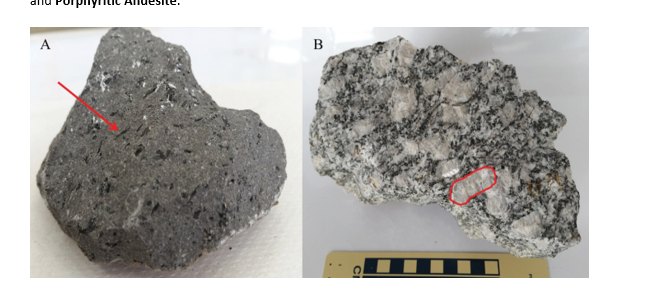
Porphyritic, (a two-stage cooling process), indicates slow initial cooling underground, followed by rapid final cooling on the surface.
An igneous rock texture that is composed of two different distinct crystal sizes
Specifically, crystals >2mm in size are called phenocrysts, and they are embedded in a groundmass made of fine-grained crystals (often called a matrix).
Porphyritic rocks are interpreted to have undergone two stages of cooling: the phenocrysts would form while the magma is slowly cooling deep underground, and, when the magma erupts, the groundmass cools quickly when exposed at the surface.
Examples include Porphyritic Rhyolite and Porphyritic Andesite.
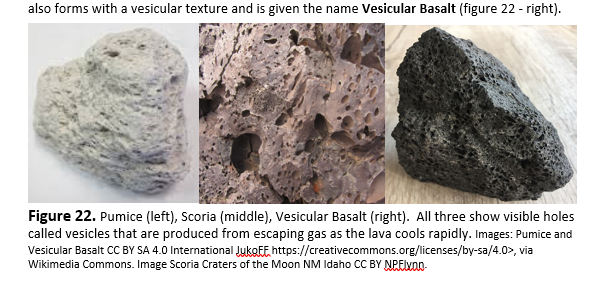
Vesicular: Vesicles are holes in volcanic rock that form as lava solidifies around gas bubbles.
These are good indicators of volcanic rocks (plutonic rocks don’t have vesicles).
The size of the bubbles is often dictated by the viscosity of the magma, with bigger bubbles forming in less viscous magma because they can coalesce more easily.
Examples of this texture are seen in Pumice and Scoria
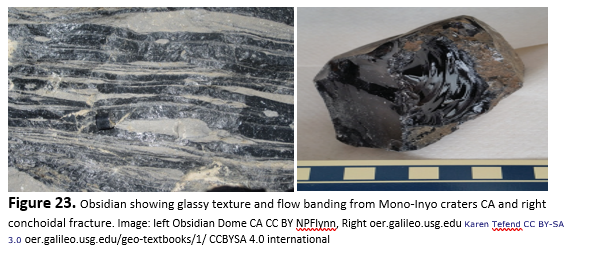
Glassy (Quenched): Volcanic glass is called Obsidian and lacks visible crystals.
Rocks that are very glassy show a characteristic conchoidal (curved) fracture pattern (figure 23). Glassy texture forms when lava cools so quickly or is so viscous that ions cannot migrate through the melt and become arranged in an ordered pattern to form crystals.
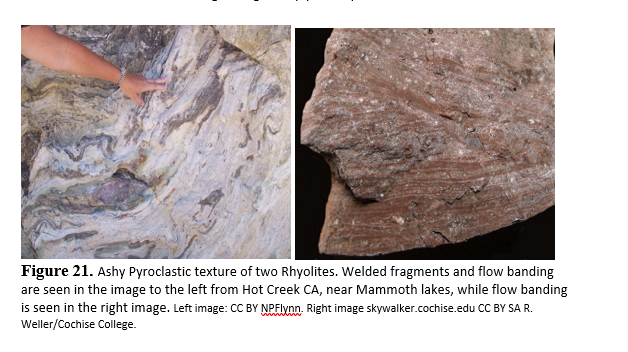
Pyroclastic (Ashy): When molten material is erupted from a volcano it can solidify before it hits the ground, yet still be hot enough to weld to other erupted material
This forms a rock called tuff, which is composed of fragments (of other rocks) and crystals, all embedded in a matrix of ash. A light weight ashy/powdery rock can also form.
Igneous Compositions
These categories are ultra-mafic (rare on the surface – abundant mantle rocks), mafic (less silica, more Mg and Fe), intermediate, and felsic (more silica, less Mg and Fe)
IGNEOUS COMPOSITION | MINERAL CONTENT | |
Ultra-Mafic -rare on the surface (not shown in figure 26) | Olivine, possibly some pyroxene, and/or Ca Feldspar | |
Mafic | Pyroxene, Ca feldspar, possibly Olivine | |
Intermediate | Feldspars, Amphibole, Biotite mica | |
Felsic | Quartz, Feldspars, Muscovite mica, Amphibole |
SEDIMENTARY ROCKS AND THEIR ENVIRONMENTS
Sedimentary rocks are the pages in which Earth’s history is written. They contain powerful environmental indicators (glacial extent, shoreline locations), traces of life, and chemical signatures that can inform us about a wealth of subjects from the occurrence of ancient catastrophes (massive floods), overall climate, to the productivity of life.
MAKING SEDIMENT FIRST: Weathering of Preexisting rocks
Sedimentary rocks are formed by the weathering, erosion, deposition, and lithification of sediments. Basically, sedimentary rocks are composed of the broken pieces of other rocks (sediment).
The obvious place to start this lab is a discussion of how rocks are broken down, which is a process called weathering. There are two basic ways that weathering occurs in nature.
First, rocks can be physically broken into smaller pieces (imagine hitting a rock with a hammer), which is called mechanical weathering
Alternatively, rocks can be broken down and altered at the atomic level (imagine dissolving salt in a glass of water), which is called chemical weathering. There are multiple ways each type of weathering can occur
MECHANICAL WEATHERING:
The most prevalent type of mechanical weathering is the collision, breaking, and grinding of rock by the movement of gravity, water, ice or air.
Several common methods of mechanical weathering are: Frost Wedging, Thermal Expansion, Unloading or Exfoliation and Biological mechanical weathering.
When sediments produced mainly by mechanical weathering turn into solid rock, they produce a classification of sedimentary rocks called Detrital or Clastic. They are made up of small bits of sediment compacted and cemented together.
Frost wedging occurs when water seeps into cracks in a rock and freezes
Thermal expansion weathering occurs when rocks are exposed to extreme heat and cold. This repeated expansion and contraction as the rock heats and cools can cause a rock to break
Unloading or exfoliation breakage can occur within rocks when they cool very quickly or experience extreme reduction in pressure
Biological mechanical weathering from plants, animals, and humans can cause significant amounts of weathering. The small roots grow and expand into fractures.
Over time rocks can be split apart by the expanding power of tree roots (figure 7).
CHEMICAL WEATHERING
Rocks can also be chemically weathered, most commonly by one of three processes: Dissolution, Hydrolysis and Oxidation.
When chemically weathered materials form a solid rock, they form a group of sedimentary rocks called Chemical or Evaporites.
If significant amounts of biological materials such as fossil shells or organic material is present a group of sedimentary rocks called Bio-Chemical rocks is formed.
Dissolution. A mineral or rock is broken apart by water into individual atoms or molecules. You are familiar with this process if you dissolve sugar in a hot beverage.
Hydrolysis occurs when a hydrogen atom from a water molecule replaces the cation in a mineral; this normally alters minerals like feldspar into softer clay minerals such as kaolinite.
Oxidation is when oxygen atoms (found in air and water) alter the valence state of a cation (a positively charged atom), this normally occurs in metal bearing iron-rich minerals such as magnetite.
Chemical and mechanical weathering can work together to increase the overall rate of weathering. Chemical weathering weakens rocks making them more prone to breaking physically, while mechanical weathering increases the surface area of the sediment, which increases the area exposed to chemical weathering (figure 12). Therefore, environments with multiple types of weathering can erode very quickly.
The main products of mechanical and chemical weathering:
Lithic (rock) fragments: broken pieces of parent (pre-existing) rock. Produces a wide range of sediments such as silt, sand, pebble sized particles of varying materials
They form a variety of sedimentary rocks such as Shale, Mudstones, Sandstones, Breccia and Conglomerates.
Resistant mineral grains: some minerals are relatively stable at the Earth’s surface and are resistant to weathering processes.
Quartz is the most common resistant mineral, and van vary greatly in their appearance (figure 14). Quartz mineral grains are a main component of most Sandstones. Ions dissolved in groundwater can precipitate and cement particles together as seen in most Sandstones and Conglomerates
Clay: clay is formed by the chemical weathering/breakdown, specifically hydrolysis, of feldspar minerals
Besides being a mineral, the term clay also refers to sediment that is smaller than 1/256 mm (figure 15). The particles are so small that you can barely detect them as individual grains if you rub them between your fingers
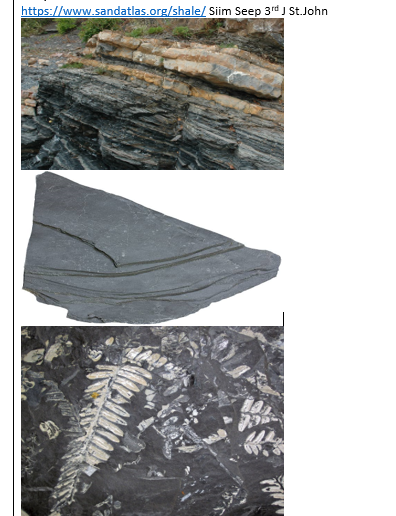
Clay sized particles form the basis of Shale and Mud stones.
Ions in solution: chemical weathering of non-resistant minerals releases ions such as Si, Ca, Na, Fe, Mg.
These ions are present in lakes, rivers, groundwater, and the ocean where chemical sedimentary rocks form by precipitation or evaporation.
Biological and Chemical Material:
Many weathered sediments occur in marine environments, such as the ocean or terrestrial environments such as lakes or swamps. As a result, biological organisms are often a small or large part of some sedimentary rocks
Fossils and shell fragments when mixed with limestone material can produce fossil Limestones. Limestone can also form from non-biological marine conditions and may not contain fossils. Limestones are the most common sedimentary rock and have a wide variety of colors and overall appearances.
Transportation and Deposition of Sediment
Weathering products that are eroded from their source can be transported by moving water, ice, or wind to a new location.
The size of the carried sediment depends on the speed and type of material carrying the sediment such as ice, water or wind
The shape, round or angular also indicates if the sediment has been transported to a nearby deposition or transported a great distance.
The sorting of the grains can also tell us about the transportation and deposition of the sediments.
Grain size of a sedimentary rock can be interpreted to indicate several things:
The energy of the environment at the time of deposition. The higher the energy (e.g. the swifter the water), the larger the grain size that can be moved.
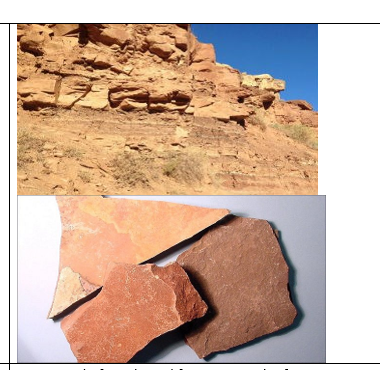
Clay and silt sized particles will settle out of transportation only in the lowest energy environments such as lakes or deep marine setting, producing Shales.
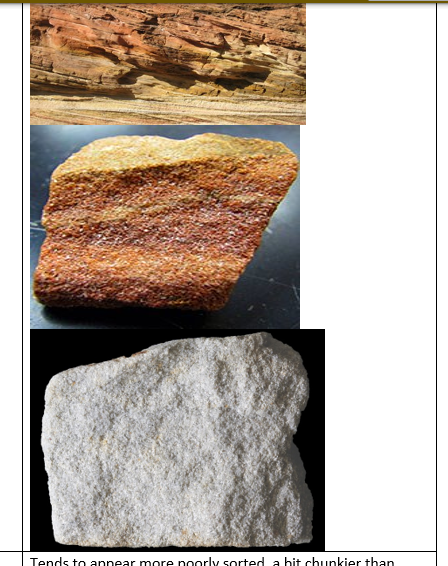
A rock made of mostly sand sized particles produces Sandstones.
Rounding is the removal of sharp edges of rock fragments and resistant mineral grains as they grind against one another or the ground surface.
Angular grains have not experienced as much abrasion as well-rounded grains.
Therefore, the presence of rounded sediments indicates that the materials have been transporting for a greater amount of time than angular sediments
The rounding of the individual, and usually larger grains can be used to distinguish between the Detrital/Clastic Sedimentary rocks called Conglomerate (rounded) and Breccia (angular).
Sorting is a process through which sediment grains are selected and separated according to grain size, and in some cases grain shape or density
Well sorted sediments indicate constant energy over time.
Poorly sorted sediments may indicate inadequate time to winnow and sort grains.
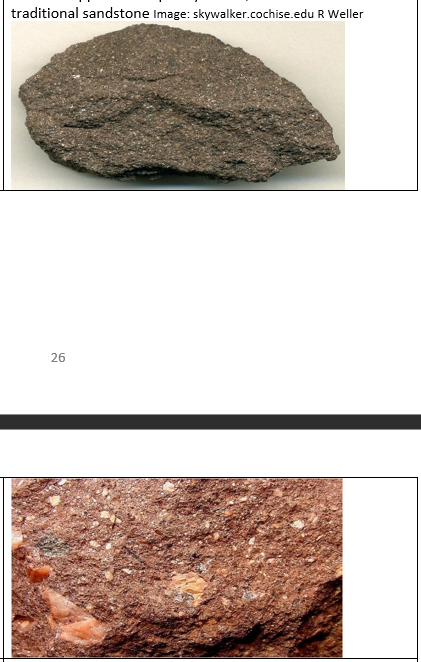
Silt/Mudstone and Sandstones are generally well sorted while Arkose Sandstone, Conglomerate, and Breccia are generally poorly sorted.
Indicators of Energy and Deposition Environment
Fast, turbulent waters are high energy environments, and calm waters are low energy environments. Higher energy environments produce large, poorly sorted sediments, especially if the energy/movement changes suddenly. Whereas low energy environments produce small, rounded, well-sorted sediments. Well sorted sediments, mostly one size range indicates a stable level of energy, not a varying energy level.
DEPOSITION: Sediment is deposited when transporting agents, such as running water, glacial ice, or wind, lose energy and can no longer transport the sediment load. Deposition also refers to the accumulation of chemical or organic sediment, such as calcium carbonate (CaCO3), clamshells on the sea floor, or plant material in a swamp.
Sediments are deposited in layers on top of one another, which packs loose sediment grains tightly together (compaction). Compacted sediment can be hardened even further by the precipitation of cement (ions dissolved in circulating groundwater) in the pore space between the grains
Property of Rock | ||
|---|---|---|
Color | Red, orange, and yellow colors occur where Iron (Fe) - and other oxides form | Oxidizing environment on continents. Exposure to air causes rusting. |
Black | Suggests carbon (possibly organic matter) that was preserved in a reducing environment (low oxygen) (i.e. swamps or deep marine) | |
Texture | Grain size (clay to boulders) | Energy or distance from source. Low energy can only carry small particles |
Rounding | Abrasion history – particles are weathered with angles and become rounded as they travel | |
Sorting | Constancy of energy – well to poorly | |
Fossils | Remains of animals of plants such as shells, bones, teeth or leaves | |
Terrestrial (Continental) | Alluvial fan | A deposit shaped like an open fan that forms at the base of mountains where a stream suddenly widens, spreads out, and dumps its load. Rock: conglomerate, breccia |
Glacial | Till - sediment melted out of glacial ice and deposited. Stratified (layered) drift - gravels sorted and deposited by glacial meltwater streams. Rock: conglomerate, sandstone, mudstone | |
Dune | Wind-deposited accumulations of mostly sand-sized particles. Common in deserts and along coastal areas. Rock: sandstone | |
River | Channel - where river water flows, channel deposits can be boulder, gravel, to sand-sized particles. Rock: conglomerate or sandstone Point bar - sand or gravel bar at the inside meander bend. Rock: sandstone (w/ cross-bedding) Flood plain - silts, sands, mud deposited when a river overflows its banks and floods Rock: siltstone, mudstone/shale | |
Lake | Freshwater low-energy environment where fine-grained sediments are deposited. Rock: mudstone/shale, limestone | |
Swamp | Low depression, poorly drained soils Rock: Peat, Lignite and Bituminouscoal | |
Transitional (marine coastlines, where the sea meets the land) | Delta | Where a river empties into the sea. Forms steeply sloping cross-bedding as delta front grows seaward. Rock: siltstone, sandstone |
Lagoon | An oceanic-sea water and freshwater environment protected from wave energy by an offshore reef. Rock: limestone, mudstone, chalk | |
Beach | The transitional zone between the sea and the land, where waves break on the shore, very high energy. Rock: sandstone, conglomerate | |
Tidal flat | Low flat area adjacent to the sea which is affected by the tides, exposed at low tide and underwater at high tide. Typically composed of silt and mud and commonly has ripples. Rock: siltstone, mudstone/shale | |
Marine | Shallow marine | Offshore, extends to about the edge of the continental shelf. Rock: mudstone/shale, limestone, chalk |
Deep marine - Abyssal plain | Fine muds and microfossils, foraminifera and Radiolaria. Rock: mudstone, chert |
Sedimentary Rock | Possible Environment of Deposition | |
Conglomerate | Alluvial fan, glacial region, near rivers, beaches | |
Breccia | Alluvial fan, base of a cliff | |
Sandstone | Glacial area, rivers, dunes, beaches | |
Silt/Mudstone or Shale | Rivers (floodplains), lake beds, tidal flats, deep marine. May have imprints of fossils | |
Limestone | Shallow marine, lagoon (and some very large freshwater lakes). May contain fossils. | |
Chalk | Shallow marine, lagoon | |
Chert | Deep marine | |
Coal | Swamp |
DETRITAL
NAME | COMPOSITION | |
SHALE | Rock fragments as small as or smaller than 1/256 mm |
|
MUDSTONE/ SILTSTONE | Rock fragments between 1/56-1/16 mm |
|
SANDSTONE | Rock fragments ranging in size from 1/16-2 mm |
|
ARKOSE SANDSTONE | Rock fragments ranging in size from 1/16 to small pebbles |
|
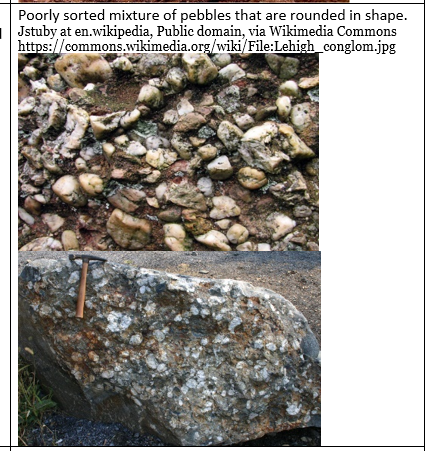
CONGLOMERATE | Rock fragments are larger than 2 mm and rounded is shape |
|
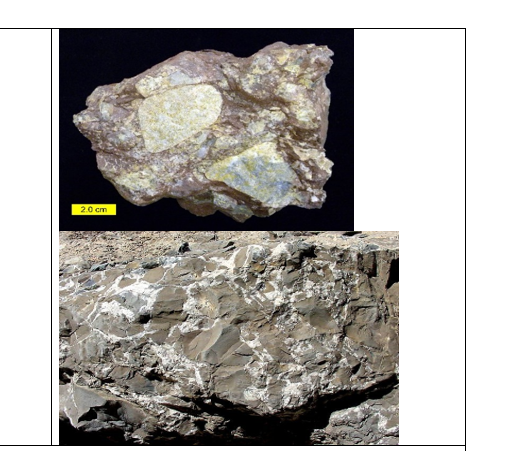
BRECCIA | Rock fragments are larger than 2 mm and usually very jagged or broken looking |
|
CHEMICAL/BIOCHEMICAL
NAME | COMPOSITION | |
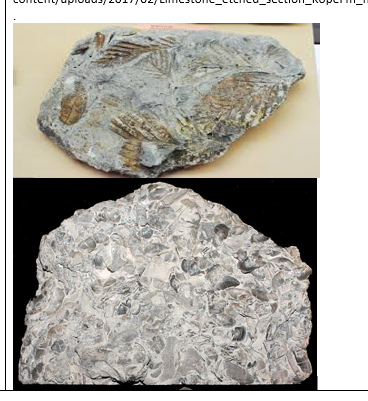
FOSSIL LIMESTONE | Calcite crystalline material. May be organic or inorganic. Rock samples may fizz when HCl acid is applied. Please note that Limestone is the most common sedimentary rock and occurs with or without fossils. |
|
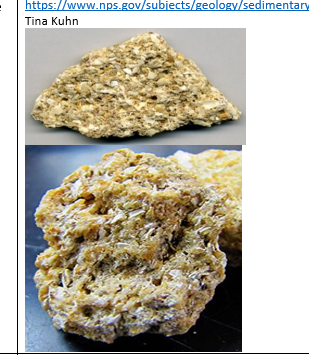
COQUINA | Calcareous often broken bits of shells or corals. The shell fragments dominate the sample. Frequently tan and beige in color. |
|
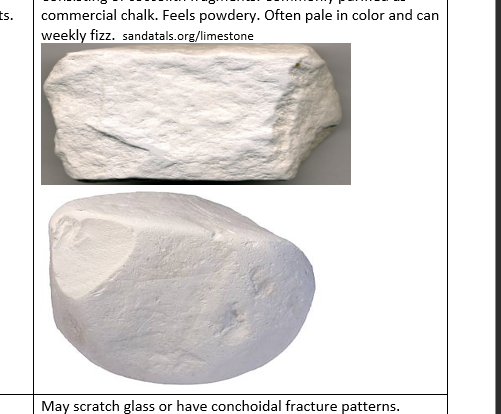
CHALK | Very fine ground carbonate deposits. |
|
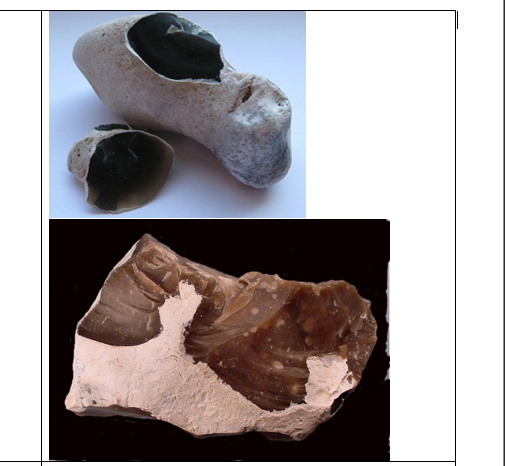
CHERT/FLINT | Microcrystalline silica-based organics |
|
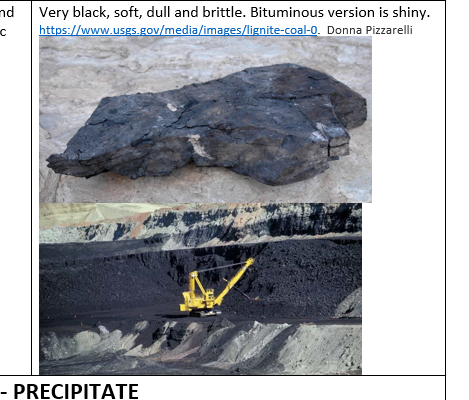
COAL – LIGNITE/ BITUMINOUS | Plant fragments and carbonized organic material. |
|
EVAPORITE - PRECIPITATE
ROCK SALT | Halite (sodium chloride - salt) deposits from evaporated sea water |
|
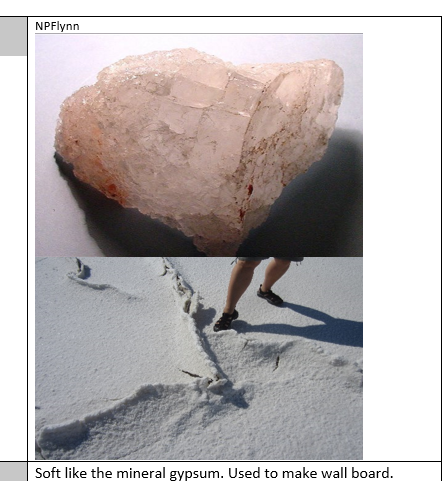
ROCK GYPSUM | Gypsum mineral (calcium sulfate) evaporated sea water |
|
METAMORPHIC ROCKS
Metamorphic rocks form when preexisting rocks such as Igneous, Sedimentary or other Metamorphic rocks are subjected to increases in temperature and pressure. These conditions can cause the rock and its minerals to change as a solid.
AGENTS THAT CHANGE A ROCK
Metamorphism refers to the changes in the solid state of a pre-existing rock, which commonly occurs deep within the lithosphere (the crust). The conditions that can change one rock into another type of rock are called Agents of Change. These are typically increased Temperature, increased Pressure and Chemically active fluids or gasses.
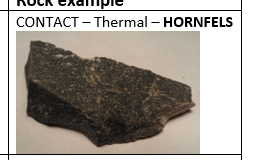
TEMPERATURE: When high temperature, without the presence of significant pressure, occurs a rock undergoes unique changes similar to cooking. This type of metamorphism is called Thermal or Contact metamorphism and typically occurs when rocks are heated by an intrusive igneous magma source
As a result of coming into contact with such elevated temperatures, the cooler surrounding rock is literally cooked. The rock becomes drier, more brittle, darker in color and develops a dull matte surface look, much like cooking a piece of bread in the toaster
The rock surrounding the intrusion where the contact occurs is called a metamorphic aureole and produces a unique rock called a Hornfels (figure 4). Hornfels tend to be very uniform in appearance and can be difficult to identify without microscopic examination or direct knowledge of the heat source (magma intrusion).
PRESSURE: All rocks beneath the surface of the earth experience an increase in pressure due to the weight of the overlying sediment and rock layers, and with increasing depth there is a corresponding increase in pressure.
This increased pressure does not necessarily cause a rock to become metamorphic, because this particular pressure is typically equal in all directions and is known as lithostatic or confining pressure.
Lithostatic pressure is similar to hydrostatic pressure, such as the pressure on the eardrums a swimmer will experience as they dive deep under water. Lithostatic pressure on rocks below the earth’s surface may cause a change (usually reduction) in overall rock volume.
If the pressure on a rock is unequal and the rocks become squeezed in one direction more than another direction it is known as differential pressure, and it can result in a significant change in the appearance of a rock
CHEMICALLY ACTIVE FLUIDS AND GASES: The phrase chemically active refers to the dissolved ions in a fluid phase that may react with minerals in a rock. These ions may take the place of some of the atoms in the mineral’s structure, which may lead to a significant change in the chemical composition of a rock.
Sometimes these fluids are quite hot, especially if they are fluids released from a nearby magma body that is crystallizing while cooling.
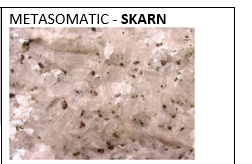
Metamorphism due to such fluids is known as hydrothermal metamorphism – literally ‘hot water’. Rocks altered in this manner are called Metasomatic or Skarns
TECTONIC SETTINGS DETERMINE THE CONDITIONS OF METAMORPHISM: The characteristics of the metamorphic rock indicate the tectonic setting of formation (Figure 9). Metamorphic conditions can occur in tectonic collision zones, subduction zones, or adjacent to igneous intrusions deep below Earth’s surface. This creates contact, regional and subduction metamorphism
CHARACTERISTICS | TECTONIC SETTING - Agents of Change | TYPE OF METAMORPHISM – Rock example |
TEXTURE: NON-FOLIATED Usually looks granular with interlocking crystals. Uniform and dense.
| Adjacent to igneous intrusions – INCREASED Temperature. Dehydrated |
|
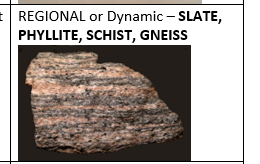
TEXTURE: FOLIATED Foliated types: Slaty – Phyllitic – Schistose - Gneissic | MOST COMMON – Convergent boundaries or continental collision. INCREASE in Pressure and Temperature
|
|
TEXTURE: NON-FOLIATED
| Convergent boundaries or continental collision. INCREASE in Pressure and Temperature
|
|
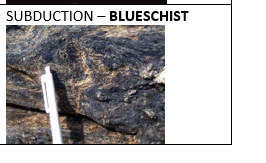
TEXTURE: FOLIATED Specifically, Schistose. Blueschist has a specific glaucophane mineralogy | Subduction Zones at convergent boundaries. Cold ocean lithosphere subducts into the hot solid mantle VERY HIGH PRESSURE and LOW TEMPERATURE
|
|
TEXTURE: NON-FOLIATED Can show large grain size but lack orientation. Are often brittle with unique mineralogy due to alteration/interaction with heated water
| Usually oceanic divergent spreading centers OR near hydrothermal sources. Chemically active Fluids and Gases, combined with increased temperature. |
|
METAMORPHIC ROCKS ARE RECYLCED FROM EXISTING ROCKS
PROTOLITH
To distinguish between the pre-existing rock (original) and the new metamorphic one, the term protolith or parent rock is used to describe the pre-existing rock.
The protolith (parent rock) along with the agents of change determine the resultant metamorphic rock
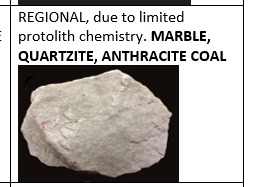
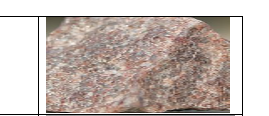
For example, if a protolith contains mostly quartz silica-rich minerals such as a sedimentary sandstone and is then metamorphosed, the limited mineral chemistry will typically create a metamorphic Quartzite
INDEX MINERALS
Index minerals are minerals that form under specific temperature and pressure ranges within a specific chemistry of a protolith.
The new minerals can be used to determine the temperature/pressure of metamorphism (figure 10). The protoliths overall chemistry can determine which new minerals can form.
METAMORPHIC TEXTURES AND CLASSIFICATION
When protolith mineralogy is combined with metamorphic conditions the development of unique metamorphic textures can form. Metamorphic rocks can be classified into two broad textural groups: Foliated – the most common type and Non-Foliated.
Foliated - Foliation is defined as the parallel or linear alignment of grains in a rock in an interlocking crystalline form. Most commonly the minerals that align are mica and amphiboles. Foliation has several grades or levels based on the duration and extent of the metamorphic conditions
Foliated rocks typically appear as if the minerals are stacked like pages of a book or stretched. This produces a platy look. Certain minerals have a single direction of growth and produce a specific type of foliation called lineation (figure 13), as though a bunch or pencils or straws were lined up.
FOLIATED TEXTURES AND ROCKS
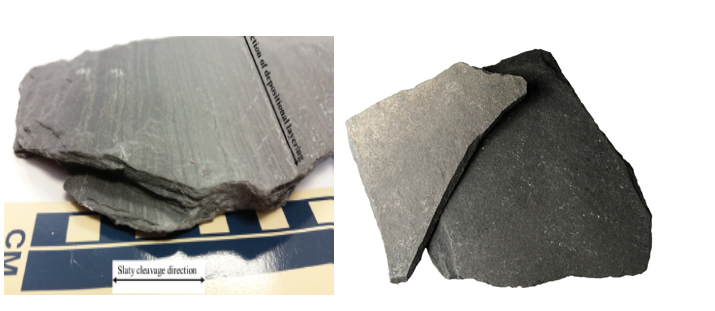
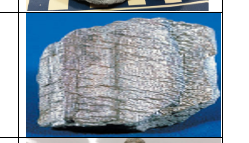
SLATY - There is one foliation type that is defined by the alignment of minerals that are too small to see, yet the foliation can still be visible. This type of foliation is only seen in the metamorphic rock called slate; slate forms by the low temperature and low-pressure alteration of a shale protolith (Sedimentary).
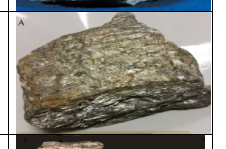
PHYLLITIC – Phyllitic texture results from the increased level of metamorphism of slates, more pressure and temperature. The already formed and aligned mica mineral grains continue to grow in size in response to increased pressure and temperature until they become large enough to make the slate very shiny.
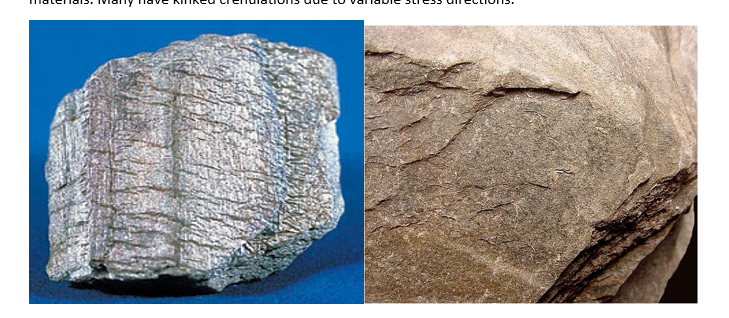
Phyllites break more easily than slates as the foliated texture produces layers of weakness.
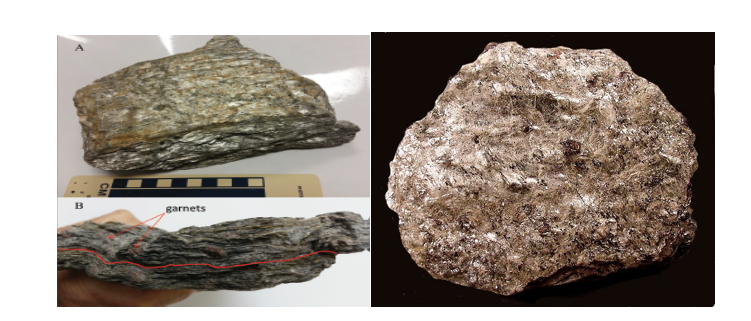
SCHISTOSE - Another type of foliation is defined by the presence of flat or platy minerals, such as muscovite or biotite micas. Metamorphic rocks with a foliation pattern defined by the layering of platy minerals are called schist; the rock name is commonly modified to indicate what mica is present
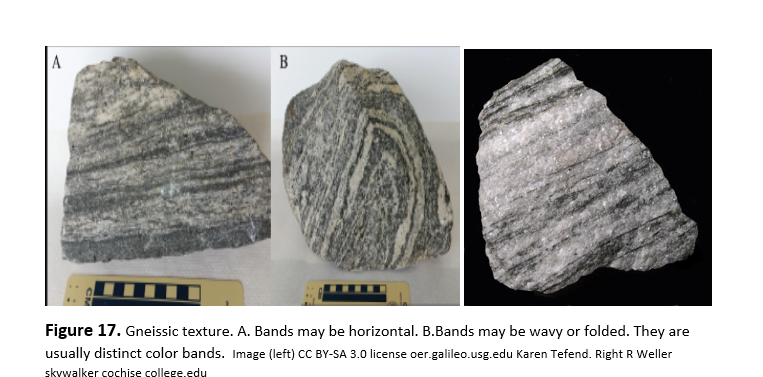
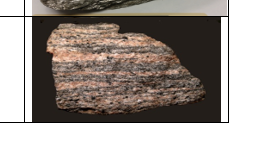
GNEISSIC – One type of foliation is described as a layering of dark and light-colored minerals, so that the foliation is defined as alternating dark and light mineral bands throughout the rock; such a foliation is called gneissic banding
NON-FOLIATED TEXTURES
Quartzite and Marble
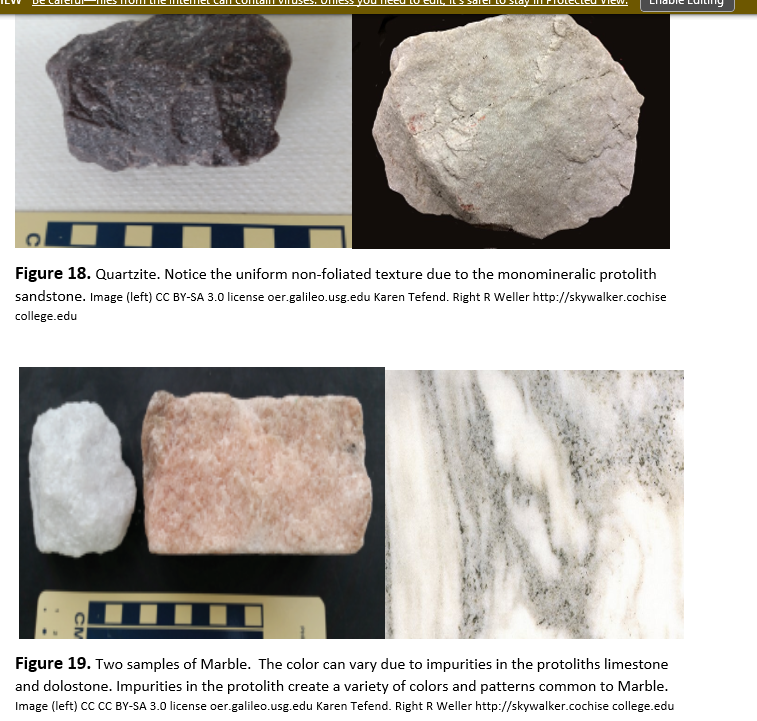
If the protolith rock is mono-minerallic (composed of one mineral type), such as limestone, dolostone, or a sandstone with only quartz sands, then a foliated texture will not develop even with differential pressure.
When rocks go through a process called metamorphism, they can change and become different types of rocks. But not all rocks will change in the same way. If the original rock, called the protolith, is made up of only one type of mineral, like limestone, dolostone, or a sandstone with only quartz sands, then it won't develop a special texture called foliation, even if there is pressure applied to it.
The reason for this is because the minerals in these rocks, like calcite in limestone, dolomite in dolostone, and quartz in sandstone, are not flat or different colors. They are more like grains or crystals. So when these minerals change during metamorphism, they become bigger crystals that are all the same size. This happens because of the way these minerals are made up.
Because these rocks don't have the special texture called foliation, they are named based on what minerals they are made of, not by the type of foliation they have. For example, if a sandstone with quartz sands goes through metamorphism, it becomes a rock called quartzite. And if limestone or dolostone goes through metamorphism, it becomes a rock called marble.
Quartzite and marble can sometimes look similar, so it can be hard to tell them apart just by looking at them. That's why we need to look at the properties of the minerals in these rocks. Quartz is harder than glass, while limestone and dolomite are softer than glass. Also, if we put acid on marble, it will react and make bubbles, but quartz won't react.
If we look closely at quartzite and marble, we can see that the crystals in marble are bigger than the crystals in quartzite. This is because the temperature during metamorphism was higher for marble, which made the crystals grow bigger.
These rocks are important because they are used in buildings and homes. Quartzite and marble are used for things like countertops and dimension stones in buildings. Marble is also used for statues and sometimes grave markers.
Metamorphic Grade
Not all metamorphic rocks are recrystallized to the same degree. The intensity of metamorphism, called metamorphic grade, depends on how much pressure and heat have been applied.
Minerals tend to grow in size with increasing grade. Also, some rocks change into other metamorphic rocks depending on the grade
Metamorphic Grade
Pressure Range
Temperature Range
Common Foliated Rock
Common Non-foliated Rock
Low
1-4 kbar
200-325 oC
Slate
Hornfels, Quartzite, Marble, Greenstone, Serpentinite, Anthracite Coal
Medium-low
1.5-6 kbar
325-450 oC
Phyllite
Medium-high
2.5-12 kbar
450-525 oC
Schist
High
2.5-20 kbar
525-650 oC
Gneiss
Igneous
Once a rock melts, it is no longer metamorphic. If only part of the rock melts, the liquid part is magma and the remaining solid part is still high-grade metamorphic rock (this kind of rock is called a migmatite)
OTHER LESS COMMON TYPES OF METAMORPHISM
Conditions that occur uniquely as the oceanic crust is subducted - Blueschist
impact cites where a meteor strikes the earth the resulting rock is called shock metamorphism
unique high stress with low temperature conditions that occur along fault zones
Mylonites (figure 22) which are formed when rocks become plastic due to high heat and pressure
TEXTURE | CHARACTERISTICS | PROTOLITH | ROCK NAME | IMAGE |
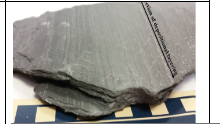
FOLIATED Low grade P and T - SLATY | Fine-grained. Tends to split in parallel fragments. Varies in color from Black (organic material) brown, red. | SHALE | SLATE |
|
FOLIATED Low to medium grade P and T PHYLLITIC | Shiny - abundance of very small mica grains. May have wavy crenulations | SLATE | PHYLLITE |
|
FOLIATED medium P and T SCHISTOSE | Contains abundance large mica grains. May contain Garnet as an index mineral | SHALE OR IGNEOUS ROCK | SCHIST |
|
FOLIATED High levels of P and T Gneissic | Alternating bands of light and dark minerals | SHALE or IGNEOUS Rock | GNEISS |
|
NON-FOLIATED | Equigranular grains of quartz - hardness of 7. May appear glassy with sharp edges. Color varies. | Sandstone | QUARTZITE |
|
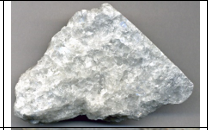
NON-FOLIATED | Equigranular grains of carbonates such as calcite - hardness below 4 producing rounded softer edges. | Limestone or Dolostone | MARBLE |
|
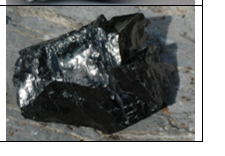
NON-FOLIATED | Contains mostly carbon. Very shiny black and light weight | Bituminous or Lignite Coal | ANTHRACITE COAL |
|
To summarize:
1. AGENTS OF CHANGE: Metamorphism is the process by which a pre-existing rock (the protolith) is altered by a change in temperature, pressure, or by contact with chemically reactive fluids, or by any combination of these three parameters. The agents of change are directly connected to unique plate tectonic conditions such as continental collisions.
2. ROCK CHANGES: The alteration process is a recrystallization event, where the initial rock’s minerals (crystals) have changed size, shape, and/or composition in response to these new external conditions. This produces unique textures such as foliation and sometimes new index minerals. The index minerals can give us clues to the amount or grade of the metamorphism.
3. PROTOLITH: What metamorphic rock you end up with is strongly dependent on what rock you started with before the metamorphic event. Images below CC license BY Pete Davis, Manishwiki15