AP Gov Semester 1 Exam
Key Cases:
McCulloch v Maryland (1819)
Court rules that states could not tax national bank
Reinforced supremacy clause of the constitution-issues between state+ federal government laws should be ruled in favor of federal
Necessary and proper clause- banks were necessary to implement federal powers
U.S. v Lopez (1995)
Challenge to the Gun-Free School Zones Act of 1990 (Banned guns on school property)
Held that commerce clause didn’t allow regulation of carrying guns
New phase of federalism- state sovereignty and local control were important
Baker v. Carr: Charles Baker sued Tennessee for not redrawing its state legislative districts because his county’s population had grown but not gained representation
Violated 14th amendment (equal protection of the law)
Ruled in 6-2 decision that the government can force states to redistrict every 10 years
Led to the development of the “one person, one vote” doctrine
Gave federal courts the right to weigh in on redistricting
Shaw v. Reno: white voters living in North Carolina’s 12th district sued the state for gerrymandering to isolate African Americans into the 12th district
Ruled in 5-4 decision that the state was using racial bias in its redistricting
Violated equal protection clause
Any racial gerrymandering required a compelling state interest
Marbury v. Madison
Chief Justice John Marshall established judicial review
John Adams commissioned William Marbury as Justice of the Peace in DC in the last hours of his presidency, approved by Senate; President Jefferson ordered Secretary of state to not deliver commission
Article III, Section 2 of Constitution - what is the extent of the Supreme Court’s power regarding judicial review?
Ruled that the part of the Judiciary Act allowing the Supreme Court to grant the position of Justice of the Peace was unconstitutional
Required Documents:
Federalist 10
Written by James Madison
Addresses Dangers of factions + how to protect minority interest groups in a nation ruled by majority
argues that a large republic keeps any single faction from taking control
Argues that a large republic keeps any single faction from taking control
Brutus No. 1
Anonymous author
critiqued the draft of the constitution
National government had too much power, an army could prevent liberty, and representatives may not truly be representative of the people
Federalist 51
Written by James Madison
Argued that separation of powers would make the government efficient, dividing responsibilities and tasks
Federalist 70
Written by Alexander Hamilton
Argued that the executive branch should only have one member: the president
Used the British monarchy as an example: the king had power but was checked by the House of Commons
Proposed term limits as another way to limit the president’s power (not set until the 22nd Amendment in 1951)
Federalist 78
Written by Alexander Hamilton
Addressed concerns about the power of the judicial branch
Argues that the judicial branch would have the least amount o power under the Constitution but would also have the power of judicial review
Check on Congress
Unit 0
Vocab:
Authoritarian Regime
A political system where power is concentrated in a leader or small group that limits political freedoms and suppresses opposition.
Causation
A relationship where one variable directly produces an effect in another variable.
Charismatic Legitimacy
Authority gained through a leader’s personal appeal, heroism, or inspirational qualities.
Civil society
Voluntary organizations and groups outside of the government that help citizens express interests and influence politics.
Cleavages
Deep, long-lasting divisions in society such as class, ethnicity, or religion that shape political conflict.
Communism
A political and economic ideology advocating for a classless society where that state controls the means of production.
Corporatism
A system where the government controls or heavily shapes interest groups to limit pluralism.
Correlation
A relationship where two variables show a pattern together but do not necessary cause each other
Democratic Consolidation
The process by which a democracy becomes stable and unlikely to revert to authoritarianism.
Democratic Regime
political system with free elections, protected civil liberties, and rule of law.
Democratization
The transition from an authoritarian system toward more democratic institutions and practices.
Economic Globalization
Increasing worldwide economic interdependence through trade, investment, and technology.
Economic Liberalization
Policies that reduce government control over the economy to encourage free markets.
Electoral authoritarian regime
A system that holds elections but manipulates them so the ruling party stays in power.
Empirical Statement
A factual claim that can be tested or observed in the real world.
Failed/ Fragile State Index
A measure of how stable or unstable a country is based on political, economic, and social indicators.
Fascism
An authoritarian ideology emphasizing nationalism, dictatorship, and suppression of opposition.
Federal
A system where power is constitutionally divided between national and regional governments.
Freedom House
An organization that rates countries’ political rights and civil liberties.
GDP Per Capita
he average economic output per person in a country
Gini Coefficient
A measure of income inequality within a country.
Government
The institutions and people who hold political authority and make public policy.
Gross Dometic Product (GDP)
The total value of goods and services produced in a country in one year.
Depicts the overall size of a national economy
This describes what GDP shows.
Head of government
The leader responsible for running the government and implementing policies.
Head of state
The symbolic leader of a country who represents the nation.
Symbolic representative of a country
This describes the role of the head of state.
Human Development Index (HDI)
A measure of a country’s development using life expectancy, education, and income.
Illiberal democracy (hybrid)
A system with elections but limited civil liberties, weak rule of law, and restricted opposition.
Individualism
The belief that individual rights and freedoms should take priority over collective or state control.
Legitimacy
The public’s belief that a government has the right to rule
Multinational Organizations
Groups made up of several countries cooperating on shared goals
Nation
A group of people with a common identity, culture, or history
Nationalization
When the government takes control of private industries or assets
Neoliberalism
A policy model promoting free markets, privatization, and limited government intervention
Normative Statement
A value-based claim about how things should be, not how they are
One party rule
A political system where one party dominates and others are banned or powerless
Parliamentary systems
systems where citizens elect the legislature, which then selects the head of government.
Personalist Authoritarian Regime
a dictatorship centered around a single leader who controls the state
Pluralism
a system where multiple groups freely compete to influence government
Political Liberalization
the expansion of individual rights, political freedoms, and openness in government
Populism
a political approach claiming to represent “the people” against corrupt elites
Presidential System
a system where the president is elected separately from the legislature and serves as head of government
Privatization
selling state-owned enterprises to private owners
Proportional Representation
an electoral system where parties gain seats based on the percentage of votes they receive
Qualitative
data based on descriptions, characters, or observations
Quantitative
data based on numbers and measurable quantities
Rational-legal legitimacy
authority based on legal rules, institutions, and procedures
Referendum
a vote in which citizens directly decide an issue or policy
Regime
the rules and institutions that determine how power is exercised in a state
Rule by law
when laws are applied to control citizens but the government itself is above the law
rule of law
when laws apply equally to all, including government officials.
semi presidential system
a system which both a directly elected president and a prime minister sharing executive power
separatist movement
a group seeking independence from an existing state
Single Member District/ First Past the Post
an electoral system where the candidate with the most votes wins a single seat
Social movements
groups that push for social or political change
Sovereignty
a state’s full authority to govern itself without outside interference
State
a political institution with power over a defined territory and population
Supranational Organization
an international group whose decisions can limit member states’ sovereignty
Theocratic Authoritarianism
a system where religious leaders control political power and enforce religious law
Traditional legitimacy
authority based on long-standing customs, beliefs, or historical practices
Transparency International
an organization that measures corruption levels across countries
Unitary
a system where most political power is held by the central/ national government
Unit 1:
Vocab:
Enlightenment
Republicanism
Citizens elect leaders for a limited period of time.
Leader’s job is to make and execute laws in the public interest
Participatory Democracy
Broad participation in politics/ society by people at various statuses
Pluralist Democracy
group- based activism by citizens with common interests who seek the same goals
Elite democracy
Power to the educated/ wealthy, discourages participation by the majority of people
Popular sovereignty
government power derives from the consent of the governed
The Declaration of Independence
Formal declaration of war between America and Great Britian
Written by Thomas Jefferson
List of grievances against the colonies
Articles of Confederation
Outlined the first government of the USA
Created Federalism
Way in which federal and state governments interact and share power
Ended Revolutionary War
Treaty of Paris- 1783
Established Northwest Ordinance
Created methods through which states would enter the US
Shay’s Rebellion
Rebellion by farmers in which a federal arsenal was attacked in protest of the foreclosure of farms in western Massachusetts
Could not impose taxes
No Military
No national currency
No supreme court
No executive branch
No control over taxes imposed between states and could not control interstate trade
Needed unanimous votes to amend the Articles
The Constitutional Convention
Meeting of the framers in 1787 In Philadelphia, Pennsylvania
Division over powers, structure, and responsibilities of governments
some believed the gov under the AOC was too weak, others believed it shouldn’t be changed
Federal Legislature had two main issues:
Unicameral
Single House
Bicameral
Two Houses
Virginial Plan
Bicameral Legislature based on population size
New Jersey Plan
Unicameral Legislature, one vote per states
would benefit smaller states
The Great Compromise/ Connecticut Compromise
A bicameral legislature with a House of Representatives and Senate
Three-Fifths Compromise
Enslaved people would be counted as 3/5 of a person when deciding seats in the HOR
The Constitution
Articles I-III
Set up three branches of government
Legislative
Executive
Judicial
Powers Under Federalism
Enumerated Powers
Powers that belong to the national government
Reserved powers
powers that belong to the states
10th amendment
include any that the constitution neither gives to the national government nor denies to the states
Concurrent Powers
Shared by Federal and state governments
Categorical Grants
Aid with strict rules from federal government about how it is used
Block grants:
aid that lets the state use the money how it wants
Separation of Powers
System of Checks and Balances
President can Veto laws
Impeachments
Supreme Court nominations and confirmed by senate
Amendment Process
Amendment: the addition of a provision to the Constitution
Main process:
Proposed amendment must be approved by 2/3 of both houses of Congress
3/4 of state legislatures must ratify (approve) the amendment, and the states themselves are allowed to determine the votes required to ratify the amendment
Congress can also mandate that each state use a ratifying convention (delegates elected to vote on the amendment)
Used once to ratify the 21st amendment (1933) - ended prohibition
Another process:
2/3 of state legislatures petition Congress for a constitutional convention
Never happened before
State and Local Governments
Executive branch led by governor
may grant pardons and reprieves
may use line-item veto
People:
Thomas Hobbes
The Leviathan
Social Contact with government
John Locke
Second Treatise on Civil Government
Natural Law- people are born free and equal
“No one can be subjected to the political power of another, without his own consent.”
Natural Rights
Charles de Montesquieu
Checks and balances
Jean-Jacques Rousseau
The Social Contact
Vocab:
Unit 2
Congress:
Congress
The bicameral legislature for writing laws
oversees bureaucracy, clarifies and codifies policy, represents citizens, build consensus
House of Representatives
a 435 member house House of Representatives: a 435-member house, with members apportioned by each state’s population (designed to represent population)
Senate: a 100-member house, with 2 members per state (designed to represent states equally)
Census: a survey taken every 10 years to count population and determine the number of congressional districts each state has
Redistricting: the redrawing of district boundaries to ensure each district has an equal population done by state legislature
Gerrymandering: drawing district boundaries to give the majority party a future advantage
Does not apply for Iowa; uses an independent commission to draw district lines
Helps incumbents
Some states have such small populations that the entire state becomes a district
Each state is guaranteed one seat in the House
Congressional Elections
Elections for the House of Representatives are every two years
Representatives must live in the district they represent and be a citizen of the state, and must be 25 years old
Elections take place within each district
Constituencies are smaller than senators’
Incumbent election rates are very high (>90%)
Less competitive
Elections for the Senate are every two years
Each term is six years
Senators must be at least 30 years old
More competitive, expensive, and high profile
Draw candidates from other offices
Baker v. Carr (1962): Charles Baker sued Tennessee for not redrawing its state legislative districts because his county’s population had grown but not gained representation
Violated 14th amendment (equal protection of the law)
Ruled in 6-2 decision that the government can force states to redistrict every 10 years
Led to the development of the “one person, one vote” doctrine
Gave federal courts the right to weigh in on redistricting
Shaw v. Reno (1993): white voters living in North Carolina’s 12th district sued the state for gerrymandering to isolate African Americans into the 12th district
Ruled in 5-4 decision that the state was using racial bias in its redistricting
Violated equal protection clause
Any racial gerrymandering required a compelling state interest
Congressional Districts and Representation
Voting Rights Act of 1965: encouraged states to increase minority representation in Congress
Initially made little change
1982 amended to make states create majority-minority districts (concentrating minority populations into districts)
Made it easier for minority candidates to get elected
Many states redistricted after the 1990 census, resulting in an increase of minority representation
District shapes were weird
Legislators in NC, GA, TX, and other states have been accused of gerrymandering
Black and Hispanic voters are majority Democrat, Republican-controlled legislatures were accused of trying to remove racial minority Democrats from districts to ensure more Republicans get elected
Packing: isolating minorities in a district
Cracking: dividing minorities across many districts
Population shifts gave more seats in the House to Southern states but took away seats from other regions
Suburban representation has increased, but both rural and urban have decreased
Hijacking: redrawing two districts in a way that forces two incumbents to face each other in a single district
Kidnapping: moving an incumbent’s home into another area after redistricting
Congressional Powers
The Constitution lists out the responsibilities of Congress in more detail than the other branches
Both houses have unique powers that require them to work together, including taxing, borrowing money, regulating commerce, raising an army, creating/making rules for courts, establishing naturalization laws, creating post offices, building a militia, and making laws
Taxing and spending clause (Article 1, Section 8, Clause 1): gives Congress much control over budgetary spending
“Power of the purse”: gives Congress power to influence others by preventing access to funds or adding conditions
Can be used positively to fund programs or negatively to harm an agency
House of Representatives can start spending bills and tax laws
House of Ways and Means Committee: oversees spending laws and taxing
Senate can approve presidential nominations to court and ambassadors to other countries
Must also ratify all treaties the president signs
Non-legislative Tasks of Congress
Congress primarily writes laws
Oversight: reviews federal agencies’ work (checks executive branch), investigates charges of corruption, holds hearings (experts and citizens discuss government issues and propose solutions)
All committee chairs can subpoena (legally compel) witnesses to show and testify
Confirms members of presidential cabinet
Approves nominees for federal court
Public education: floor debates and committee hearings increase awareness of government/social issues and help to focus national attention
Representing constituents within the government: politicos (representatives of electorates, Congress members) help constituents with the government and vote on laws; can act on complaints about federal services/agencies, sponsor those who seek contracts, and seek suggestions on improvement
Delegate Model (representational view): consider themselves delegates who mirror the views of their districts
Trustee Model (attitudinal view): some consider themselves trustees who should think about constituents’ views but use their judgement when making decisions
Constitutional amendments: can propose amendments by 2/3 vote in both houses or by a convention called by 2/3 of state legislatures
Electoral duties: House can elect next president if neither candidate gets 270 votes, Senate picks VP
Impeachment: House has power over impeachment; if majority votes to impeach an official, the Senate runs the impeachment trial and convicts/removes the official from office with 2/3 of Senate votes
Confirmation duties: Senate can approve both presidential appointments and federal officials
Ratification: only Senate can ratify treaties if 2/3 votes
Senate can influence international relations and foreign policy
Investigation: can be conducted by either a standing or committee and may last months while members gather evidence and witnesses
Majority lead to new legislation to address the issue, changes in programs, or officials’ removal from office
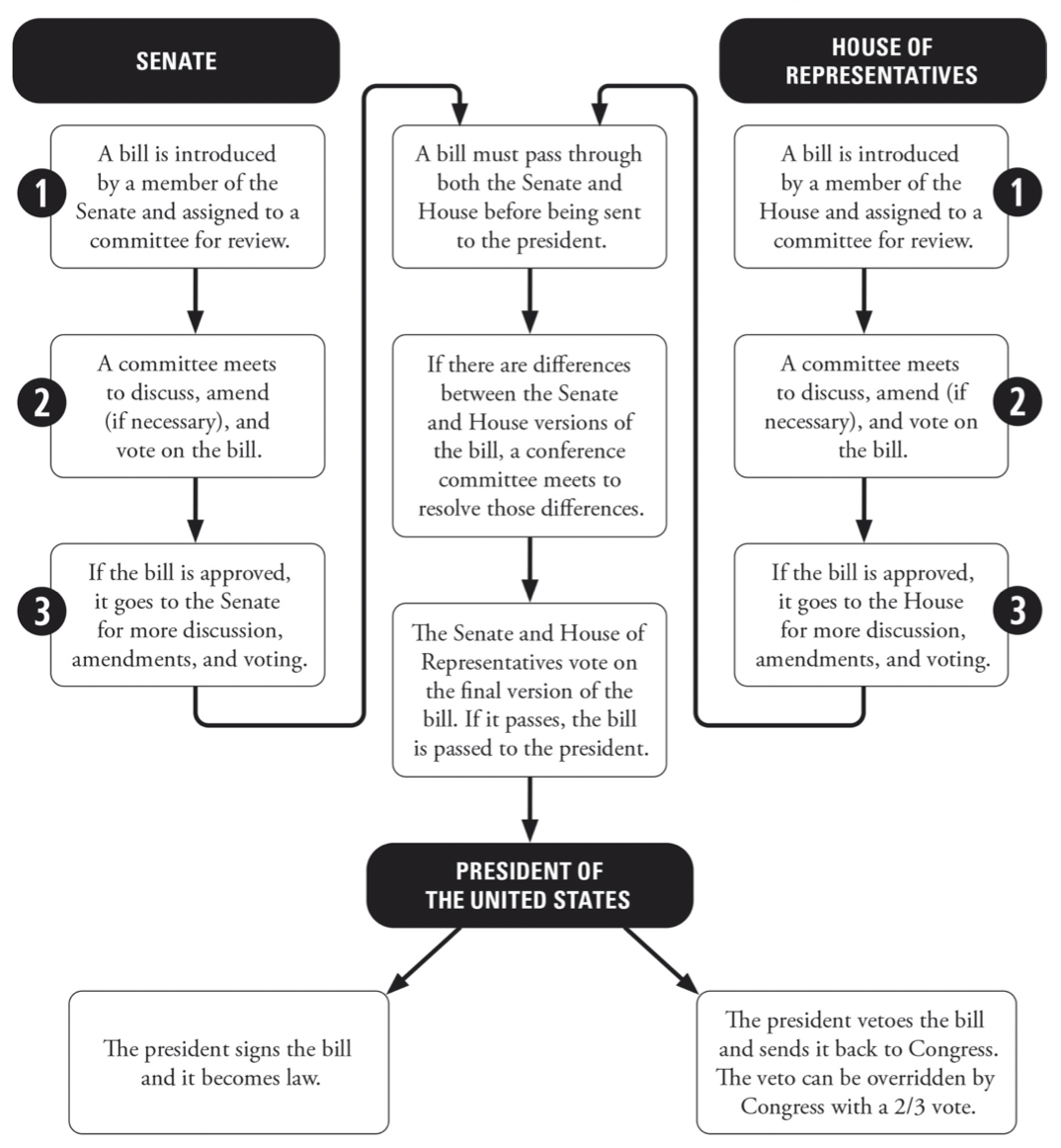
Legislative Process
Slow and complicated
Prevents decisions from being made too quickly
Facilitates compromise and communication between both sides
Bills
10,000 bills introduced every year
Some written by Congress members and staff
Others are written by executive branch and introduced by Congress members
Many are written or suggested by interest groups + lawyers
Can only be proposed by a Congress member (the sponsor of the bill)
Requires two houses to work together
Both houses must pass the same bills
Different debate and voting processes
House of Representatives:
Debates about bills are limited in House of Representatives (too many people)
Rules Committee: determines how long a bill will be debated and whether open or closed rules for amending bills are allowed
Open rules allow amendments
Closed rules forbid amendments
Republicans (majority) in 1994 promised open rules for most bills
Considered most powerful committee in House
Can kill a bill by postponing vote or make it easy for an opponent to add killer (poison-pill) amendments
Can bring bills up for immediate vote
Senate:
Does not strictly control debate, no time constraints
Filibuster: used to delay bill’s vote and tie up Senate’s work, usually by a senator making a very long speech
Can happen without speeches
Senate majority may require a traditional filibuster if needed
Cloture: the vote which is the only way to end a filibuster, requires votes of 60 members
No closed rules
Riders: amendments, do not have to be relevant to bill, allow senators to add amendments
Pork barrels: “pet project” riders created to get money to a home state
Earmark: provisions in legislation that allot money to a project (appropriation and authorization bills)
Not allowed by House
Conference committee: committee each house’s version of a bill is sent to which come from the committees of each house that wrote the bill
Attempts to negotiate compromise bill
Compromise bill returns to both houses for voting
Failure to pass a compromise bill will kill it
Sent to White House if passed for presidential approval
President:
Bill becomes law after 10 days if president does nothing regardless of signature
Bill is pocket vetoed if president doesn’t sign every bill into law and congressional session ends during 10 days
President can veto entire bill if congressional session doesn’t end in 10 days and gives reasons for vetoing
Both houses can override veto by a two-thirds vote
Houses can also make any required changes
If house of origin does nothing with veto, bill is dead
Line-item veto: given to President Clinton in 1996 by Congress, allowed the president to veto certain parts of a bill
Clinton v. City of New York (1998): the Supreme Court struck down the line-item veto as an unconstitutional power of the president
Congress has tried to give itself veto power over the president
Wrote legislation giving Congress ability to void presidential actions by a vote of the houses
INS v. Chadha (1983): Supreme Court declared legislative veto unconstitutional
Legislation by Committee
Most legislative activities by Congress are in committees
Committee members are determined by many factors
Majority party of each house holds all committee chairs
Also holds most seats on each committee (2/3 on important committees)
Oldest/most experience member of majority party is chair and senior member from minority party is ranking member
Ranking member becomes chair if minority party becomes majority party
Assignments determined by House and Senate leaders + both parties’ caucus
Try to get on committees that will help them help the constituents the most and with reelection
Investigate and debate bills that otherwise wouldn’t be considered due to time
Call interested parties and expert witnesses (often lobbyists)
Congress can subpoena witnesses
After investigations committees amend and rewrite parts of bills in meetings known as markup sessions
Often first assigned to subcommittee for consideration
Often determine how money is spent
Most die because of lack of interest
Membership of committee and subcommittee is crucial
Bills written to appeal to certain committees
Can refuse to vote a bill out
Pigeonholed: a bill stuck in a committee
Discharge petition: the way to force a bill out of committee for a floor vote
Oversee bureaucratic agencies and departments
Heads of agencies often appear before congressional committees
Can subpoena witnesses (legally requires individuals to appear or produce requested documents)
Can hear testimony from agency heads asking for money or people
House has more committees and are more specialized because each member serves on fewer committees
Types of committees:
Standing committees: permanent, specialized
Ex. House Ways and Means, Senate Judiciary, Senate Armed Services
17 in the Senate, 20 in the House
Joint committees: made up of members of both houses
Normally used for investigations or communicating with the public
Select committees: temporary committees created in each house for a special reason
Usually carry out investigations to write special bills
Ex. House Watergate Committee, Senate Select Committee on Unfair Practices
Conference committee: temporary committees made up of members from committees of both houses who wrote a bill
Try to create compromise bills, then submit to both houses
Disbanded once a compromise bill is negotiated
Congressional Leadership
The House
The leader is the speaker
Chosen by the majority party in an election
Can direct floor debate and has influence over committee assignment and the Rules Committee
Can control which bills are assigned to certain committees
Majority leader is in charge of party members, determines party policy and agenda
Minority leader is in charge of minority party members, determines party’s agenda
Majority and minority whips help their leaders keep members loyal to the agenda, coordinate members, and get support for legislation
The Senate
President of the Senate is the vice president, only official responsibility
Only votes to break a tie
President pro tempore is the temporary president when the VP is absent
Mostly honorary position
Usually given to oldest member of the majority party
Majority leader controls agenda and acts as policy initiator and power broker
Minority leader is similar, not policy initiator or agenda controller
Why Do They Vote That Way?
Pressure to influence vote from own party and opposition
President jawbones (tries to influence) and colleagues logroll (mutual help)
PACs, constituents, and interest groups donate to try to influence votes
Judgment can be affected by personal ideology and religion
Party affiliation is most important factor
Notable Legislation
National Growth, Expansion, and Building Institutions
Northwest Ordinance (1787, 1789): created by the Articles of Confederation, provided guidelines for settling new territories and creating new states, reaffirmed in the Constitution in 1789
Government and Industry Regulation
Pendleton Act (1883): got rid of the spoils system for government job selection, set up exam-based merit system for candidates
Sherman Anti-Trust Act (1890): gave Congress the power to regulate and disassemble monopolies in the US, abused to break up labor unions
Hatch Act (1939): let government employees vote in elections but prevented them from participating in partisan politics
Freedom of Information Act (1966): let the public view government documents
Air Quality Act (1967) and Clean Air Acts (1960s-1990s): regulated environmental impacts by establishing standards for factories and cars
Federal Election Campaign Acts (1971, 1974): created the FEC and required contributions and expenditures to be disclosed, created limits on presidential election expenditures and contributions, created subsidies for presidential candidates
War Powers Act (1973): put limits on presidential power to use troops overseas, created time limit, gave Congress power to withdraw troops; all presidents have declared act unconstitutional since 1973
Budget and Impoundment Control Act (1974): created Congressional Budget Office and congressional budget committees, gave Congress authority to prevent president from refusing to fund congressional initiatives
Gramm-Rudman-Hollings Bill (1985): created budget reduction targets to balance the budget; failed to eliminate loopholes
No Child Left Behind Act (2001): states must adopt education accountability standards, requires annual progress testing, and sanctions schools that fail to meet the yearly progress goals
Unfunded Mandates Reform Act (1995): Congressional Budget Office must analyze impact of unfunded mandates on states, must have separate congressional vote on bills that impose them
Rights and Freedoms
Espionage Act (1917), Sedition Act (1918): greatly reduced rights of Americans during war and increased federal government’s power to control public activity; repealed by Congress in 1921
Immigration Act (1924): limited number of immigrants entering the US and set strict standards for entry
Voting Rights Act (1965): eliminated literacy tests, let federal officials register voters, prevented states from changing voting procedures without the government’s approval; let federal officials count ballots and make citizens vote
Age Discrimination in Employment Act (1967): prevented age discrimination in jobs unless job is affected by age
Civil Rights Act or Fair Housing Act (1968): Title II prevented discrimination in public places based on race, color, national origin, or religion, Title VII banned employment discrimination based on gender
Title IX Education Act (1972): banded gender discrimination in federally funded education
Americans with Disabilities Act (1990): protected disabled Americans’ rights and required accommodations to public facilities; prohibited job discrimination if accommodation could be made, required access to facilities for the disabled, allowed non-paid leave of absence without fear of firing
National Voter Registration Act (1993): AKA The Motor Voter Act, allowed people to register to vote when receiving driver’s licenses
Patriot Act (2001): After 9/11, Congress permitted police authority to federal, state, and local governments to interdict, prosecute, and convict suspected terrorists; known as the USA-PATRIOT (Uniting and Strengthening America by Providing Appropriate Tools Required to Intercept and Obstruct Terrorism) Act
Government Aid to the People
New Deal Legislation (1933-1939): expands role of government in society and the economy; created Social Security, the Tennessee Valley Authority, and the Securities and Exchange Commission; expanded role and size of government
Personal Responsibility and Work Opportunity Reconciliation Act (1996): Welfare Reform Act signaled change in national role with states, tried to increase role of personal responsibility in welfare recipients, shifted many responsibilities to state governments for welfare provision, ended federal entitlement status of welfare, replaced with block grants to states; recipients of grants had to work within 2 years and could not get benefits > 5 years
Bipartisan Campaign Reform Act (2002): AKA McCain-Feingold Bill; banned soft money to national political parties and raised hard money limits to 2,000 dollars; SCOTUS struck down several parts of this law in Citizens United v. FEC, especially parts related to donations made by corporations
The President
The Formal Powers of the Presidency
Article II, Section 2 of the Constitution
Responsible for serving as the ceremonial head of state, handling foreign policy, and enforcing laws
Administrative head of government
Can force Congress into session, brief Congress on State of the Union, veto legislation
Must cooperate with Congress (checks and balances)
Can appoint federal judges, SCOTUS justices, ambassadors, and department secretaries that must be approved by the Senate
Negotiates treaties that must be ratified by 2/3 of the Senate
Executive agreements do not require Senate approval, agreements between country leaders
The President as Commander in Chief
Commander in chief of the armed forces
Only Congress can declare war, but president can make war
Can mobilize armed forces
Chief strategist and director of military
Relies on Congress for money
Gulf of Tonkin Resolution (1964): gave president broad powers to bring unlimited troops for unlimited time to Vietnam
War Powers Act (1973): passed in an attempt to make president get congressional approval before making war, limiting president to 10,000 troops or 60 days and 30 additional days to withdraw
The Informal Powers
Build morale
Lead legislation and build coalitions
Set legislative agenda
Important when government is divided
Chief of party
Influence on party’s agenda, issues, policy, strategy, and direction
Divided government: when the president and majorities in houses are not from the same political party
Unified government: when the house majorities and the president are from the same political party
Persuade policy and communicate to Congress and the country
Bully pulpit lets the president speak with the American people and helps them to pressure Congress
Theories about how the president chooses to use power:
Literalist doctrine: president only has the powers listed in Article II of the Constitution and should not use power that is not granted; not followed by any president 1920s
Stewardship doctrine: gives the president the ability to use power in multiple ways and arenas; free to use any power not denied to them by the Constitution; increases power of president
Unitary executive theory: gives executive branch nearly unlimited power to develop any policy that is necessary
Executive Office of the President
Helps carry out president’s administrative responsibilities
Made up of agencies involved in the White House, divided into domestic, foreign, and military areas
Chief of staff: top aid to the president; very trustworthy and known for a long time; considered extremely powerful, manages Executive Office, controls access to president (+ information received by president)
National Security Counsel (NSC): headed by national security advisor, direct access to president in situations related to the military or foreign policy; involved during national emergencies, free from congressional oversight, favored by president
Domestic Policy Counsel: helps the president create policies related to agriculture, education, energy, natural resources, drug abuse, crime, health, the economy, and welfare
Office of Management and Budget (OMB): prepares US budget and used to control/manage executive agencies; very powerful because it is able to fund cabinet departments and control the department’s effectiveness
Council of Economic Advisors: helps the president make economic policy; made of economists to advise president
US trade representative: negotiates trade and tariff agreements with help from the White House
The Cabinet
Created through custom and usage, not by the Constitution
Cabinet departments created by acts of Congress to control executive branch responsibilities
Cabinet secretaries appointed by president + approved by Senate
Able to be dismissed by president
Run departments, carry out policies
Used to deflect criticism and explain/promote policy
Fight for their own department => friction between departments
Presidents don’t usually hold full cabinet meetings
15 cabinet departments in total (latest: Department of Homeland Security, created after 9/11)
Impeachment
Gives Congress the ability to remove president for crimes
Crimes undefined by Constitution-- up to legislative branch to decide
House of Representatives impeaches president (brings charges) by majority vote
Senate holds trial with Chief Justice presiding if impeachment passes w/two-thirds vote to remove president
Political disagreement over when impeachment should be used
Every impeachment has divided Congress between parties
No president has been removed from office
House impeached Andrew Johnson for violating Tenure in Office Act, Senate fell one vote short of removing him from office
Watergate scandal caused Richard Nixon to resign before impeachment could begin
Impeachment of Bill Clinton for lying under oath was political, slim chance of Senate conviction
Donald Trump impeached for abuse and power and obstruction of Congress, but not convicted by Senate
Federal judges can only be removed by impeachment and have lifetime terms
Only 8 have ever been removed
The Judiciary and the Law
American Legal Principles
Equal justice under the law
Due process of law
Substantive due process: whether laws are fair
Bill of Rights, 14th Amendment, Constitution
Procedural due process: whether laws are applied fairly
Adversarial system
Both sides must be represented
Opposite = inquisitorial system
Presumption of innocence
Innocent until proven guilty
Types of Law
Most legal cases involve civil law or criminal law
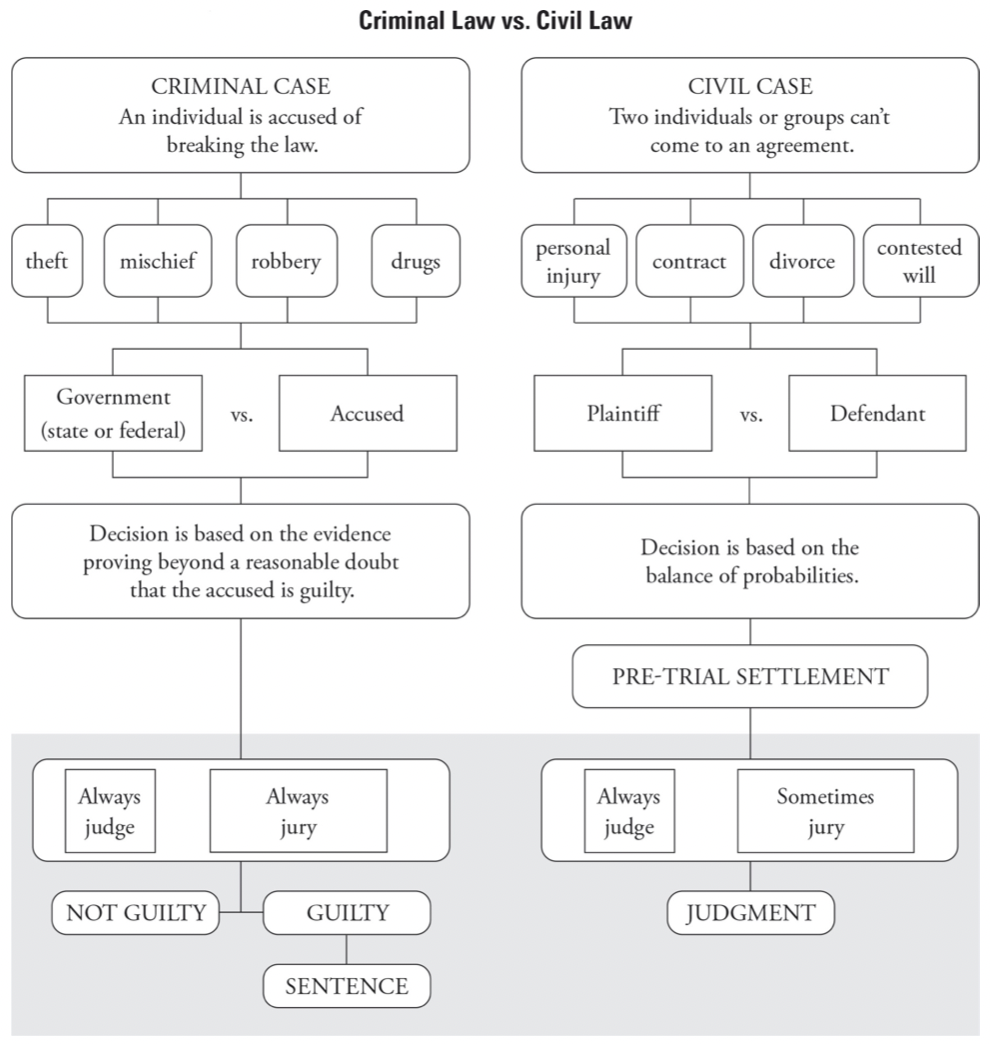
Criminal law involves crimes that harm others
Suspect arrested and to be indicted by grand jury (24-48 jurors, decide whether or not trial should begin
If accused is indicted they have the option of plea bargaining with the prosecution to agree to a less serious crime and sentence
Most cases end in plea bargains
State/US opposes accused in criminal trials
Prosecution should prove guilt beyond a reasonable doubt
Held before petit juries (12 people), decision known as verdict
Guilty verdict only returned if all 12 jurors vote to convict
Split jury = “hung jury”, results in a mistrial
Civil law solves conflicts over custody, contracts, property, or issue of liability
Government is not involved unless it is being sued
No prosecution
Plaintiff vs. defendant in civil court
Case moves forward if judge/jury thinks complaint has merit, settlement is used to avoid trial
Settlement = how much each party is willing to give up
Plaintiff only needs to show that a preponderance of evidence favors their side (~51% of evidence)
Juries can be made of as few as 5-6 members
Winning can result in payment of monetary damages or equity (loser forced to stop doing something that was annoying or harmful)
Structure of Jurisdiction
Federal courts responsible for interpreting/settling disputes from federal law
State courts responsible for interpreting/settling disputes from state law
Three levels of federal courts:
Federal District Courts: have original jurisdiction
Federal Circuit Court of Appeals: hear cases on appeal from District Courts
Supreme Court: hears appeals of cases dealing with the constitution from Circuit Courts and suits between states or cases involving foreign ministers
No jury
Collegial court - decisions made by 9 justices
Acts in appellate jurisdiction, can only decide issues of law and not facts of a case
94 Federal District Courts
Inferior to Supreme Court
Civil and criminal cases in original jurisdiction
Trial court that determines guilt/innocence is court of original jurisdiction
Heat evidence and use juries to decide verdict
dDecide liability in civil cases with monetary losses
Also have juries
Defendant can ask judge to decide a case, but a judge can refuse and force the defendant to have a jury trial
13 Circuit Courts of Appeals
Hear cases on appeal from Federal District Courts or state Supreme Court
Someone has to claim that a federal constitutional right has been violated
Decide issues of law and not fact
No juries - decisions made by panels of appointed judges
Court of last resort, Supreme Court almost never hears cases appealed from the Circuit Courts
Origins of most Supreme Court justices
The Politics of the Judiciary
All judges are appointed by the president for life
Must go through confirmation process in Senate
Impeachment is only method of removal
Appointments have become political
Some presidents have required potential appointees to fill out a questionnaire to determine political/judicial ideology
Nominees almost always of same party as president
In nomination hearings before Senate Judiciary Committee, both parties try to determine how appointees would rule in cases dealing with their issues
American Bar Association evaluates nominee’s qualifications and interest groups often show their opinions
Senators in a state where an appointee will sit have exercised senatorial courtesy - submit a list of acceptable nominees to president
Expected only when president and senators are the same party
Ideological changes in Court’s makeup has resulted in new precedents and rejection of old precedents
More precedents overturned since 1950s than in 150 years
Courts are seen as the least democratic, when they overturn an act of legislature they are overruling the people’s will
Judges who are hesitant to overturn legislature practice judicial restraint
Liberals see judges as constitutional interpreters who reflect the people’s values
Judicial activist: a judge who will readily overturn an act of legislature
Process by Which Cases Reach the Supreme Court
Not part of the Constitution
Supreme Court will not grant an appeal until all other opportunities in lower courts have been exhausted
Often refuses to hear appeal because it agrees with lower court decision
If 4 justices agree to review lower court’s decisions, court issues a writ of certiorari - document used to request lower court transcripts of case
Only rules in cases that involve an actual legal dispute (justiciable)
Places limits on who can bring cases before it - petitioner must have interest in case outcome (have standing)
Judicial Review
Not in the Constitution
Marbury v. Madison (1803):
Chief Justice John Marshall established judicial review
John Adams commissioned William Marbury as Justice of the Peace in DC in the last hours of his presidency, approved by Senate; President Jefferson ordered Secretary of state to not deliver commission
Article III, Section 2 of Constitution - what is the extent of the Supreme Court’s power regarding judicial review?
Ruled that the part of the Judiciary Act allowing the Supreme Court to grant the position of Justice of the Peace was unconstitutional
How the Court Hears Cases
Both sides submit summaries of their arguments (briefs) and legal foundations
Interest groups affiliated with both side of the case submit their own briefs
Amicus curiae briefs: effort to sway the justices, can be very influential
From October to April, court hears oral arguments for cases
Lawyers for each party have 30 minutes to present their arguments before the justices
Federal government will often take one side, solicitor general can argue on the government’s behalf
Known as the “tenth justice”
Second-ranking member of the justice department
Often makes appearances before the high court
Justices meet for a secret meeting after the oral arguments, cast votes, and write opinions
Four types of opinions:
Unanimous opinion: all justices agree, carries most force in future legal cases, ex. Brown v. Board of Education
Majority opinion: the opinion with the most votes, decides the case
Concurring opinion: justices may vote with majority but take issue with legal reasoning
Dissenting opinion: written by justices in the minority, questioning the winning side
Power of Supreme Court limited through:
Constitutional amendments
Judicial appointments/confirmations
Legislation that changes court jurisdiction
Legislation written to counteract Supreme Court decisions
President and states refuse to comply with Supreme Court decisions
The Bureaucracy
Ensures that policies and programs created by Congress and executive branch are carried out
Considered part of the executive branch
Supposed to function above partisan politics
Bureaucrats operate under merit system - hires and promotes people based on skills and experience
15 cabinet secretaries and heads of independent agencies appointed by president and approved by Senate
Most people who work for the government work for one of the executive departments or other “cabinet level” agencies
Department of Defense: largest department, administered by Secretary of Defense
Reports directly to president
Each military service is led by a uniformed chief of staff
Work together as the Joint Chiefs of Staff, carry out defense policy and report directly to president and Secretary of Defense
Policy implementation: primary role of the bureaucracy, determines the process for implementing policy once passed
Must act within constitutional limits and agency jurisdiction
Can develop rules to govern policies and procedures
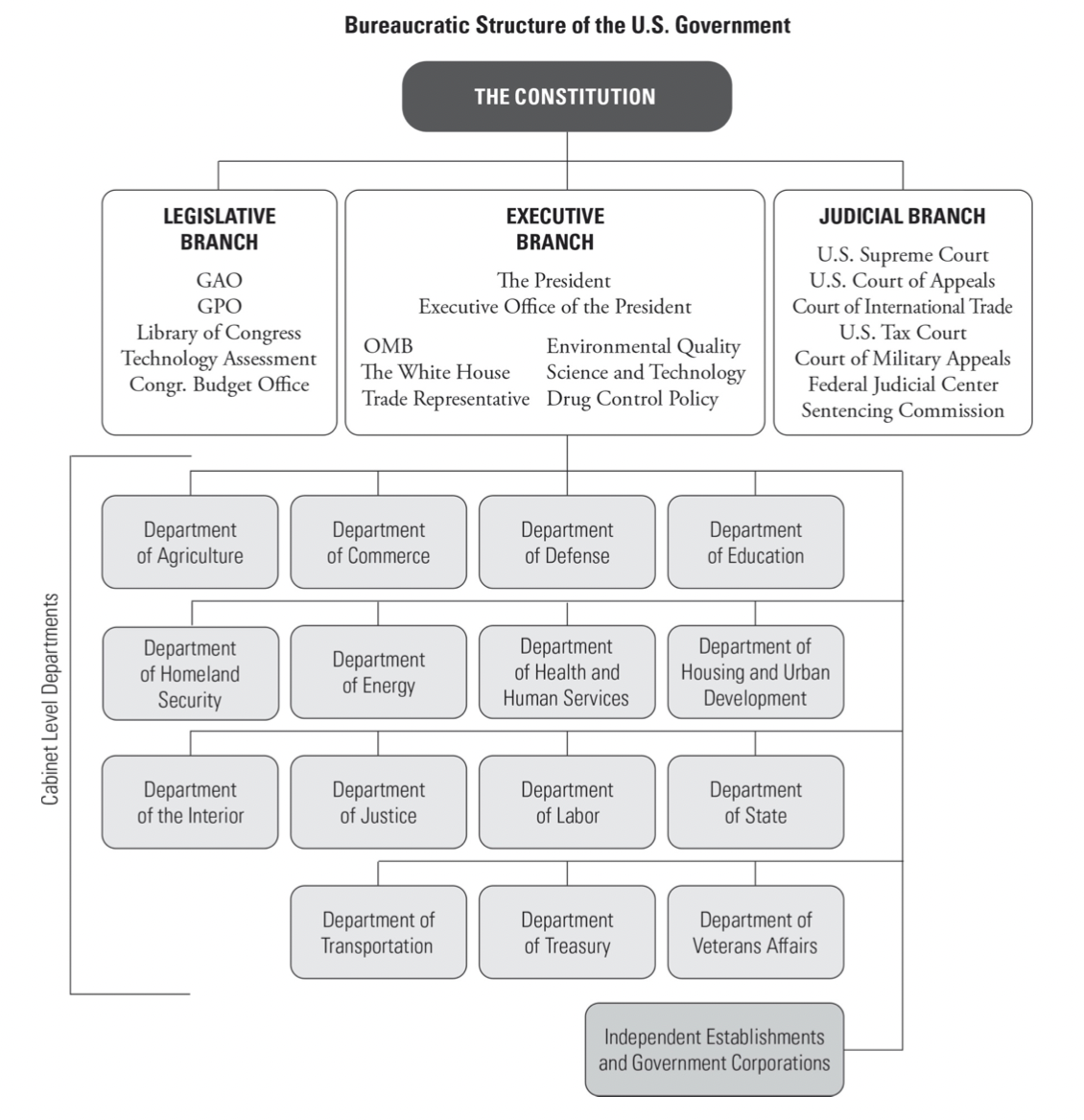
Secretary of department at head of each “pyramid”
Appointed by president, approved by Senate
Undersecretary is direct subordinate, appointed by president without Senate approval
Both undersecretary and secretary replaced at the end of president’s term
Personnel of Senior Executive Service below the secretaries, including appointed and non-appointed
Do not need Senate confirmation
Responsive to White House policy goals and help bureaucrats implement president’s policy preferences
Government Corporations
Hybrid organizations, private business corporation + government agency
Freedom of action and flexibility, produce revenue to support themselves
Ex. Amtrak
USPS was originally created as a cabinet position but has become a government corporation
Corporation for Public Broadcasting produces and airs television and radio
PBS funding comes from private and government subsidies
Most programming related to public affairs, news, and culture
Regulatory Agencies and Commissions
Not within 15 cabinet departments
Two categories:
Independent agencies: generally normal bureaucracies with presidential oversight
Regulatory agencies/independent regulatory commissions: more independence, act as watchdogs over federal government; Congress and president are not supposed to interfere
Writing legislation is complex and often beyond lawmakers’ abilities and expertise - often written in general terms with many gaps
Quasi-legislative agencies: independent agencies who fill in gaps and write rules
Quasi judicial agencies: rule enforcement, punish violators
Bureaucrats often has answers for Congress
Asked for advice and expertise
Often ignored because of interest groups’ pressure
Write and enforce rules that regulate environment, economy, or industry
Examples of regulatory agencies:
Federal Trade Commission: prevents fraud in marketplace, prevents price fixing and deceptive advertising
Securities and Exchange Commission: protects investors by regulating stock markets and preventing corporations from false and misleading claims of profits
Nuclear Regulatory Commission: controls how power companies design, build, and operate nuclear reactors
Federal Communications Commission: assign broadcast frequencies, license radio/TV stations, regulate use of wireless communication
Food and Drug Administration: inspect food supply, regulate sales of over-the-counter drugs and patent medicines
Federal Energy Regulatory Commission: prevent price fixing and price manipulation in energy
Occupational Safety and Health Administration: ensures a safe work environment for workers
Who Runs Regulatory Agencies?
Run by Board of Commissioners (panels of administrators)
Appointed by president with Senate approval
Terms usually overlap president’s term, intended to minimize White House political pressure
Term is 3-14 years
Ex. Federal Reserve Board: policies affect public’s buying power - regulates banks, monetary value/supply, and interest rates
Policies can conflict with president’s policies
Who Controls the Bureaucracy?
Political considerations always play a part in the appointment process, but presidents and boards/commissions vary regularly
Rank-and-file bureaucrats are permanent, but they do not like political interference
Presidents can promote supporters and use budget to change agency’s influence while in office
More congressional power over bureaucracy than presidential
Senate affirms/rejects appointments
Congress can destroy agencies or change jurisdiction
Final say over funding
Rule Setting, Alliance Building, and Iron Triangles
Regulatory agencies set rules and regulations that industry must follow
Participatory process, industry involved in determining rules
Hold public hearings for testimony and advice
Law requires agencies to consult with industry in most cases before rules/regulations can go into effect
Iron triangle: informal alliance made of three groups: particular industry + lobbyists, congressional committee dealing with that industry, and the agency that is affected
Groups that make iron triangle work together to create and implement policy
Lobbyists representing industries promote their agendas by claiming it is in the best interest of the American people
Special interests contribute money to congressional campaigns, large donators ask for help from representatives
Alliance/issue network: a close working relationship formed when issues affect many groups by pro/con coalitions of interest groups, Congress members, and bureaucrats
Regulatory agency writes/publishes rules after input and debate opportunities have been exhausted
Industry can sue regulatory agency if it objects to regulation
Deregulation: removing government restrictions and regulations
Those in favor claim that competition of marketplace is all that is needed
Regulation is expensive and time-consuming
Civil Service and Maintaining Neutrality
Civil service system: Office of Personnel Management is bureaucracy’s employment agency, administers civil service examination, publishes job opening lists, and hires based on merit
Established in 1883 by the Pendleton Act, which ended the patronage system (giving government jobs for political support)
Intended to create a competent, professional bureaucracy
Merit Systems Protection Board investigates charges of agency corruption, protects whistleblowers
Hatch Act (1939): passed to ensure bureaucratic neutrality; permits bureaucrats right to vote but not the right to campaign for political candidates, run for office, or work for parties
Revision of 1993 is less restrictive - bureaucrats can join political parties, make campaign contributions, and display political advertising (buttons/bumper stickers)
Still cannot run for public office, solicit campaign funds from subordinates, or make political speeches