L6 - Nernst Equation and Eh-pH Diagrams
Redox Reactions Continued
Review of Redox Reactions
Recap of yesterday's topics:
Introduction to redox reactions.
Oxidation number: calculation and significance.
Balancing redox reactions.
Potential or electromotive force (EMF): measure of electrochemical energy in redox reactions.
Related to Gibbs free energy.
Convenient way to measure energy flow associated with electron transfer.
Standard hydrogen potential: potential of a half-reaction coupled with the standard hydrogen electrode.
Redox reactions in natural environments.
Today's Focus
Introducing the Nernst equation: its derivation, meaning, and usage.
Eh-pH diagrams: their utility in aqueous geochemistry.
Analogous to mineral stability diagrams (covered last week).
Two-dimensional diagrams with Eh (redox potential) as one axis and pH as the other.
The Nernst Equation
Derivation:
Based on known equations.
Relationship between Gibbs free energy and potential (from yesterday):
Under standard conditions (25°C, 1 bar, activities = 1):
Relationship between free energy, standard free energy, and reaction quotient (from earlier lectures):
Combining these equations gives the Nernst equation.
Nernst Equation:
Simplified version (at 25°C, converting to base-10 logarithm):
Uses of the Nernst Equation
Calculates the potential of a redox reaction under non-standard conditions.
Example: Reduction of iron(III) to iron(II) by hydrogen gas.
Calculate the standard potential () from standard free energies of formation.
(for this reaction) = .
Nernst equation:
If you measure concentration of iron, pH, and hydrogen partial pressure, then you can estimate the potential.
Standard Hydrogen Potential
Potential of a redox couple (half-reaction) measured against the standard hydrogen electrode.
Standard hydrogen electrode: solution with protons at 1 mol/L and hydrogen gas at 1 atm.
For the couple:
Subscript H indicates measurement against standard hydrogen electrode.
Generalized form:
is equal to 1.
Note that the fraction in the log has been flipped because of the sign change.
Example application:
Reducing environment (e.g., sediments): Measure
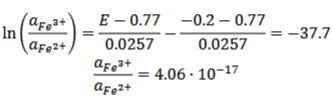
Means massively more iron(II) than iron(III).
Oxidizing environment (e.g., surface seawater): Measure
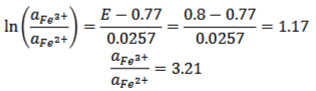
Means more iron(III) than iron(II).
Eh-pH Diagrams
Eh and pH are important environmental variables.
pH: Controls proton concentration; important for acid-base reactions, carbonate systems, mineral precipitation/dissolution.
Eh: Indicates how oxidized or reducing the environment is; controls distribution and concentration of redox-sensitive elements.
Construction:
Similar to mineral stability diagrams.
Lines represent equilibrium between species.
Diagrams are drawn for a specific pressure and temperature (typically 25°C and 1 bar).
Always include stability limits of water.
Water is stable within a certain range of Eh and pH conditions.
Limits are determined by the oxidation of water to oxygen.
Upper limit:
The upper limit is constrained by the oxidation of water to dioxygen
Stability limits of water can be represented by equation. The upper and lower limits of water in the environment are:
Upper Limit:
Lower Limit:
Example: Eh-pH Diagram for Iron-Oxygen-Water System
System: Iron, oxygen, and water at 25°C and 1 bar.
Minerals considered: Magnetite () and Hematite ().
Dissolved species: and .
Total activity of the dissolved Fe species:
Gibbs energy of formation for all species:

Assume a total activity of dissolved iron species (e.g., mol/L).
Steps to Build the Diagram
Boundary between and
Oxidation numbers are different, so it's a redox reaction.
Half-reaction:
Calculate standard free energy of the reaction:
Calculate standard potential:
Apply the Nernst equation:
Looking at this equation, we can see that
Boundary condition: activities of and are equal, so the log term equals 0
Horizontal line on the Eh-pH diagram.
stable above the line (more oxidizing conditions), stable below.
Boundary between Magnetite and Hematite
Oxidation numbers of iron are different, so it's a redox reaction.
Balanced redox reaction:
Calculate standard free energy of reaction using standard free energy of formations.
Calculate the standard potential:
Apply the Nernst equation:
Plot line: y-intercept = 0.152, negative slope with pH.
Hematite is more oxidized, so it's above the line; magnetite is below.
Boundary between and Hematite
Oxidation number of iron is the same in both species (Fe(III)), so it's not a redox reaction. This means that the reaction is independent of
Mineral dissolution reaction:
Calculate the free energy using and rearranging for K.
Write law of mass action:
Boundary condition: activity of equals total dissolved iron activity.
Solve for pH to plot the vertical line.
Hematite stable at high Ph.
Boundary between and Hematite
Redox or not?
Apply Nernst equation.
Remember that at the boundary I have this boundary condition where the activity of the solute is 10 to the -6.
Uses of Eh-pH Diagrams
Predict what is likely to happen in a system.
Determine conditions in the geological record.