Robert Browning
Authorial Context: Robert Browning (1812–1889)
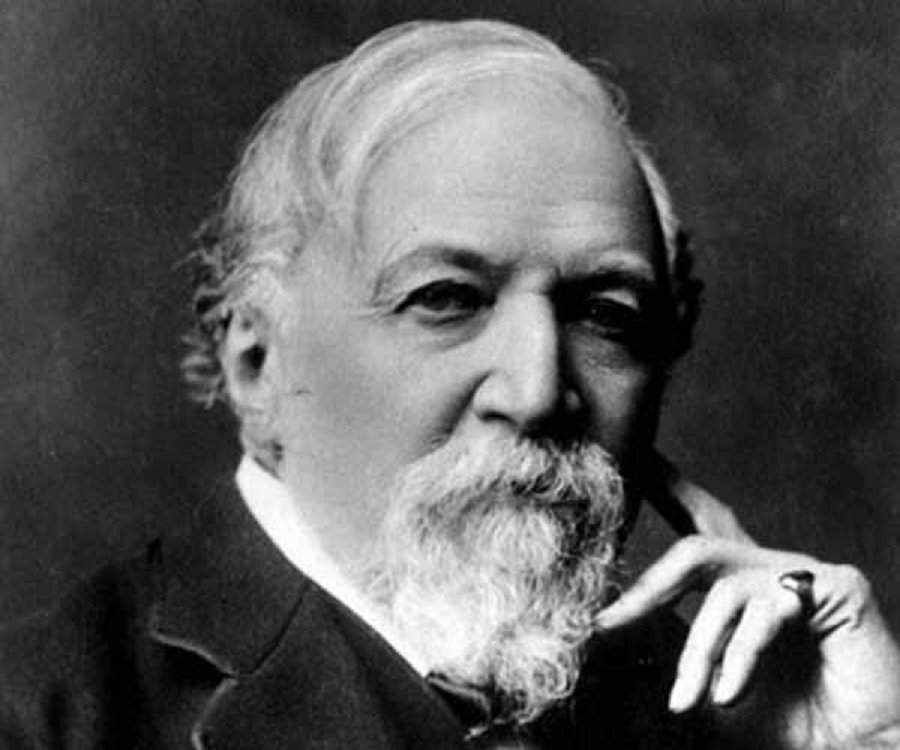
Robert Browning was born in London to a well-read father and an artistically-accomplished mother. Browning received most of his education in and near home. He read and studied eagerly, understanding multiple languages by age 14.
Browning also enjoyed poetry from a young age, particularly the Romantic poems of Percy Bysshe Shelley. Beginning in 1833, Browning began to publish poems and plays. Although his early work was not well-received, later critics have admired his experimental form and diction.
In 1844, Browning read Elizabeth Barrett's collection Poems and struck up a correspondence with her. By 1846, he had arranged for a secret elopement, and they ran away to Italy. There they had a son and continued to write until Elizabeth died in 1861.
Browning and his son moved back to London after Elizabeth's death. Happily, Browning went on to write his most acclaimed works, including The Ring and the Book, and was known as more than "Elizabeth Barrett Browning's husband" before his death in 1889.
Browning's Legacy
According to critics, Browning's poetry is not typically Victorian, and his energetic style reflects Shakespeare and Donne more than Milton or Wordsworth.
Browning is also remembered for his establishment of the dramatic monologue. His monologues are densely layered, requiring the reader to infer pieces of information about the speaker and the poet in each unfolding line.
"My Last Duchess" (1842)
Poem Context
The inspiration for this dramatic monologue was an Italian duke of the Renaissance era, Alfonso II, whose young first wife, Lucrezia, died in 1561. Soon after her death, the Duke courted and married another woman, the niece of the Count of Tyrol.
03:08
Embedded here is an audio performance of the poem. To help with comprehension, listen along as you read or before/after you read.
That's my last Duchess painted on the wall,
Looking as if she were alive. I call
That piece a wonder, now: Frà Pandolf's hands
Worked busily a day, and there she stands.
Will't please you sit and look at her? I said [5]
"Frà Pandolf" by design, for never read
Strangers like you that pictured countenance,
The depth and passion of its earnest glance,
But to myself they turned (since none puts by
The curtain I have drawn for you, but I) [10]
And seemed as they would ask me, if they durst,
How such a glance came there; so, not the first
Are you to turn and ask thus. Sir, 'twas not
Her husband's presence only, called that spot
Of joy into the Duchess' cheek: perhaps [15]
Frà Pandolf chanced to say, "Her mantle laps
Over my lady's wrist too much," or "Paint
Must never hope to reproduce the faint
Half-flush that dies along her throat": such stuff
Was courtesy, she thought, and cause enough [20]
For calling up that spot of joy. She had
A heart—how shall I say?—too soon made glad.
Too easily impressed: she liked whate'er
She looked on, and her looks went everywhere.
Sir, 'twas all one! My favor at her breast, [25]
The dropping of the daylight in the West,
The bough of cherries some officious fool
Broke in the orchard for her, the white mule
She rode with round the terrace—all and each
Would draw from her alike the approving speech, [30]
Or blush, at least. She thanked men, – good! but thanked
Somehow – I know not how – as if she ranked
My gift of a nine-hundred-years-old name
With anybody's gift. Who'd stoop to blame
This sort of trifling? Even had you skill [35]
In speech—(which I have not)—to make your will
Quite clear to such an one, and say, "Just this
Or that in you disgusts me; here you miss,
Or there exceed the mark"—and if she let
Herself be lessoned so, nor plainly set [40]
Her wits to yours, forsooth, and made excuse,
—E'en then would be some stooping; and I choose
Never to stoop. Oh sir, she smiled, no doubt,
Whene'er I passed her; but who passed without
Much the same smile? This grew; I gave commands [45]
Then all smiles stopped together. There she stands
As if alive. Will't please you rise? We'll meet
The company below, then. I repeat,
The Count your master's known munificence
Is ample warrant that no just pretence [50]
Of mine for dowry will be disallowed;
Though his fair daughter's self, as I avowed
At starting, is my object. Nay, we'll go
Together down, sir. Notice Neptune, though,
Taming a sea-horse, thought a rarity, [55]
Which Claus of Innsbruck cast in bronze for me!
"My Last Duchess"
The last three lines imply that the Duke has already set his sights on his next wife. "Innsbruck" is the location of the Count of Tyrol's capital.
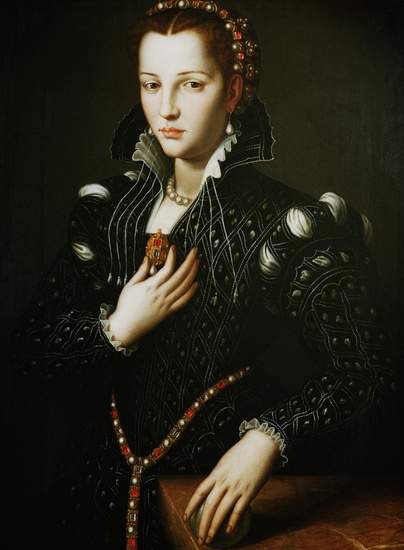
Lucrezia de' Medici, by Bronzino, generally believed to be "My Last Duchess”