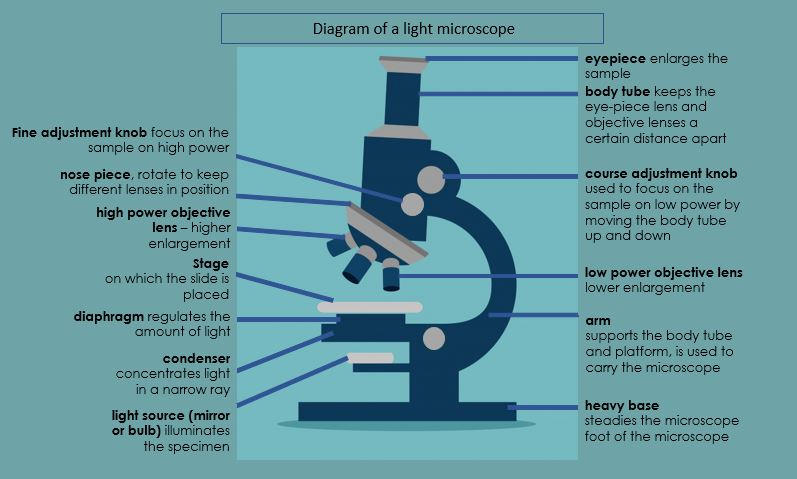
The Microscope
The Evolution of the Microscope
• The microscope was developed in the 11th century by Roger Bacon and was made of magnifying glass.
• Robert Hooke (1635-1703) designed a microscope with two lenses, the first human to observe living cells.
• Anton van Leeuwenhoek (1632-1723) designed a microscope with one lens and became the first human to observe microorganisms.
• Edmund Culpeper (1670-1738) used a mirror to reflect light from beneath the specimen to illuminate it.
• Robert Koch (1843-1910) discovered the bacteria causing tuberculosis and cholera.
• In the 1930s, German scientists developed the electron microscope, which uses a beam of electrons to illuminate the specimen and produce a magnified image.
• Electron microscopes have a greater resolving power than light-powered optical microscopes and can achieve better than 50 pm resolution and magnifications of up to about 10,000,000x.
• Electron microscopes are used to observe a wide range of biological and inorganic specimens, including microorganisms, cells, large molecules, biopsy samples, metals, and crystals.
• Scanning Electron Microscope (SEM) and Transmission Electron Microscope (TEM) are two types of electron microscopes.