Microbiology Lecture 2 - Chapter 3-4
Will not give structures and tell you to label them
Should know what 2 sugars that make it up:
Should know the number of proteins that are mentioned in the slides (like membranes are made up of 2 proteins to give an example
Peptidoglycan Structure
Peptidoglycan is the structure that is responsible for linking the cell wall together
It becomes a helical polymer made up of:
N-Acetylglucosamine (NAG)
N-acetylmuramic acid (NAM)
And attached by oxygen molecule (basically water since the O is attached to 2 H)
Rigidity give specific shape while flexibility allows it to adjust to environment
Not able to withstand osmotic pressure which is what causes cells without cell wall to experience lysis
Can generate one backbone but they have to be linked together
These peptides will be used to form peptide bridges and they will vary (don't need to memorize what they look like )
Enzymes that target the structure vary due to the variations within the structures that link the peptides together
They have learned to protect their structures tho (the amino acids protect against enzymes)
Gram Positive Cell Wall
Gram positive cell wall is unique bc it has thick peptidoglycan wall
Anchors: that anchor together the various layers of cell wall but allow its attachment to anchor to the plasma membrane itself
They impart a neg charge on the cell wall
The lipid headgroups tend to be neg charged as well
This is what causes some stains to stick
They repel anything that is negatively charged
Periplasmic space is open to the outside. they're being Bacteria will release enzymes and they stay in this area
The cell wall is porous and they are large enough to let bacteria pick up what they need from the periplasmic space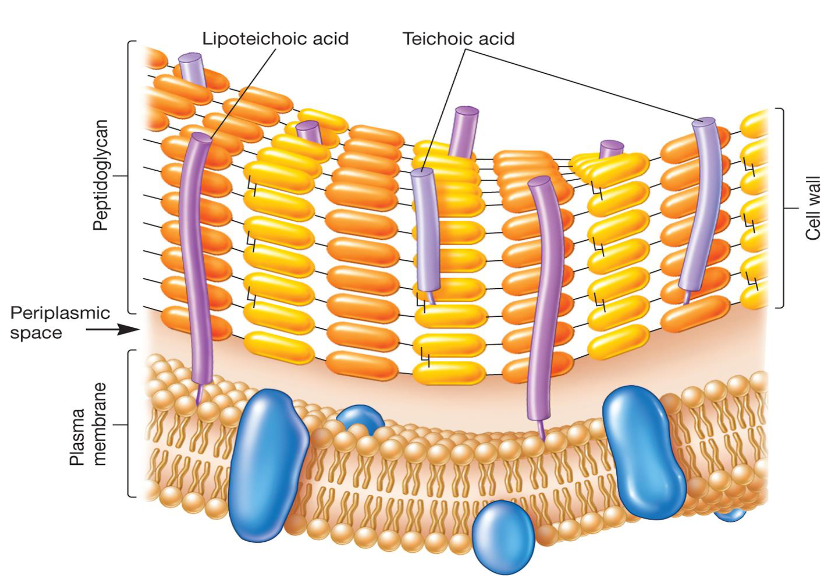
Gram Positive cell walls also contain teichoic acids
They are negatively charged
Help maintain cell enveloped because they’re anchors to the plasma membrane
Protect from environmental substances by acting as a repellent to other negatively charged things
May bind to host cell in the case of a bacteria or pathogenic microbe
Random notes she mentioned:
- dont have extra compartment where they can select what to keep or what to send out
They can't digestive stuff in this periplasmic space
Gram Negative
Order of cell wall layer from outer to inner most:
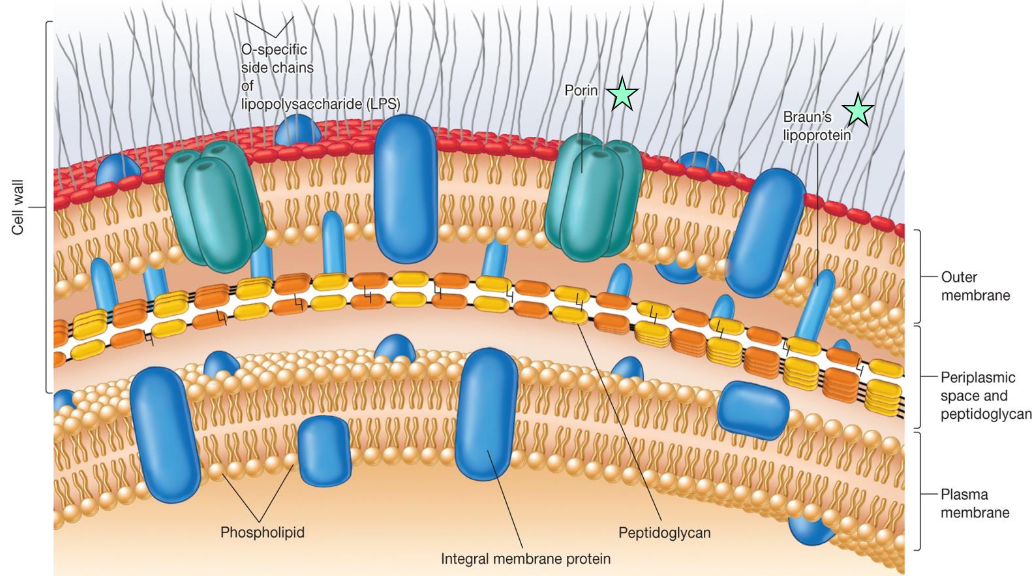
Outer most wall composed of Lipopolysaccharide (O specific side chains)
Includes porins
Creates a hard shell around the typical bi-phospholipid layer
Bi-phospholipid layer with embedded porins and lipoproteins
Brauns lipoproteins serves as anchor btw layer 2 and 3
Small layer of peptidoglycans
Final most inner cell wall comprised of phospholipids with embedded integral membrane proteins
LPS - Lipopolysaccharide
Makes up the outer wall casing
Extensive periplasmic space
Much more complex due to the duel cell wall
Hydrophilic pores open to the external environment and they are large are not selective, this is passive transport
Transport proteins and enzymes and electron carriers
Porins: water filled channel allows passage of molecules smaller than about 600 dallons
The inner layer of the outer membrane is the same structure of the inner membrane
LPS – Lipopolysaccharide
Makes permeability barrier
restrict entry of bile, antibiotics, etc
Protects pathogenic bacteria from host defenses by changing O antigen
Gram neg attract things that live within our gut and this o antigen will allow the body to recognize this pathogen as a threat so that it can get attacked
So basically the bacteria a baller and going incognito into your guts
Lipid A is a potent endotoxin
May casually cause septic shock
Gram negative infection: If youre whole immune system is notified of a pathogen and it reacts as the whole, this could potentially cause high blood pressure and convulsion
You would not use antibiotics that target the LPS
Endotoxin is only release when the cell lysis itself
Exotoxin is released as it is being activated
Prevent this by stopping cell lysis of gram negative cells on a large scale
Glycocalyx
Glycocalyx: Coating of molecules external to the cell wall
Layer of amino sugars
Cant be washed off and allows them to adhere to surfaces
Allows water to be stored around the wall and remain hydrated
Two types:
Slime layer: twitching motility
Capsule: K antigen
A layer of mucus that protects them
Kind of a biofilm
Has them remaining slippery (this is good for viruses)
Negative stains will let you know if the microbe has a capsule
S layers
Regulatory structured layers of protein or glycoprotein that self-assemble
This is like some armor
Protects from ion and PH fluctuations, osmotic stress, enzymes and predation
Involved with the growth of the cell wall - helps in cell wall synthesis and maintenance
Involved in cell division
In gram negative bacteria the S layer adheres to outer membrane
In gram positive bacteria it is associated with the peptidoglycan
^ basically in both it is on the outer most layer
Maintains the shape and rigidity
External structures
Fimbriae
Hairlike bristles that are used to attach to a surface; e.coli is an example
Are a lot more numerous on the body
Adheres to other surfaces or microbes
Pili
Diff bacteria are able to synthesis tubes made up of protein that can anchor other microbes towards their body
A form of sexual reproduction since the anchoring leads to reproduction
Less on the body (looked like 2-4 max)
Flagella
Threadlike locomotor appendages extending outward from plasma membrane and cell wall
Functions
Mobility and swarming behavior
Attachment
May be virulence factors
Come in different arrangements and with different amounts depending on the goal of the bacteria
Structure
Gram neg bac and pos are different but they both have the filament which will help it propel itself; it is embedded into the onvola/membrane itself from the basal body (part of the flagella)
Bacterial Flagellar growth
Have ribosomes that assemble proteins that will associate with the inner phase of the plasma membrane and will transfer RNA that is the blueprint for the flagellar protein. There are no ribosome in the periplasmic space so that means that everything out of the plasma is assembled and pushed through the basal body
The ribosome has help of cap proteins with one job on the outside of the cell wall (typically know the structure of the flagella
Mechanism of Flagella
The flagella
Basal body is the mechanism that performs the movement
The mechanism of the energy using that allows for movement (it uses the charge/proton gradient)
The bottom disc of the basal body does the twisting movement (basically the rotor)
Many strains that are antigenically
O antigen
Somatic antigen
H antigen
Flagella antigen
K antigen
Capsular fimbriae antigen
^ this allows you to know what type of microbe it is (goal and mechanism)
Motility
Flagella move in to different directions (counter and clockwise)
Bacteria and archaea have directed movement
Chemotaxis: directional movement towards or away from something
Move in response to
Movement
Tumble (clockwise)- halting movement or change direction
Run (counter) - pushing forward
Twitching motility - bacteria with pili do this to move around using the pili (not for sex)
Chemotaxis
directional movement towards or away from something
Can have positive or negative chemotaxis
When no gradient of nutrients, they just tumble in a lost fashion, this means they most likely have chemoreceptors
Swarming
It is not understood
Bacteria always form a pattern when you put them under similar conditions
They stay as a little colony and move as a colony
Spirochete motility
Spirochete mobility: The flagella wraps around the body of the bacterium
They have a corkscrew movement after taking this shape
They're flexible (which separates them from
Specific to spirochete bacteria
The cytoskeleton
They don't
have organelles
Nucleus centered
Rough endoplasmic reticulum
Mitochondria membrane
FtsZ protein is what allows microbes to divide and remain together
Intracytoplasmic membranes
A lot of bacteria that perform respiration or photosynthesis or using nitrogen they have additional membranes due to the extra proteins necessary which means they will inc their surface area of the cell wall and membrane
This results in infolded membranes to inc surface area
Inclusions
Mechanisms to store glycogen and overall storage
Granules of organic or inorganic material that are stockpiles by the cell for future use
Granules, crystals, globules
Some icnlusions are enclosed by single layered membrane (which help put things away)
Membranes vary in composition
Storage inclusions
Carbon storage
Phosphate storage
Amino acids
Diff microbes have ability to store different things
Micro-compartments
Micro-compartments: Organelles that help compartmentalize different functions
*not for storage
Done by proteins
Gas vacuole that made up of layers and layers of proteins
Makes it buoyant
Magnetosome - align them with the earth's magnetic field
Linear arrangement
Attached to teh membrane
Ribosomes
Involved in protein synthesis
Can target bacteria ribosomes with antibiotic but spare our owns meaning they're a bit different
Ribosomal RNA have protein and some are similar but some are different
#S in font of the protein name is used to show how quickly they settle down and this difference can be used to target them
If they use their shape, they lose the ability to perform tasks
Nucleoid and Plasmids
Haploid:
Diploid: 2 copies of genetic material
Polyploid: Can have multiple copies of their genetic material
Nucleiod refers to the place that has the genetic material and mainly free of enzymatic reaction (its own little area)
Needs to package it well or could be too long
Proteins tightly package it and is found in nucliod region
The main dna that has all the genes will be found in the chromosomal dna
Plasmids used to transform bacteria
Advantagous:
F factor plasmid carries gene for fertility
These are not essential for nutrient usage, waste productions
R Factor plasmid allows to pass genes on
Endospores structure
Sometimes bacteria will make endospore and keep them around or use them
They are survival structures and store them in a particular space within the cell
Endospores layers
Coat is most important layer; impenetrable layer
Cortex a lot of peptidoglycan
Core is dehydrated (has 70% water and needs a lot of water)
This makes it stabilized
Hydration causes reactions (water needs to be there), if no water than there are no reactions happening
No metabolic reactions to happen, and no water changes the shape of the enzymes, therefore nothing happens
In a way its just dormant
*bacillus spores is what causes smell of rice after being sat out for a couple of days
Boiling spores will only germinate them
Spores grow and produce gas and thats why you shouldn't use cans that are deformed
Sporulation
Divides unequally (which not normal)
The endospore (free spore at the end) has to remerge >>> look at hte next slide for more info
ARCHAEAL Membranes
Composed of unique lipids
Have a monolayer
They have very stable chemical bonds which allows them to thrive in extreme environments
They have the ability to introduce ring layers
They dont have peptidoglycan but they have cell wall with similar structural integrity and function
Lysosomes dont work against them, their peptides are made up of ….
Ribosomes
Share same proteins with everyone but also have their own
GO OVER THE SLIDES LEFT OVER
Staph - violet positive
Mega - violet positive
Endospore - both, variable?
P aeru - red, neg
E. coli - red, neg
*membranes need a bi layer