Spinal Reflexes
simplest neurological pathways
basic reflexes: we are born with these inherent reflexes, usually protective, also called spinal reflexes
acquired reflexes: become reflexive after a lot of practice and learning
reflex arc: components involved in making a reflex happen, consist of:
receptor: detects stimulus
afferent pathway: triggers action potential in afferent neuron
integrating centre: processes and decodes afferent information (usually the spinal cord in basic reflexes)
efferent pathway: transmits integrating centre’s ‘decision’/motor action
effector: receives signal from efferent pathway, typically a muscle
Myotatic (Stretch) Reflex
triggered by passively stretching a muscle, which then causes it to contract
the passive stretch of the whole muscle is detected by the muscle spindle
muscle spindle is the receptor in a stretch reflex, found deep within muscle belly
muscle spindle’s stretch triggers action potentials in the afferent pathway
Monosynaptic reflex: when two neurons, and therefore one synapse, are involved
ex. patellar tendon reflex
Reciprocal Innervation
most stretch reflexes have reciprocal innervation to prevent antagonist muscle from contracting (keeps it relaxed)
sensory afferent neuron synapses with the inhibitory interneuron —> inhibitory neuron synapses with antagonistic muscle
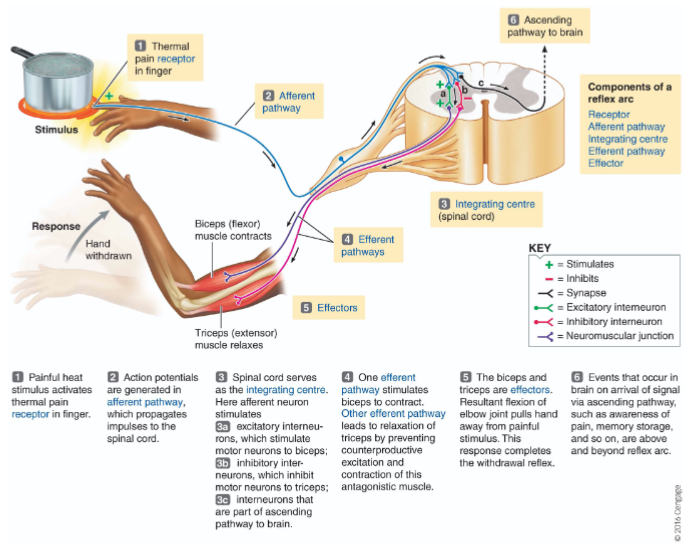
Withdrawal Reflex
painful stimulus will activate a receptor (ex. touching hot surface)
sensory afferent neuron synapses with:
excitatory interneuron —> motor neuron (ex. to biceps)
inhibitory interneuron —> motor neuron (ex. to triceps)
interneuron —> brain
Polysynaptic reflex: involve more than 1 synapse between afferent and efferent neurons
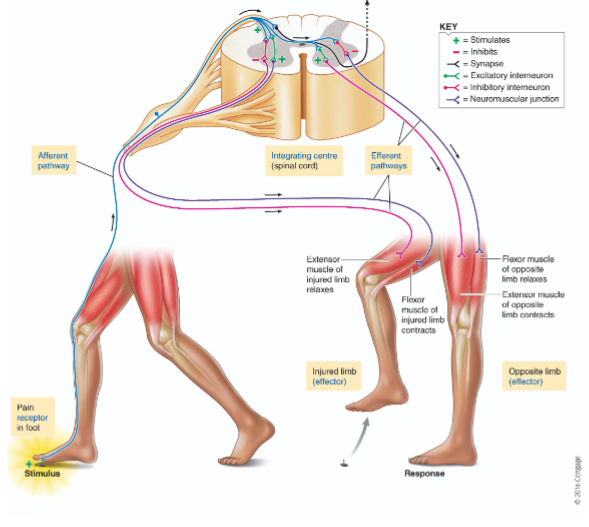
Crossed Extensor Reflex + Withdrawal Reflex
painful stimulus activates receptor
sensory afferent neuron synapses with:
Excitatory interneuron —> motor neuron to flexor
Inhibitory interneuron —> motor neuron to extensor
Interneuron crosses spinal cord then up to brain
sensory afferent neuron cross spinal cord and then synapses with:
Excitatory interneuron —> motor neuron to extensor
Inhibitory interneuron —> motor neuron to flexor