2. Complement Deficiency & Pathology
Complement is part of the innate immune system which has three pathways in order to destroy pathogens
Classical
Alternate
Lectin
The main aim of complement is to ensure when attacking pathogens in the body they do not destroy our own healthy cells.
Just like a helmet is worn in order to prevent massive damage from an accident. Our normal healthy cells have precursors to prevent our own innnate immune system to destroy themselves.
Membrane Bound Regulators:
Decay Accelerating Factor (DAF)
Membrane attack complex - Inhibitory protein (MAC-IP)
Membrane Cofactor of proteolysis (degrades C4b and C3b)
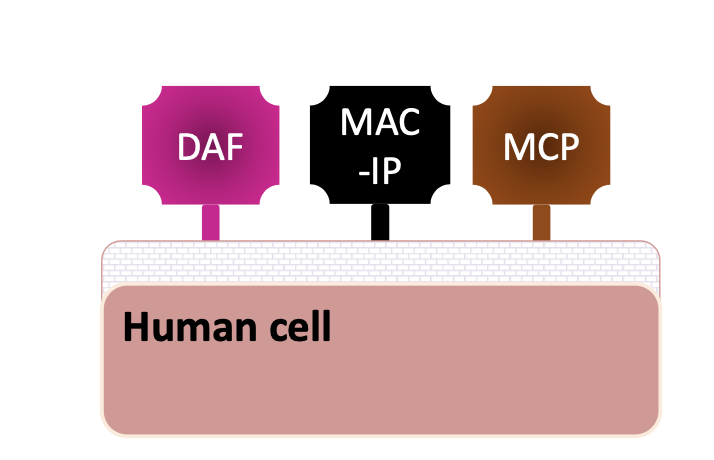
There are also soluble regulators in the plasma or extracellular fluid which are recruited on host cell surfaces to prevent complement self-attack. Sialic acid and glycosaminoglycans on the human cell will also facilate in the binding or reulators from the blood.
MOST SELF ATTACK IN THE BODY HAPPENS VIA ALTERNATE PATHWAY
C3 in the blood stream undergoes constant hydrolysis especially in the plasma to become C3b.
C3b can bind to any -OH or -NH2 groups either on microbial or human cells leading to complement activation and cell lysis
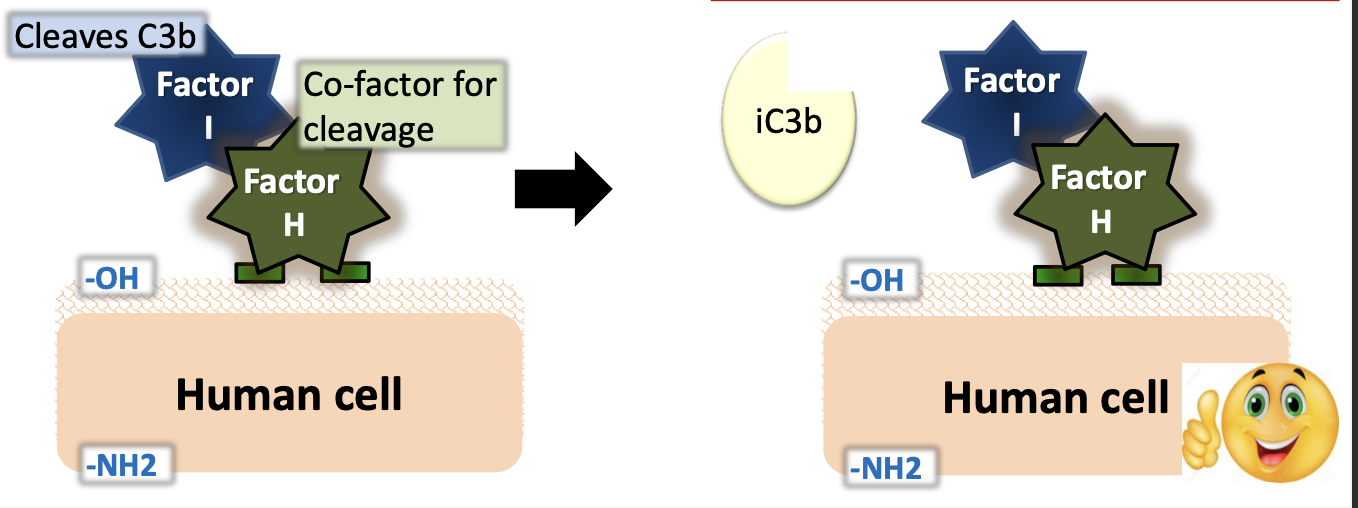
In order for healthy cells to prevent being attacked. Factor I (in blue) is an enzyme used to inactivate C3b to breakdown the healthy cell. However it requires a co-factor in order to work and stop C3b from breaking down the cell (in this case factor H)
C3b will then be iC3b (inactivated C3b) meaning the complement cascade that happens after will not proceed and the cell will not break and be safe
However what happens when there is a polymorphism in the factor h protein?
when one amino acid sequence is mutated in factor H it makes it wont be able to bind t glycosaminoglycans that are present on human cells. As factor H is unable to bind to glycosaminoglycans the co-factpr is unable to function with factor I
Therefore if factor I cannot bind this will lead to C3 continued complement activation. Therefore the healthy cell will breakdown.