Research
Improving Animal-Welfare Standards for Invasive-Species Management (in England)
to explore this i will be juxtaposing the treatment of endangered species as opposed to the managment of invasive species
The logic of choice/ care with the other (animals, plants) - disease and farming, pets and preservation/extinction- invasive species, what we define as alive, pain and different standards, pesticides, the “other”
van Dooren (2015) — ‘A Day with Crows: Rarity, Nativity and the Violent-Care of Conservation’
summarising an issue of wider concern
‘violent-care’ that structure
how living beings are valued or sacrificed within contemporary conservation practice’ pg 1
‘ values and framings that are already shaping
possibilities for life and death’ pg 1
the future of the
species is dependent on the intimate and dedicated daily care provided in these captive facilities:
feeding, cleaning, protection and enrichment, provided by a small team of staff 365 days a year’ pg 2
‘a ‘conservation ontology’ – that shapes
decision making about which animals are cared for, but also about those that can, or must, be
‘sacrificed’ in the name of conservation.’ pg 2
the notion that conservation
today is grounded in a very particular ‘regime of violent-care’ that operates with reference to
two key criteria: rarity and nativity. Of course, the violence of conservation can take a variety of
forms: abandonment, suffering, captivity, and killing (Rose; Chrulew; van Dooren 2014;
Kirksey).
‘competing ontologies and their associated regimes of
violent-care, each proposing that different values and criteria – other than those of rarity and
nativity – should structure decision making about who lives, who dies and for whose sake’ pg 3
‘highlight and analyse the way in
which relatively abstract conservation values and priorities are being enacted in situated
locations.’ pg 3
‘Day in day out, 365 days a year, these birds must be fed, watered, monitored and cared for. In
addition, staff spend hours each afternoon on ‘enrichment’ activities, working with the birds to
ensure that they are challenged and stimulated physically and mentally (discussed further
below).’ pg 5
‘Once eggs are laid,
some of the females are given the opportunity to incubate, while other eggs are taken away by staff to be machine incubated and hand reared, requiring round the clock feeding and care for
their first months of life.’ pg 5-6
‘While many aspects of the project are certainly very basic, and conservation work on the
islands in general is highly underfunded relative to mainland expenditure (Leonard), this
investment is a clear indication of how much these birds matter, at least to some people and
some institutions.’ pg 6
‘care for ‘alalā is grounded in the now thoroughly entrenched ideals and values of a global
conservation movement’ pg 6
‘as Kate Rawles has argued, it would be a mistake to assume that the sole
focus of contemporary conservation is biodiversity in an absolute or straightforward sense. She
notes that “there is an element in conservation goals that is irreducibly to do with preserving the
native, or the natural or, perhaps, with preserving a historical lineage” (Rawles 205). In this
context, contemporary conservation is not just about maximizing biodiversity, but rather native
biodiversity: the goal is to maximise the right kinds of diversity in the right places (van Dooren
2011).’ pg 7
‘What emerges from these values and commitments is an approach to managing the
living world in a way that, in each distinct locale, prioritises the needs of the rare and the native,
and above all else the rare native – like the ‘alalā’
‘these birds are arguably the
‘pinnacle of intelligence in the ecosystem.” pg 9
‘More generally, people point out that these birds are a vital
living member of the larger Hawaiian landscape that carries meanings and stories, and so ought
to be valued and protected (anonymous interviews, 2013)’ pg 9
‘In Hawai‘i, and around
the world, care for some species and ecosystems is now inseparable from the ongoing, and often
fatal, ‘management’ of others. Focusing specifically on the violence of killing, we see that it is
widespread and multiplicitous in contemporary conservation.’ pg 9
‘Sometimes conservation programs kill to remove predators or competitors, or to remove individuals or species that alter
ecosystems in undesirable ways At other times, animals might be killed to provide food for an
endangered species, either because a captive population needs to be fed or because for some
other reason a group of ‘desirable’ free-living animals is not able to locate adequate amounts of
safe food (i.e. ‘vulture restaurants’). In yet other cases, animals might be killed to provide
valuable information and learning opportunities, either for individuals of the endangered species
itself or for their human carers (van Dooren 2014, 108-122).
‘On the day of my visit, the main enrichment focused on
‘gourmet mice’ – animals bred for the pet food industry, frozen and flown in from Florida. We
pushed each dead mouse into a green rubber ball, which we then stuffed with grass to conceal
the mouse and make it a bit more challenging for the ‘alalā to get at.’
‘My interest in juxtaposing care for species like ‘alalā with the killing of a range of other
animals is to explore the underlying regime of violent-care that structures life and death
possibilities in contemporary conservation.’
‘This regime is a product of the broader framework
of values that informs conservation ontologies: in particular, it is structured around the
aforementioned goal of conserving native biodiversity’
‘Grounded in this goal, conservation
programs tend to create basic divisions between desirable and undesirable organisms through the
interplay of two key contrasts: ‘rarity’ and ‘nativity’’
‘In this context, the deaths of mice enable care for ‘alalā.’ pg 11

‘As an abundant and easy-toreproduce
‘resource’, these mice are a good example of the operation of the criterion of rarity.’ This distinction embodies the two extremes of the endangered species classification systems that
now exist at a range of scales, local, national regional and international, ranging between the
‘critically endangered’ and those of ‘least concern’. pg 11
‘‘Least concern’ here
crosses over from the species to the individual as those, like mice, whose species is of least
concern are themselves rendered dispensable for the sake of the more endangered. Their lives
simply do not count equally through the lens of a conservation ontology.’ pg 11
‘In contrast to this rare individual, around the world captive endangered animals whose
genetic material is ‘over-represented’ might be deemed to be surplus to the ‘species survival
strategy’, and consequently killed when space or resources are limited (Chrulew).’ pg 12
‘But here too,
even if in more subtle ways, those birds who are ‘over represented’ (or no longer breeding) –
those with the genes of ‘least concern’, relatively speaking – will tend to be called upon first in
potentially higher risk situations.’ pg 12
‘utilised “adult nonreproductive
‘alalā” to ensure that certain plant species were not toxic before allowing the rest
of the captive flock to consume them’ (Culliney 8) pg 12
‘Similarly, as the time
approaches for release, it is likely that, as in similar programs around the world, birds with less
valuable genes will be the first to travel out into the wider world, paving the way for their
(genetically) rarer and more valuable kin.’ pg 12
‘It is therefore not rarity in any
objective sense that structures priorities here, but rarity as filtered through the prism of a range
of all too human, and often all too ‘western’ (Thompson), institutions, assumptions and
priorities’ pg 13
‘In addition, cats spread
toxoplasmosis, which can be lethal to many native and endangered species in the islands, from
‘alalā to Hawaiian monk seals (Work et al.; Honnold et al.). As a result, in many conservation
areas around the islands cats are now trapped and culled.’ 13
‘When
she enquired about the pigs he told us that they were two relatively young males. Now tied up in
the back of his truck, they would be killed and butchered for meat that afternoon.’ pg 14
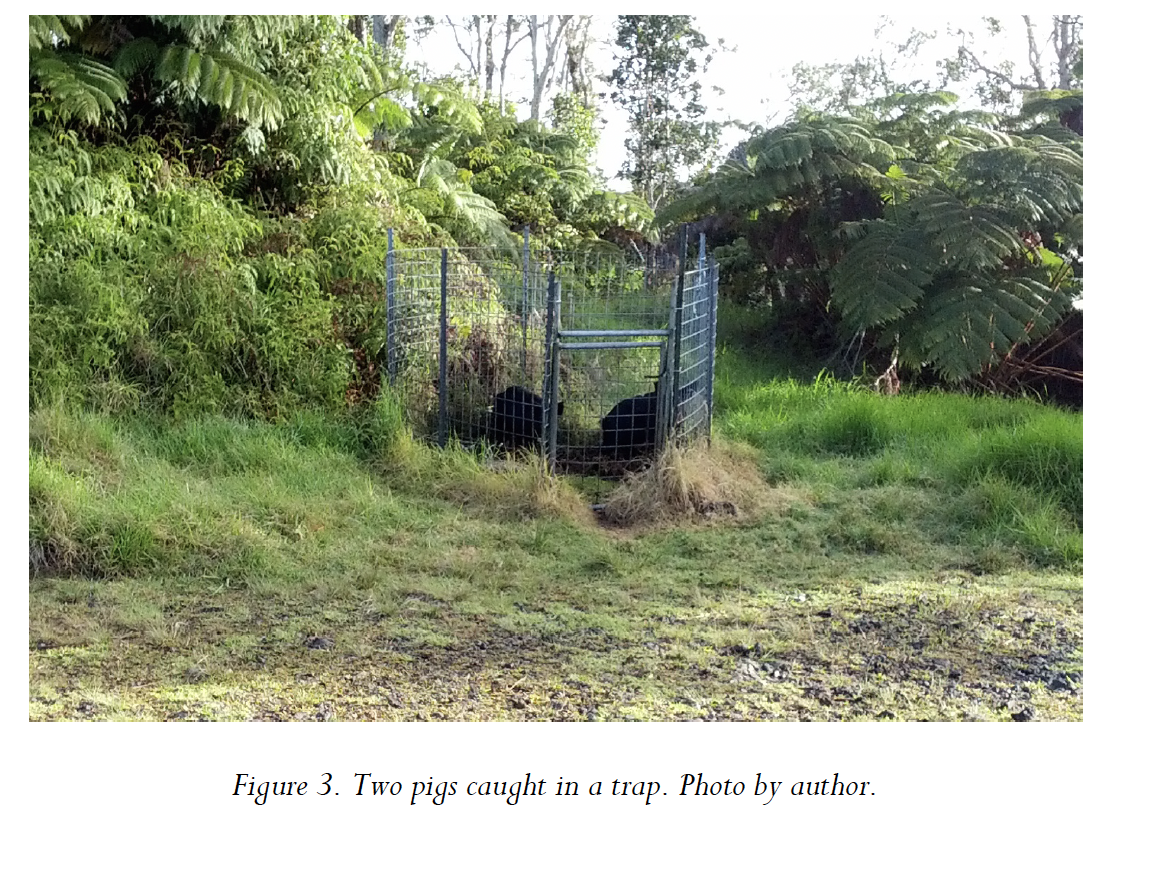
important to note that the pigs cause a lot of setruction of the islands forest and so on pg 15
‘Amongst Hawaii’s conservation community, it is now hard to find someone who thinks
that maintaining the island’s biodiversity is at all compatible with the presence of pigs and other
ungulates – at least within any given area (Juvik and Juvik). But pigs and many other ungulates
are ubiquitous in Hawai‘i – unless they have been fenced out, culled, and then actively managed,
they are present. As this is expensive, it tends to only happen in limited areas. In addition to
expense, there is ongoing and often forceful opposition by hunters to most efforts to remove
pigs and other ungulates from public lands, including state forest reserves that are, at least in
part, designated as conservation areas (van Dooren 2016). While it may be reasonable to keep
populations of ungulates for hunting in some specific areas, for most conservationists it is vital
that they not be allowed to continue living as widely as they currently do.’ pg 16
‘As noted above, it is not simply
biodiversity writ large, but rather native biodiversity, that is the goal of conservation.’ pg 16
‘Through the lens of a conservation ontology, those ‘introduced
species’ that arrived after this point are viewed as at best expendable, and at worst a threat that
requires eradication. All over the world, introduced species are now often public enemy
number one, killed in their thousands and sometimes millions (Simberloff).’ pg 16
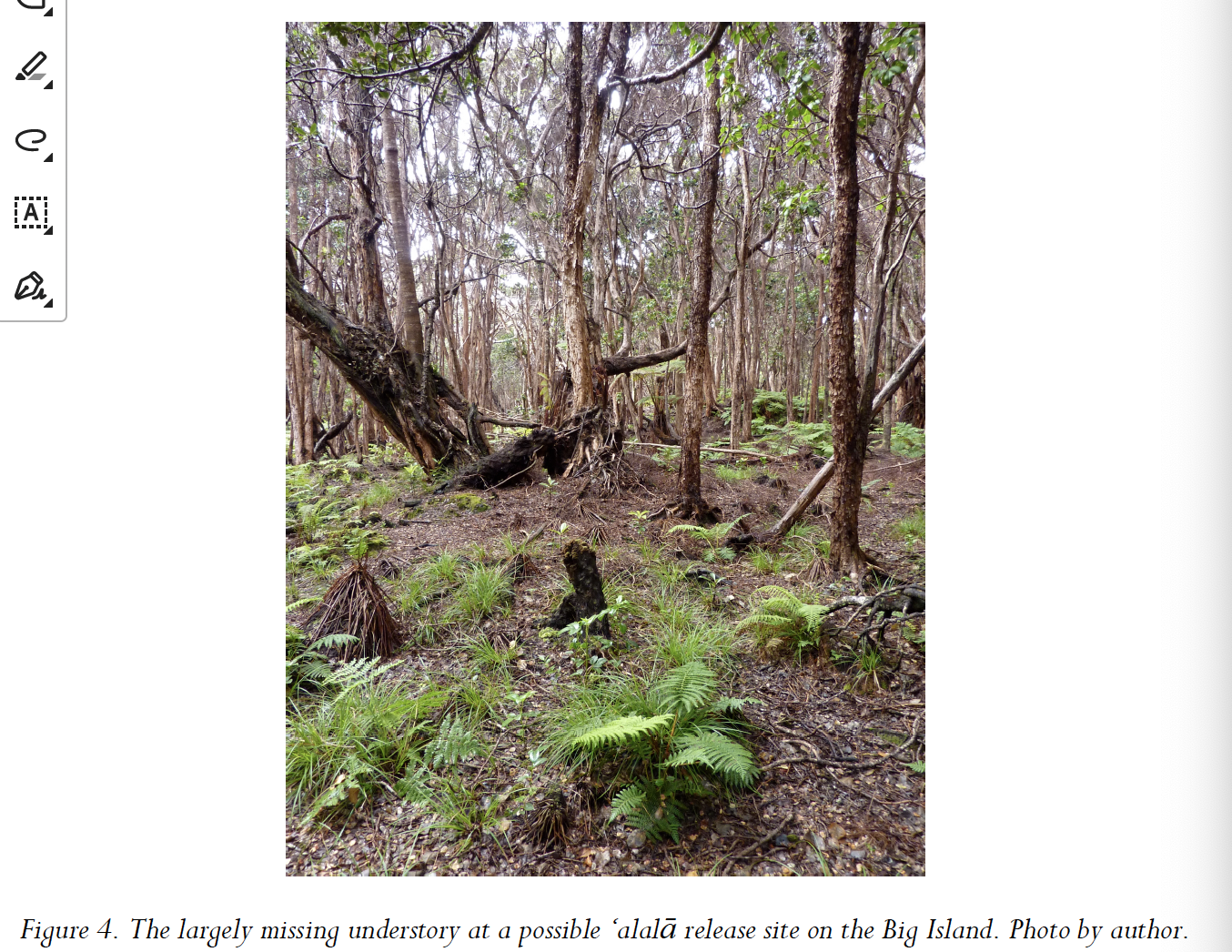
‘While cats, mongoose and pigs pose little threat to the crows at KBCC, things will be
very different for released birds. At the present time, several areas of forest have been proposed
as possible release sites for ‘alalā. In each case, a large area of forest will be fenced to exclude
pigs and other ungulates, and all of those animals inside will be killed to enable the restoration of
forest ecosystems (Geometrician Associates). Doing so, it is hoped, will provide ‘alalā with the
diversity of plants necessary for good year-round diets and an understory to hide from ‘io
(Hawaiian hawks), while also minimising the spread of avian malaria. Cats and mongoose, as
well as rats, who cannot be excluded by basic fencing, will likely be actively poisoned or
trapped. ‘Removal’ of these predators will reduce their impacts on birds, especially juveniles,
and minimise the risk of toxoplasmosis and some other diseases.’ pg 16
‘Over the past several decades, the introduced/native divide has been the subject of
sustained criticism from within both the natural sciences and the humanities and social sciences
(Davis et al.; Wright; Keulartz).’ pg 17
‘Scholars have explored the problematic nature of assuming that
some prior historical state marks the ideal or best environment. In the context of ongoing
evolution, migration, climatic and other transformations, there is no static ‘right state’ or
‘correct’ species composition. With this dynamism in mind, scholars have argued that perhaps
we ought to pay more attention to actual relationships between newly-arrived species and
existing ecosystems, rather than assuming that ‘introduced’ species will necessarily cause ‘harm’
(Sagoff; Davis et al.).’ pg 17
‘In the context of climate change and other large-scale ecological
transformation, this traditional approach will be at best unworkable and at worst deeply
destructive (Soulé 1990).’ pg 17
‘Other scholars have drawn attention to the anthropocentric, and often
Eurocentric and xenophobic, assumptions and rhetoric that underlie the notion that (some)
human activity and species introductions necessarily disrupt the ‘natural state’, and that vigorous
‘invading aliens’ ought to be suppressed in the national interest (Head; Coates’ pg 17
‘In Hawai‘i, this already complex division between native and introduced takes on a
particular political form. As Stefan Helmreich notes, many local people – including biologists –
now commonly speak of a third category of organisms: canoe species. These are the plants and
animals brought to the islands by Polynesian peoples roughly 1,500 years ago, almost all of
which are culturally significant. As will be discussed further below in the context of pigs – one
of the most culturally important and arguably ecologically destructive of these canoe species –
there is sometimes strong opposition to claims that these animals are ‘introduced’ or ‘invasive’
and consequently ‘out of place’ in Hawai‘i. Humans are bound up with other animals here, and
this ‘ecological’ claim is readily interpreted as (or becomes?) a ‘political’ one (van Dooren
2016).’ pg 17
‘Of course, figuring out where organisms ‘fit’ in relation to criteria of rarity and nativity is in
practice only the first part of determining who should live and who should die in the name of
conservation.’
‘At KBCC on the day of my visit, the lives and deaths of animals, the violence and the care, were
all very straightforwardly structured around the priorities of contemporary conservation
ontologies.’ pg 19
‘distrust. In contrast to the dominant scientific view that pigs damage
forests and cause erosion, some hunters argue that pigs actually play a positive ecological role:
tilling the soil and rooting out weeds. For other hunters, these ecological debates are largely
irrelevant: the question is simply whether birds and their conservation should take priority over
hunters (anonymous interviews, 2013).’ pg 19
‘These debates between hunting and conservation are now familiar all over the USA, and
in many other parts of the world (Adams; McCarthy). In Hawai‘i, however, they take a
distinctive form, especially when it comes to pigs. Unlike other ungulates, pigs were initially
introduced to Hawai‘i by Polynesian peoples and they remain an important part of Hawaiian
culture in the form of stories like that of Kamapua‘a, the pig god (Kame‘eleihiwa). More
importantly, today pig hunting is seen by many to be a traditional cultural practice, as well as an
important recreational and subsistence activity. As a growing body of scholarship is showing,
however, pig hunting in the islands is likely a product of the last couple of hundred years.’ pg 19
‘Pigs offer a prime example of the way in which the dominant conservation discourse is
disrupted by the ‘friction’ produced in local contexts’ pg 20
‘As Jonathan Goldberg-Hiller and Noenoe K. Silva have
noted in relation to the conservation of sharks in Hawai‘i, native culture is frequently
‘(mis)appropriated’ in these conversations, and presented as unproblematically aligned with
government conservation objectives.’ pg 20
‘Quoting proposed 2010 legislation, they note that
“ecological balance is seen as coterminous with the ‘great cultural, historical and spiritual
significance [of sharks] for many native Hawaiians, native Hawaiian practitioners, and others who
value the Hawaiian culture’” (430).’ pg 20
‘In addition to
questioning the conservation science and its values, many of these people see the pig as a vital
part of their culture, and take personal offence at the suggestion that it is an ‘invasive pest’.’ pg 20
‘“These animals brought by Hawaiians and given to Hawaiians as a walking
food source is not invasive. And if they are, Hawaiians are invasives?’ pg 20
‘For these people, conservation is often incompatible with culture and tradition (van Dooren
2016).’ pg 20
‘To this end, some hunters advocate the introduction of plants and other alterations to the
environment that will aid pigs and other ungulates to thrive, and even (re)introduce pigs to
already fenced conservation areas. In one sense, these animals are deeply cared for here,
although always under the spectre of their coming death; cared for so that they might be killed
another day. But this care too is unavoidably coupled with violence towards others, in this case
towards ‘alalā and the many other birds and plants hanging on at the edge of extinction in
Hawaii’s forests.’ pg 21
‘Hawaiians do not share the views of these hunters about the place of
pigs in either the forest or in Hawaiian culture. For these people, the islands’ forest are alive
with a diversity of plants and animals, all of whom have their places in Hawaiian stories and
culture, and many of whom are currently being sacrificed for the sake of pigs and those that hunt
them (van Dooren 2016).’ pg 21
‘In the case of
‘alalā, the primary issue is what is to be done with the many feral cats in release sites who will
likely depredate young birds and spread toxoplasmosis and other diseases. Usually, trapping and
killing – preferably over a broad area – is the key response from conservationists.’ pg 21
‘Situations like this one remind us that, although ostensibly built around care for animals,
activities grounded in animal welfare and rights agendas are nonetheless structured by their own
regimes of violent-care.’ pg 22
‘We see this too in diverse animal ethics positions which – whether
focused on capacities like sentience (Singer), being the “subject of a life” (Regan), or more
informal criteria like cuddliness and familiarity – inevitably end up preferencing the lives of
some over those of others.’ pg 22
‘Preferential treatment may take many forms, from feeding pets with
the meat produced in industrial abattoirs, or choosing to eat shrimp that ‘lack’ the capacity to
suffer, to advocating for the rights of feral cats while remaining silent about rats and mongoose
(and certainly not providing food for them). In advocating to keep feral cats in the Hawaiian
environment – especially in large numbers – these cat advocates also contribute to the deaths of
countless birds and the potential extinction of their species. This is, of course, a complex space
of competing ethical claims, but it seems far too simplistic not to remove these cats – and to
even actively support their growing presence through feeding – because of their rights or claim
to ongoing life, while ignoring all those other lives that are lost as a result.’ pg 22
‘Both positions necessarily allow the sacrifice of those that
don’t ‘make the cut’ from the perspective of their particular way of classifying who counts and
who doesn’t’ pg 22
‘Beyond a simple acknowledgment of different perspectives, this
engagement must be ‘situated’ (Haraway 1991b), it requires detailed attention to local
specificity – to these animals and these people in these places – as well as to the deeper ontologies that
structure the fundamental and often unexamined values, categories and priorities that we think
and inhabit the world with.’ pg 23
(alala crow) ‘At the same time, staff didn’t want him to be lonely, so his
sister was put in the large aviary next to him to keep him company.’
‘This was the most intimate expression of care that I encountered in my time at KBCC.
Staff did everything they could to make the experience as painless as it could possibly be. As I
left the facility that afternoon, on a high from my day of interacting with such charismatic and
beautiful birds, as well as their caring and committed humans, I was quickly brought back down
to earth when I arrived at the end of the long dirt road back to the highway. As I opened the
door and got out of my rental car to unlock the property gate I heard a high pitched squeal and
then a dull thud from the direction of the carport by the ranch manager’s house, where his truck
was parked. I wondered at first if a pig was being killed but then quickly realised that they were
still in the back of the truck and the sound was just one of them kicking out at the metal. With
thoughts of captive ‘alalā and trapped pigs, of loving care coupled with ongoing violence and
death, I got into my car and quietly drove back to town.’ pg 24
analysing the problem
making key recommendations.
’groups tend to advocate
‘capture, neuter and release’ programs, which don’t remove – and according to many
conservationists don’t even effectively limit the growth of – cat populations (anonymous
interviews, 2013).’ pg 22
‘In this context, ‘predator avoidance training’ might
involve exposing ‘alalā to the calls and silhouettes of ‘io, and then creating a situation where
they see another bird nearby – perhaps a myna, a khaliji pheasant or another common bird –
attacked by an ‘io.13 In other uses of this technique, for example with the critically endangered
Puerto Rican Parrot, a trained hawk has been used and the attacked bird has been fitted with a
protective ‘jacket’ to minimise harm (White Jr., Collazo and Vilella). As ‘alalā, like parrots, are
intelligent birds, it is thought that a few such demonstrations would likely instil in them the
importance of avoiding ‘io once released.’ pg 18
Additional reading:
Of course, the violence of conservation can take a variety of
forms: abandonment, suffering, captivity, and killing (Rose; Chrulew; van Dooren 2014;
Kirksey).
bovine tb and the culling of badgers
‘as Kate Rawles has argued, it would be a mistake to assume that the sole
focus of contemporary conservation is biodiversity in an absolute or straightforward sense. She
notes that “there is an element in conservation goals that is irreducibly to do with preserving the
native, or the natural or, perhaps, with preserving a historical lineage” (Rawles 205). In this
context, contemporary conservation is not just about maximizing biodiversity, but rather native
biodiversity: the goal is to maximise the right kinds of diversity in the right places (van Dooren
2011).’ pg 7
In yet other cases, animals might be killed to provide
valuable information and learning opportunities, either for individuals of the endangered species
itself or for their human carers (van Dooren 2014, 108-122).
‘In contrast to this rare individual, around the world captive endangered animals whose
genetic material is ‘over-represented’ might be deemed to be surplus to the ‘species survival
strategy’, and consequently killed when space or resources are limited (Chrulew).’ pg 12
'‘utilised “adult nonreproductive
‘alalā” to ensure that certain plant species were not toxic before allowing the rest
of the captive flock to consume them’ (Culliney 8) pg 12
‘Through the lens of a conservation ontology, those ‘introduced
species’ that arrived after this point are viewed as at best expendable, and at worst a threat that
requires eradication. All over the world, introduced species are now often public enemy
number one, killed in their thousands and sometimes millions (Simberloff).’ pg 16
‘Over the past several decades, the introduced/native divide has been the subject of
sustained criticism from within both the natural sciences and the humanities and social sciences
(Davis et al.; Wright; Keulartz).’ pg 17
‘Scholars have explored the problematic nature of assuming that
some prior historical state marks the ideal or best environment. In the context of ongoing
evolution, migration, climatic and other transformations, there is no static ‘right state’ or
‘correct’ species composition. With this dynamism in mind, scholars have argued that perhaps
we ought to pay more attention to actual relationships between newly-arrived species and
existing ecosystems, rather than assuming that ‘introduced’ species will necessarily cause ‘harm’
(Sagoff; Davis et al.).’ pg 17
‘In the context of climate change and other large-scale ecological
transformation, this traditional approach will be at best unworkable and at worst deeply
destructive (Soulé 1990).’ pg 17
‘Other scholars have drawn attention to the anthropocentric, and often
Eurocentric and xenophobic, assumptions and rhetoric that underlie the notion that (some)
human activity and species introductions necessarily disrupt the ‘natural state’, and that vigorous
‘invading aliens’ ought to be suppressed in the national interest (Head; Coates’ pg 17
‘As Jonathan Goldberg-Hiller and Noenoe K. Silva have
noted in relation to the conservation of sharks in Hawai‘i, native culture is frequently
‘(mis)appropriated’ in these conversations, and presented as unproblematically aligned with
government conservation objectives.’ pg 20
‘Quoting proposed 2010 legislation, they note that
“ecological balance is seen as coterminous with the ‘great cultural, historical and spiritual
significance [of sharks] for many native Hawaiians, native Hawaiian practitioners, and others who
value the Hawaiian culture’” (430).’ pg 20
‘For these people, conservation is often incompatible with culture and tradition (van Dooren
2016).’ pg 20
‘While conservation ontologies encourage the valuing of rare
and native ‘alalā and the deaths of introduced (and far too common) pigs – especially because the latter is threatening the former and others – some hunters instead see a violence to
themselves, their cultural practices and even their families’ subsistence, in the fencing and
removal of pigs.’
‘We see this too in diverse animal ethics positions which – whether
focused on capacities like sentience (Singer), being the “subject of a life” (Regan), or more
informal criteria like cuddliness and familiarity – inevitably end up preferencing the lives of
some over those of others.’ pg 22