FW 404: Conserving Bobwhite and Other Wildlife in Agricultural Landscapes, 11/18-12/2
Conserving Bobwhite and Other Wildlife in Agricultural Landscapes
Global Declines in Upland Gamebirds
Gray partridge in Italy, Ireland, England
Pheasant in Austria and central US
Spotted tinamou in Argentina
Global land use intensification
Overgrazing and shifts to non-native pasture grass
Conversion to intensive agriculture and forestry
Fire suppression or reduced ignitions (exclusion)
Similar Changes in NC
fewer larger farms (consolidated ownership)
more efficient machinery
advancements in herbicides and insecticides
land conversion to urban
few fallow fields; instead, double crops
fire exclusion
forests with high canopy cover %
Northern bobwhite population trends—NC
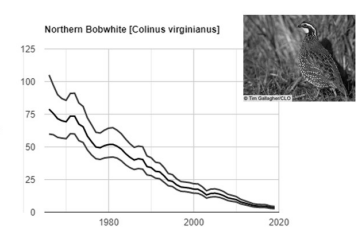
Early Concerns on Farmland
mowing of ditch banks and field edges
insecticide toxicity
clean farming remains a concern
NO poisoning from insecticides
broos use crop fields/borders when sprayed
lannate and larvin insecticides
sprayed over imprinted broods
no effects
Farm units with field borders had:
more birds
more nests/bird
smaller movements
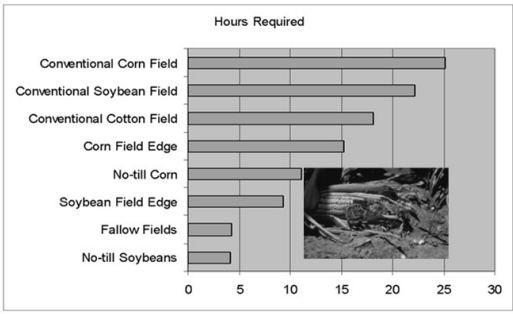
Chick feeding efficiency
Landscape-scale Experiment
four farms in each of hyde, tyrrell and wilson co, nc and amelia co, va
farms were from 250-500 acres
control, predator reduction (17 days), field border (10% of cropland), field border and predator reduction
followed for 4 seasons
Build it and they will come
trapping alone provided no benefits
quail increased more than 50% after borders
borders + trapping slightly better than borders
Removing predators was expensive and of questionable value
recolonized rapidly
same number of caps each year
Landowner Concerns About:
lost crop production
increased insect damage to crops
social barriers (clean farm mentality)
maintenance
Economics of Field Borders
Field borders did not contribute to pest problems and may enhance beneficial insect populations
Research contributed to introduction of field borders into the Conservation Reserve Program (CP-33)
Characteristics of CURE
no more “shot-gun” approach
focus management efforts in best landscapes
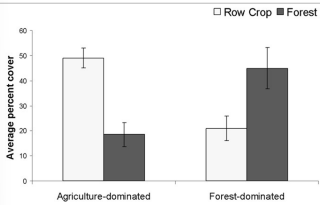
50-70% row crops, 20-40% woodland, <20% pasture

Does the CURE concept work?
high percentage of habitat may:
facilitate dispersal and year round survival
disperse predators and increase nest survival
Does habitat patch shape matter?

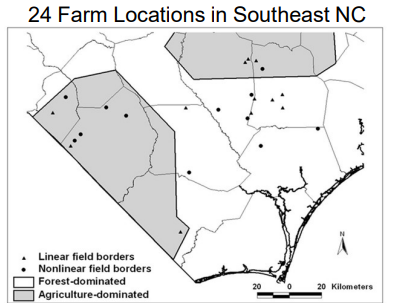
Landscape context (5000 ac)
Habitat patch shape summary
Linear borders
~3-m (10-feet) wide
Average length = 475 m (range = 66 to 1,940)
Nonlinear blocks
Average size = 0.25 ha (range = 0.05 to 2.48)
About 2-3% of row crop area on each farm
Non-linear Blocks Increased Quail
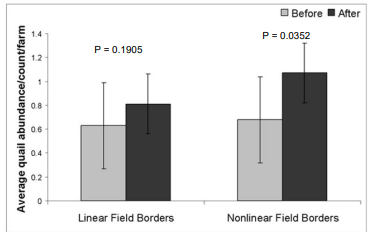
57% increase with nonlinear field borders
Quail Increased in CURE Landscapes

87% increase in agriculture-dominated landscapes
Summary Implications
Borders increased quail by 45%
Nonlinear borders best
Agriculture-dominated landscapes best
Increase less than in other studies
Rates of increase proportional to border size or % of cropland that is converted
Increase immediate
Where do birds come from?
Why Does Landscape Matter?
Does it affect occupancy dynamics?
Local occupancy (presence-absence)
Extinction in borders or habitat patches
Colonization of borders
What are the relative effects vs local habitat improvements (e.g., create a CP-33 border) in different landscape conditions?
Influence of Variables on Density
2,322 male bobwhites detected over 6 years
Densities 29% greater at sites with CP-33
Densities decreased as:
Urban increased
Pasture increased
Forest increased
Extinction increased as:
Urban and forest increased
Cropland decreased
Landscape Matters
Field borders increase density locally
Borders don’t influence large-scale processes
Colonization and extinction linked to landscape
Cropland is “permeable” to dispersers
Prevents local extinction
Urban, pasture, and closed-canopy forest are not
Are Planted Borders Better?
Fallow borders status quo
Proven benefits to quail
But few nectar-producing plants
Hence, few pollinators and adult parasitoids
Planted native grasses & wildflowers
Conserve beneficial insects and attractive
Also provide quality brood cover for quail?
native grasses/wildflowers, native wildflowers, fallow, mowed
No need to actually plant, the existing plant community is already there
Summary Implications
Planted borders comparable to fallow
Mowed borders have food but lack cover
Planted borders good choice when:
Establishment $$ available ($728/acre)
Beneficial insects are an objective
Aesthetics is important
Fallow borders are the most efficient for bobwhite
Farm-level population study
Compared bobwhite populations between:
farm with 9% in non-crop early succession
farm with no habitat improvement
3000-acre farm
2-year study
Captured and radio-collared 241 individuals
160 birds survived until breeding season
Located 71 nests
64 were on improved farms
7 on unimproved farms
31 nests hatched 335 young over the 2 years
64% incubated by female, 36% by male
Nesting Cover Limiting Factor
47% nest success on improved farms
29% nest success on 2 unimproved farms
Unimproved farm nesting ecology
Birds didn’t nest or nested in poor quality locations
Corn, hay field, closed-canopy forest
Adult survival was relatively high
Ground cover is limiting factor for quail
Improved farm nesting ecology
64% of nests located in ES areas (11% of farm)
Another 10% of nests adjacent to ES areas
Nest sites had greater perennial forb and grass cover
What Barriers Persist?
“Neat and Green” mentality – social norms
Too much mowing
Limited money to support conservation
No control of the “landscape”
Poorly managed forests – closed canopy
Lack of prescribed fire
Misdirected blame – “it’s the damned hawks!”