Plate Tectonics
Birth of the Earth
Dust → Ring → Small protoplanets smashed together, made Earth, smashing made it really hot, which is why Earth has the inner hotness
Because it’s liquid and inner is hotter, we have convective flow, heat up and move around
Crust is where nondense rock floats into, and far enough so that it’s solid
Mantle is also rock, but has metals (iron, magnesium), which gives it some properties. Rigid, top is plastic (moldable), where most convective flow happens.
Core is all metal, where all the hot stuff is. Nickle, iron, and other super dense things all the way down. Only purpose in plate tectonics is making things move because it’s really hot, fully liquid portion and solid portion (because too much pressure so it can’t melt).


Plate Tectonics
Causes are convective flow and top of mantel is plastic
Continental crust is thicker and less dense
Oceanic crust is significantly thinner and more dense

Tectonic Plate Boundaries
Interactions of the border between two tectonic plates
Transform Boundary: Two tectonic plates are sliding past each other, no creation or destruction, just moving onwards on conveyor belt
Fault lines
Earthquakes, ranges in strength depending on tension and strength
Divergent Boundary: Two tectonic plates moving away from each other, beginning of conveyor belt, magma turns into rock → lithosphere, new plates
Rift valleys (Midatlantic Ridge), volcanoes, small & shallow earthquakes
Iceland & East Africa Rift Valley
Under the ocean, seafloor spreading
Where seafloor is young
Convergent Boundary: End of conveyor belt where you die, destruction of tectonic plates because of two tectonic plates moving towards each other
Only nonnormal transformation, composition density & size of tectonic plates (most different due to type of crust, continental vs oceanic)
Mountain ranges
Volcanoes
Underwater trenches
Underwater mountains, creates islands
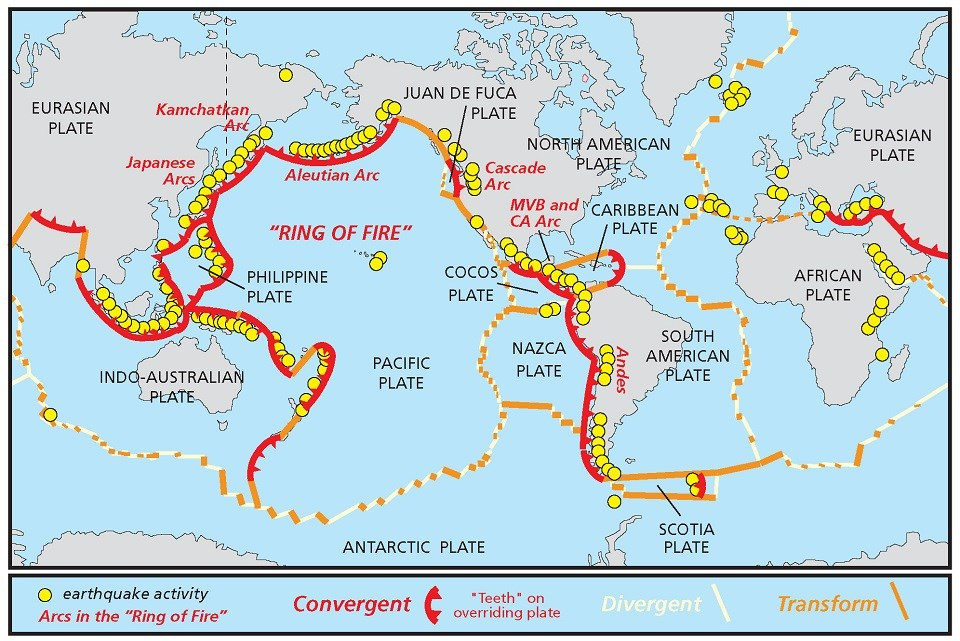
Not enough friction when subduction happens, really deep and strong earthquakes, 80% of earthquakes happen at convergent boundaries
Japanese Island Arc, Andes Mountains, Himalayan Mountains

Subduction Zones: Where crust forced down and starts melting, material will rise due to low density and high temperature, resulting in volcano or island formation

Importance
Earthquakes
Ring of Fire: Volcanoes, around super active plate tectonics

Earthquake Formation
When energy stored up because of friction between 2 plates
Side-by-side or convergent spring in upwards
Energy stored determines strength of earthquake
In Transform Boundaries, tectonic plates are stuck, then huge amount of energy is released at once which causes earthquakes
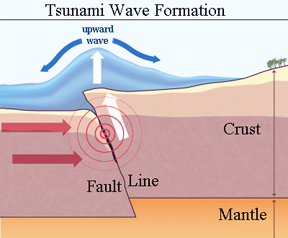
Tsunamis: Underwater earthquakes, worse at convergent because of vertical displacement, a lot of water moving up at once because of high energy activity
Earthquake pushes land up, makes water go up
Can also happen at transform boundary, creates underwater landslide which moves a lot of water
Usually at convergent boundaries
Describe: 1-2 sentences, provide relevant characteristics (what it looks like, how it works)
Explain: 1-2 sentences, cause & effect, big emphasis on why something happens with evidence and reasoning
Ecological: animal/nature
Social: Welfare (diseases, food, shelter)
Economic: money/businesses