Polymers Production Methods
How to go from Crude oil → Acrylic pellets
- Crude oil is extracted from the ground with drills and pumps.
- The oil is shipped to an oil distillery.
- The oil is heated to break it down into different fractions through industrial fractional distillation. It undergoes industrial cracking so that monomers are produced from the hydrocarbons.
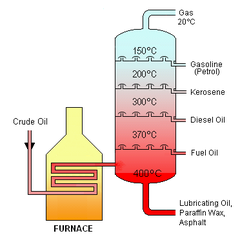
- Then the monomers undergo polymerisation, which links them together to make a polymer chain.
- The formed plastic undergoes extrusion and is then cut to form pellets (its stock form).
^^Injection Moulding^^
(e.g. polypropylene (PP), low-density polyethylene (LDPE), high-density polyethylene (HDPE))
- Using CAD, the product is designed and checked for potential flaws.
- A metal (e.g. die steel) mould would be made to fit the dimensions of the product design. The mould is then secured onto the injection moulding device.
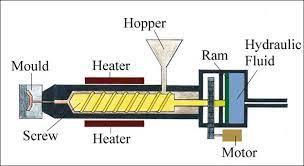
- The granules of (PP) plastic powder are poured into a hopper.
- A heater heats the tube and when it reaches a high temperature, a screw thread attached to a motor, starts turning. This turning motion pushes the granules along the heater section, melting them.
- The molten plastic is forced into the mould where it cools into the shape.
- The mould is then opened and the plastic is removed.
Pros: Cons:
- Fast production - High tooling costs
- Intricate/complex detail on the designs - Lead time is lengthy
- Large material choice - Limited to thermoplastics
- Low waste rates
==Blow Moulding==
(e.g. polythene, polypropylene (PP), PVC)
- The plastic (in granular form) is fed into a hopper that stores it.
- A large thread is turned by a motor which feeds the granules through a heated section, melting it.
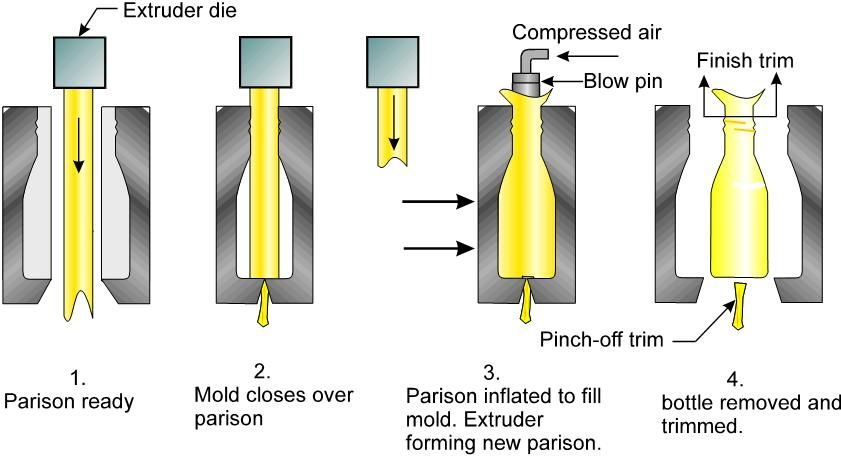
- The liquid plastic is fed into a parison (hollow tube).
- The mould surrounding the parison closes in order to grip the parison.
- Compressed air inflates the parison so that it fills the mould, giving the parison the shape of the mould.
- The mould is cooled and then the finished product is removed and excess plastic is trimmed.
Pros: Cons:
- Relatively inexpensive - Limitations in the design of blow-moulded products
- Fast process - Trimming is necessary
- Highly versatile - Limited to thermoplastics
Vacuum Forming
Used to form/shape plastics such as: polythene and Perspex.
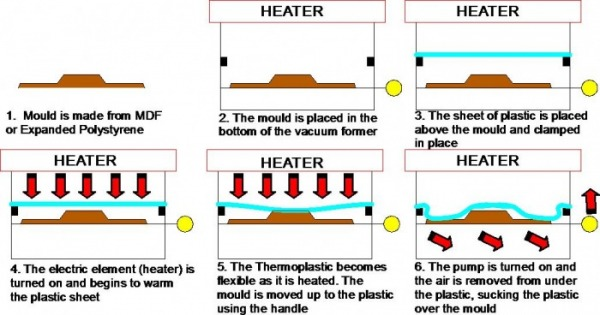
- A former is made form a material such as soft wood. The former is placed in the vacuum former.
- A sheet of plastic is clamped in place above the mould.
- The heater is turned on and the plastic becomes soft and pliable. After a few minutes, the plastic becomes flexible and is ready for forming.
- The heater is turned off and the mould is moved upwards by lifting the lever until it locks in position.
- The vacuum is turned on - pumping out all the air beneath the plastic sheet. Atmospheric pressure above the plastic sheet pushes it down on the mould.
- When the plastic has cooled, the vacuum pump is switched off. The plastic sheet is then removed from the vacuum former. The sheet has taken the shape of the former now.
- The excess plastic is trimmed.
Pros: Cons:
- Versatile - Only one product can be made at a time
- Customisable mould shapes + sizes - Can’t make intricate/complex designs
- Excess plastic can be recycled and reused. - Bubbles can form
- Fast procedure