Topic 1 - Deoxyribonucleic Acid
DNA stores the genetic information for the production of protiens
In a eukatyote it is associated with histone protiens found within the nucleus
Naked DNA is also found in the Chloroplast and mitocondria
Prokaryotes contain a single circular chromosome within the nucleoid
A Naked Chromosone means it is not bound to any protien
In Eukaryotes DNA is stored as linear paired chromosomes
DNA Structure
The two strands are are joined together by pairs of bases to form a double helix
Deoxyribose (Sugar) and a Phosphate Group Bind on either sides of the pairs of bases
Nucleotide
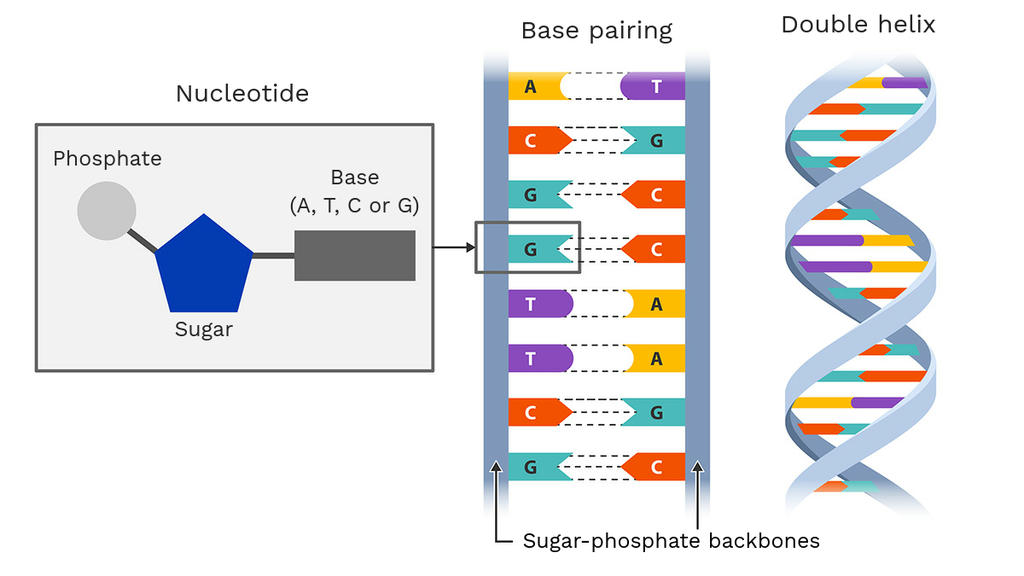
There are 4 possible bases with A bonding with T and C bonding with G
Adenine, Thynime, Cytosine and Guanine are the 4 bases
They bond based on the number of hydrogen bonds, for A and T that is 2 and for C and G that is 3
Each base is attached to a sugar which is attached to a phosphate groupe.
5’ and 3’ Ends
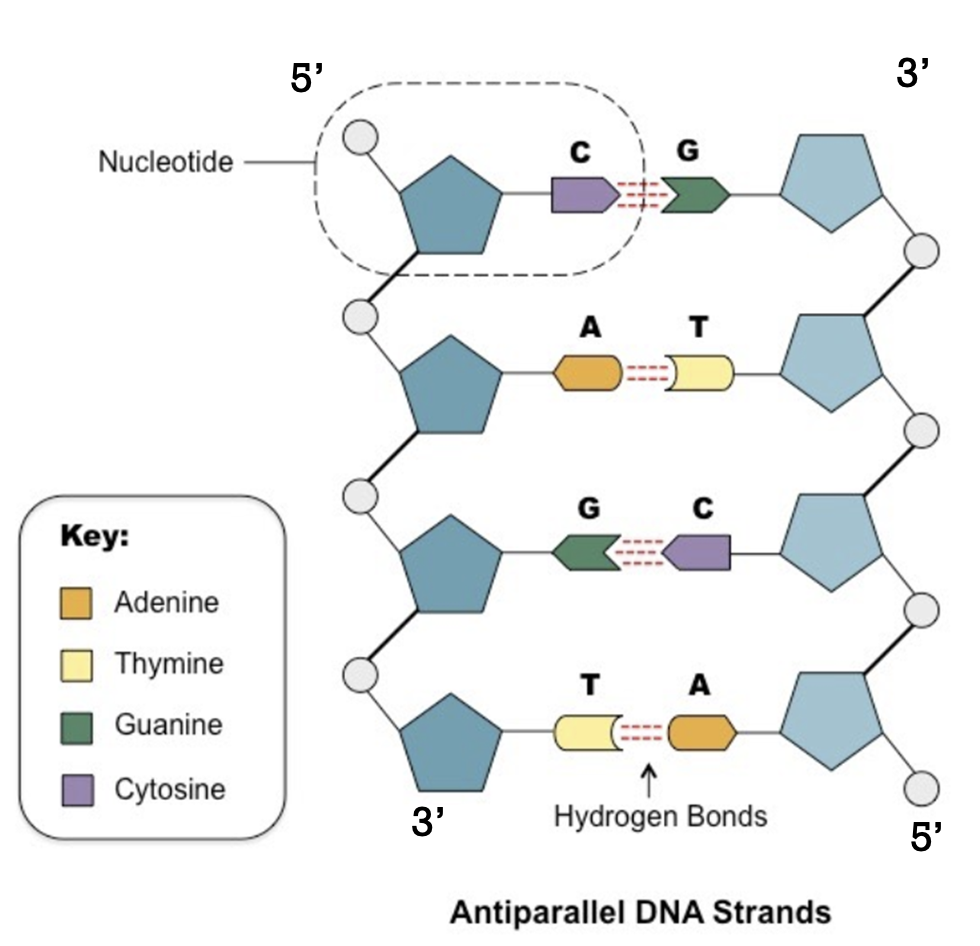
DNA groups have direction defined by the bound or unboud phosphate group
The 5’ end has an unbound/terminal phosphate group
The 3’ end has an unbound/terminal hydroxyl group
The strands run in opposite direction antiparralel.
Linkages go from 3 prime to 5 prime as they are aysmetrical.
DNA is transcribed in the 3’ to 5’ direction of the template DNA
Transcribe means creating RNA to send protien codes from the DNA to the ribosome inorder to make protiens.
Purine and Pyrimade Bases
The nitrogenous bases can be wither puriens or pyrimide bases based off the structure
Purines (2 Ring) Pyrimidine (1 Ring) | |
Adenine | Thymine |
Guanine | Cytosine |
Uracil |
DNA vs RNA
DNA has dexyribose where as RNA has only ribose
RNA is single helix where as DNA is a double helix
In RNA uracil replaces Thymine
DNA is longer
Types of RNA
Messenger RNA (mRNA) Template for Translation
Ribosomal RNA (rRNA) component of ribosome as catalyst)
Transfer RNA (tRNA) delivers Amino acids to ribosome - has 3 bases as an identifer called a condon
DNA Packing
In eukayotes DNA is bound to histone to form chromation.
It is wrapped around 8 histone protiens in an organised way to form a nucleosome.
Nuclesomes are losely packed during most of the cell phase.
Methylation causes nucleosomes to pack tightly, decreasing expression of the gene.
Acetylation results in losely packing, increasing gene expression.
Topoisomerase Enzymes causes DNA to supercoil
Why?
For organises DNA to fit inside the nuclues as well as for the DNA to stay organised in cell replication.
DNA Replication
DNA replication is the process by which DNA makes a copy of itself.
DNA replicates during Interphase (S-Phase) before mitosis and Meiosis.
Step 1. Unwind DNA
Completed by a helicase enzyme which breaks the hydrogen bonds.
Stage 2. Build daughter DNA strand
DNA polymerase adds complemantry bases.
The polymerase move from 3’ to 5’
Therefore strands grow from 5’→ 3’
Stage 3. Rewind
The new daughter DNA rewind into the doubele helic form.
DNA Replication is Semi-Conservative
One Strand will be the original template
The other strand will be the newly synthesized.
Multiple Replication Sites
Origin of replicatation occurs at multtiples points where the DNA comes unzziped and forms a replication fork moving in two directions.
Many sections of DNA can be replicated at once for speeding up the replication.
Contentious and Discontinuous
As polymerase run unidirectional it causes a lagging and leading strand.
Leading Strand:
Assembled continuously, starts replication from the 3’ end
Lagging Strand:
Broken up into (Okazaki) fragments later joined together by the ligase enzymes. Starts replication from the 3’ end.