Resting & Action Potentials
Resting Membrane Potential
The cell membrane has many proteins that move ions from one side to the other.
At “rest” (not sending a nerve impulse), the membrane has an excess of charge on one side of the membrane → The membrane is polarized.
The flow of charge in and out of the cell creates electrical energy that allows the cell to do work.
The electric potential can be measured (inside → outside) at - 65 mV.
This is proven with experiments with axons from giant squid.
Large negatively charged ions and proteins are attracted to the inner membrane face, which creates a greater charge separation.
→ At rest, the electrical potential difference between the two faces of the cell membrane is - 65 mV.
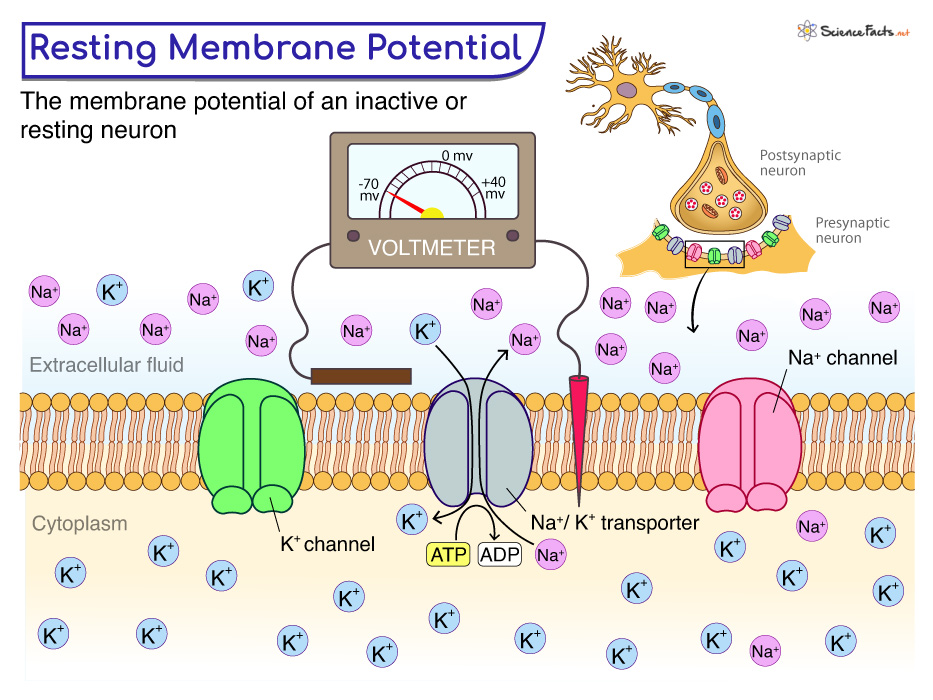
The membrane resting potential is achieved by 3 membrane proteins.
Na+/K+ pump
Na+ is actively transported out of the cell.
K+ is actively transported into the cell.
For 3 Na+ to be pumped out of the cell, 2 K+ are pumped into the cell.
→ Maintains the inside negatively charged relative to the outside.
Na+ channel
Not very permeable.
Allows a backflow of Na+ to diffuse into the cell.
→ Maintains a high external [Na+].
K+ channel
Quite permeable
Allow some K+ to diffuse out of the cell.
→ Makes the outside even more positive.
Nerve Impulse
A nerve impulse occurs when a neuron is active, NOT at rest, in response to a stimulus.
When the neuron is activated, Na+ and K+ channel gates open in response to electrical stimulation (= a change in voltage) → Rapid diffusion.
Action Potential
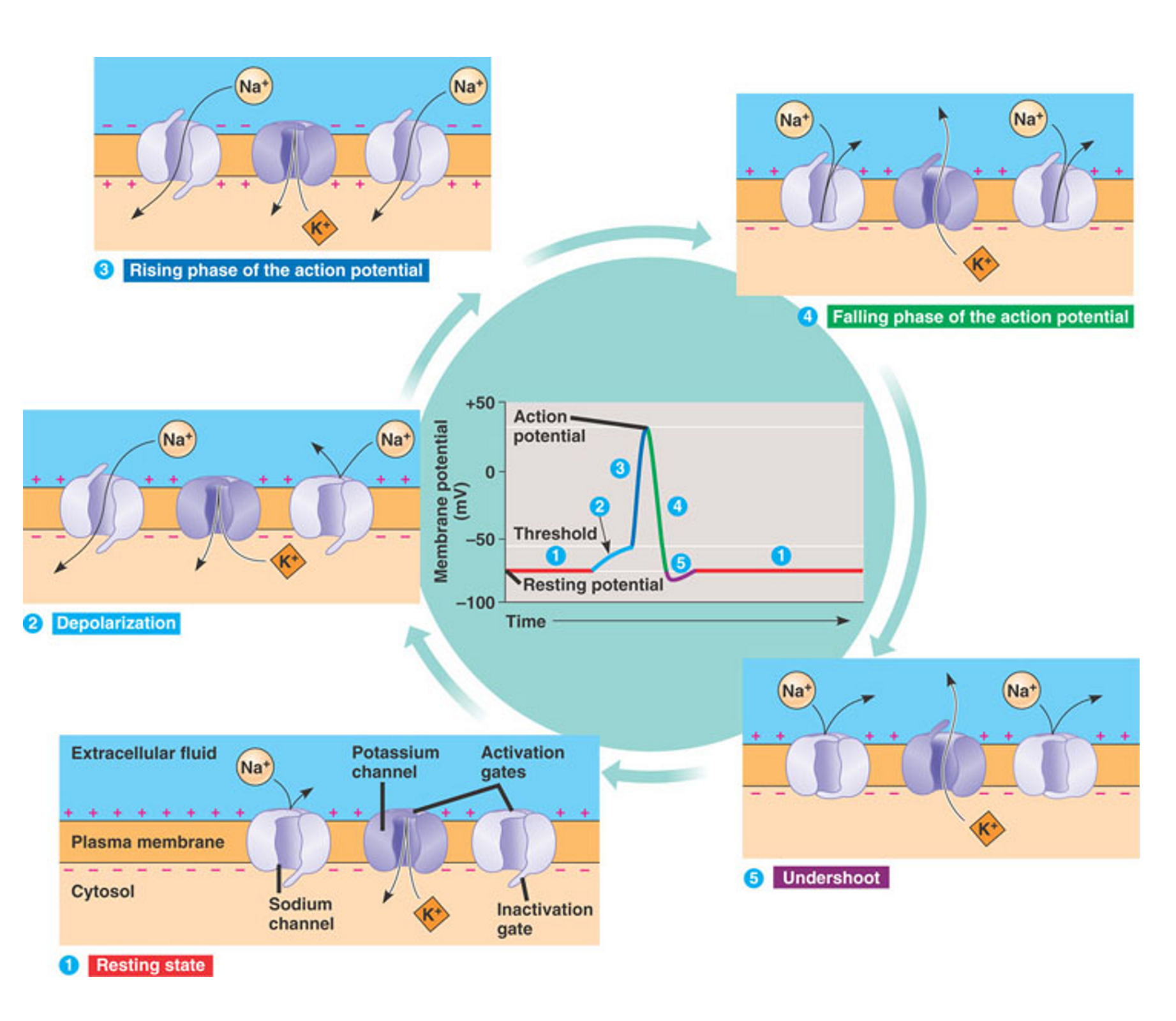
1. Dendrite stimulation
Dendrites receive stimulation from the receptor or the previous neuron.
Causes the membrane to leak a little Na+ in and K+ out of the cell.
Reduces the polarization (less difference between the inside & the outside).
When the potential reaches the threshold level, - 55 mV, the two gates open up, initiating the action potential.
2. Na+ gates open quickly
Causes a rapid flow of Na+ into the cell through Na+ channel gates.
Leads to depolarization of the membrane (no more membrane potential difference).
The membrane depolarizes, exceeding 0 mV, to ~ 35 - 40 mV.
3. Na+ gates close
Na+ gates start to close once the voltage reaches 0 mV.
It takes time for them to fully close, which occurs by the time the voltage reaches 40 mV.
At this time, K+ gates fully open.
4. K+ gates open quickly
A lot of K+ diffuses out of the cell through the K+ channel gates.
Causes repolarization of the membrane, returning to the negative charge inside the cell.
At - 65 mV, the membrane undergoes hyperpolarization
→ Some excess K+ diffuses out, decreasing the voltage to below - 65 mV.
5. Refractory period
Refractory period: When a section of membrane depolarizes, it cannot transmit another impulse (action potential).
After the hyperpolarization, both Na+ and K+ are on the wrong sides, and this must be corrected before another action potential occurs.
The Na+/K+ pump is responsible for returning the membrane to the resting state (high Na+ outside, high K+ inside).
While the resting membrane is re-establishing, an action potential only occurs if the stimulus is stronger than usual.
This is because an action potential occurs in an all-or-none fashion.
It only occurs when the membrane reaches the threshold of - 55 mV
→ The membrane will depolarize maximally to 40 mV, and repolarize to - 65 mV.If the threshold is not reached, no action potential occurs.