Functional Assays II
Definition of Second Messengers: These are usually small molecules or ions that act as signaling molecules to move a signal from one location within a cell to another location. Second messengers play a crucial role in cellular communication, helping cells respond to external signals. They are vital in processes like muscle contraction, hormone action, and neurotransmitter release.
Cyclic AMP (cAMP) as a Second Messenger:
Mechanism: G proteins tend to activate the enzyme adenylate cyclase, which is like a switch that gets turned on when a signal is received by a cell. Once activated, adenylate cyclase converts ATP (a molecule that provides energy) into cyclic AMP.
Adenylate cyclase is the specific enzyme responsible for synthesizing cyclic AMP, and cAMP functions as a signal within the cell, activating various pathways.
Indirect Measurement Cascade:
Measuring cyclic AMP levels acts as an indirect measure of adenylate cyclase activity. When scientists measure levels of cAMP, they can infer how active adenylate cyclase was.
Measuring adenylate cyclase activity acts as an indirect measure of G protein activity, meaning that changes in cAMP can tell us about how G proteins are functioning in the signaling pathway.
Measuring G protein activity acts as an indirect measure of G protein-coupled receptor (GPCR) activity resulting from ligand binding. When a signaling molecule (ligand) binds to a receptor, it activates the G protein, which in turn affects the levels of cAMP in the cell.
Calcium Concentration Assays:
Calcium levels change in response to various stimuli as calcium moves in and out of many cell types. Cells are very sensitive to calcium levels, and small changes can trigger significant reactions in the cell.
A change in calcium levels serves as a trigger to change how a cell behaves, such as contracting muscles or secreting hormones.
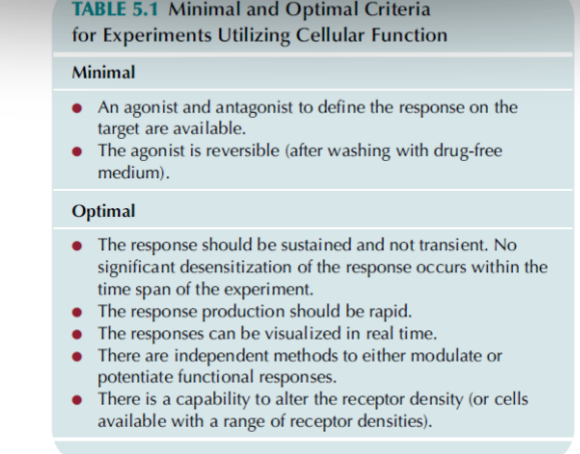
Transient Nature of Calcium: Calcium levels are a highly transient property. Cells maintain calcium at a specific baseline. When stimulated, calcium is pumped in or out, but levels eventually return to the baseline. This quick rise and fall in calcium levels help control cellular responses.
Challenges: Because the signal is transient, these changes must be measured in real-time. Scientists need to use quick and precise methods to capture these fast changes in calcium concentration.
Advantages (Reproducibility): Because the system returns to baseline, it is highly reproducible. An agonist can be added and measured, then added again to the same cell for repeated measurements, rather than needing separate experiments for comparison. This means scientists can rely on the consistency of their measurements over time.
Group 3 Assays: Measuring Cellular Products
Mechanism of Group 3 Assays: While cyclic AMP is a second messenger, it also activates various items downstream, including enzymes that carry out critical functions in the body. Researchers can leverage this by transfecting cells with a plasmid containing the gene for luciferase, a light-emitting enzyme.
Luciferase Application:
Luciferase is the enzyme found in fireflies or jellyfish that causes them to glow. This natural luminescence is a handy tool for scientists.
The system is engineered so that luciferase is produced specifically when cyclic AMP is being produced in the cell. This provides a direct connection between cAMP signaling and the measurable effect of light.
The amount of light (glow) produced by the cell is used as a measurement gauge for cyclic AMP levels, adenylate cyclase activity, G protein activation, and GPCR activation. The brighter the light, the more active these processes are.
Advantages of Group 3 Assays:
Signal Accumulation: An agonist can be applied, and the researcher can return after to allow the luciferase to build up to a measurable level. This gives researchers a larger signal to work with over time.
Detection of Weak Agonists: Some agonists may have a very small effect that is difficult to detect via direct cyclic AMP measurement. Because cyclic AMP is a short-lived molecule, it does not accumulate. However, the luciferase produced in response to cAMP is more stable and builds up over time, making a weak signal detectable the next day. This means even subtle responses can be identified.
Disadvantages of Group 3 Assays:
Long-term Toxicity: Some drugs or agonists may not be healthy for cells over long periods. If an agonist is left on the cells overnight, it may kill the cells, and dead cells cannot produce luciferase. Therefore, researchers must carefully consider the timing of experiments.
Assays Based on Membrane Dynamics
Non-Static Nature of Membranes: Receptors on the cellular membrane are constantly changing. They bind other proteins (e.g., GPCRs binding to G proteins), undergo modification (such as phosphorylation or other post-translational modifications), and undergo internalization. This fluidity in the membrane is crucial for cell signaling.
GPCR Internalization and Beta Arrestin:
Beta arrestin is a protein that "arrests" or stops the function of GPCRs, providing a regulatory mechanism for signaling.
When a GPCR is activated, beta arrestin grabs onto it and pulls the receptor into the cell (inside the membrane). By internalizing the receptor, the cell can prevent excessive signaling and reset its sensitivity to future signals.
Internalization serves as a negative feedback loop to shut off signaling and prevent over-activation by removing the receptor from exposure to agonists outside the cell. This is crucial for maintaining homeostasis in cellular signaling.
Measuring Internalization via Fluorescence:
Direct Tagging: Attaching a fluorescent tag directly to the GPCR to observe its movement under a microscope helps visualize receptor dynamics in real-time.
Beta Arrestin Tagging: Attaching a fluorescent tag to beta arrestin. Researchers observe the fluorescent beta arrestin move to the membrane, bind the GPCR, and then move inside the cell. This method provides insights into how quickly the receptors are internalized.
Cipher five (pH-dependent tag): A more sophisticated method using a pH-dependent fluorescent tag called cipher five.
Mechanism: Cipher five only fluoresces in the environment inside the cell (where pH is different) and does not fluoresce while on the membrane. This helps distinguish between membrane-bound and internalized receptors.
Advantage over Microscopy: Standard fluorescence microscopy requires manual observation or AI to determine if a receptor is on the membrane or inside, and it is usually limited to a single-cell assay. Using cipher five allows for accurate measurements on a larger scale without the same noise.
Population Measurement: Using a pH-dependent dye like cipher five allows for measurements in a well-plate containing millions of cells. This results in significantly less noise and lower error because it captures the aggregate effect across a large population of cells, making it easier to analyze trends and responses without individual cell variability.
Post-Internalization Pathways: Once internalized into an endosome, there are two primary options:
The receptor is degraded, which is a way to permanently reduce the receptor levels in a cell, impacting future signaling.
The receptor is recycled back to the membrane (the most common path), allowing signaling to occur again later. This recycling mechanism allows the cell to reset its signaling capabilities efficiently.
Recombinant Systems and Expression Levels
Recombinant Expression: Modern science allows for the expression of almost any protein in any cell. This provides control over the concentration of receptors used in an assay, meaning researchers can optimize experiments to achieve desired results.
Benefits of Over-expression: If an assay has low sensitivity, researchers can express more receptors to produce more signal and make the system more detectable. This can greatly improve the clarity of experimental outcomes.
Risks of Over-expression (Physiological Relevance): If too much receptor is expressed, the system may no longer be physiologically relevant. It may create a situation that would never naturally occur in a human, leading to criticism during the peer-review process for publication. Concentration must be carefully balanced to model natural processes appropriately.
Analysis of Agonist/Receptor Response Graphs:
Using the peptide PYY as an agonist example: The X-axis represents the agonist concentration, and the Y-axis represents the response, forming a clear visual representation of how effective the agonist is at different concentrations.
Different curves represent different levels of receptor expression. As the amount of receptor expressed increases, the response for the same amount of agonist also increases, showcasing how more receptors can lead to stronger cell responses.
Detection Limits: If an assay has a detection limit (e.g., it can only measure responses above ), a low level of receptor expression may never reach that threshold. In such cases, increasing the receptor expression is necessary for detection, allowing researchers to capture important data even at low concentrations.