Wave Properties, Mechanics, and Sound
Wave Fundamentals and Classification
Wave: A rhythmic disturbance that transfers energy without carrying matter along with it; travels through matter or empty space.
Electromagnetic Waves: Waves capable of transferring energy through a vacuum (e.g., light waves).
Mechanical Waves: Waves that require a medium (matter: solid, liquid, or gas) to travel through (e.g., sound waves, water waves).
Cannot transmit through a vacuum (e.g., in space, taking a photo using light waves works, but transmission of sound via a standard phone call does not).

Wave Types and Anatomy
Transverse Waves: Matter in the medium oscillates perpendicular (at right angles) to the direction of wave travel.
Examples: Electromagnetic waves, vibrating string instruments, surface ripples in water.
Crest / Peak: The highest point of a transverse wave.
Trough: The lowest point of a transverse wave.
Normal / Resting Position: The baseline equilibrium position.
Longitudinal (Compressional) Waves: Matter in the medium oscillates parallel (in the same direction) to the direction of wave travel.
Examples: Sound waves, ultrasound, slinky wave compressions.
Compression: Region where particles of the medium are clustered together.
Rarefaction: Region where particles of the medium are spread apart.

Wave Properties and Mathematical Relationships
Amplitude: Measure of the energy carried by a wave.
Transverse: Wave height measured from the resting position to the crest or trough.
Longitudinal: Degree of particle compression within the wave.
Wavelength (): Distance between one point on a wave and the nearest corresponding point (crest to crest, trough to trough, compression to compression, or rarefaction to rarefaction); measured in meters ().
Period (): Amount of time required for one full wavelength to pass a given point; measured in seconds ().
Frequency (): Number of complete waves passing a point per second; measured in Hertz (), where .
Inverse Relationships:
Period and frequency:
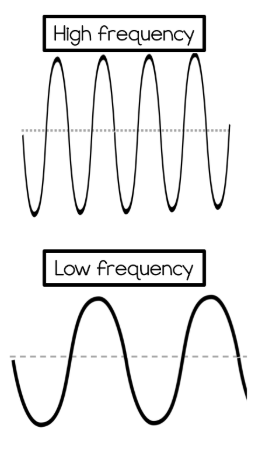
Frequency and wavelength: As frequency increases, wavelength decreases; lower frequency results in longer wavelength.
Wave Speed (): How rapidly a wave propagates; measured in .
Mechanical Waves (Sound): Depend on particle proximity. Travel fastest in solids, intermediate in liquids, and slowest in gases; travel faster through warmer media due to increased particle collisions.
Electromagnetic Waves (Light): Do not require a medium; propagate fastest through a vacuum and slowest through solids.
Sound Wave Behavior and Perception
Production of Sound: Created by mechanical vibrations of an object (e.g., vocal cords, plucked guitar strings) transferring energy to surrounding molecules as alternating compressions and rarefactions.
Wave Traces: Oscilloscopes visually display sound longitudinal vibrations over time using transverse graphs for analysis.
Pitch and Frequency: Pitch corresponds directly to wave frequency.
High frequency () creates a high pitch (e.g., bird chirp).
Low frequency () creates a low pitch (e.g., drum beat).
Loudness and Amplitude: Loudness corresponds directly to wave amplitude and energy.
Larger amplitude carries more energy, producing a louder sound (e.g., yelling).
Smaller amplitude carries less energy, producing a softer sound (e.g., whispering).
The Doppler Effect
Definition: The observed change in pitch (frequency) that occurs when a sound source moves relative to an observer.
Approaching Source: Sound waves compress ahead of the source, resulting in higher perceived frequency and higher pitch.
Receding Source: Sound waves expand behind the source, resulting in lower perceived frequency and lower pitch.
Common Contexts: Moving sirens, passing airplanes, and race cars.