Skin Disorders Ebook
Chapter 68: Skin Disorders
Psoriasis is a skin disorder characterized by scaly dermal patches and caused by overproduction of keratin. This overproduction can occur at a rate up to seven times the rate of normal cells. It is thought to be an autoimmune disorder and has periods of exacerbations and remissions. Although lesions can appear anywhere, they are commonly present on the elbows, knees, trunk, scalp, sacrum, and the lateral aspects of extremities. Psoriasis can be classified as psoriasis vulgaris, exfoliative, or palmoplantar pustulosis. In some clients, psoriasis affects the joints, causing arthritis-type changes and pain.
Dermatitis is an inflammation of the skin resulting from exposure to allergens (internal or external) that causes changes in the skin structure or tissue destruction. Manifestations of dermatitis can be nonspecific and include itching, lesions without distinct borders, and different distribution patterns. Rashes can evolve from acute to chronic and place the client at increased risk for bacterial infection resulting from breaks in the skin caused by scratching. Dermatitis can be classified as nonspecific eczematous, contact, or atopic.
Infections of the skin can be of bacterial, viral, or fungal origin. Prevention is the key; therefore, it’s important for the nurse to educate clients about the importance of appropriate personal hygiene (daily bathing/showering and handwashing).
Psoriasis
Data Collection
Risk Factors
Infections (severe streptococcal throat infection, Candida infection, upper respiratory infection)
Skin trauma (recent surgery, sunburn)
Genetics
Stress (related to overstimulation of the immune system)
Seasons (warm weather improves manifestations)
Hormones (puberty or menopause)
Medications (lithium, beta blocker, indomethacin)
Obesity
Expected findings
Psoriasis vulgaris presents as reddened, thickened skin with silvery white scales with bilateral distribution.
Exfoliative psoriasis displays as erythema and scaling from a severe inflammatory reaction with no obvious lesions. The reaction can cause dehydration and hypothermia or hyperthermia.
Palmoplantar pustulosis manifests as reddened hyperkeratotic areas (accelerated maturation of epidermal cells) due to an inflammatory disorder. Plaques form and pustules turn brown, peel, and form a crust on the palms of the hands and soles of the feet. The course of the disease is cyclic.
Exacerbation and remission of pruritic lesions.
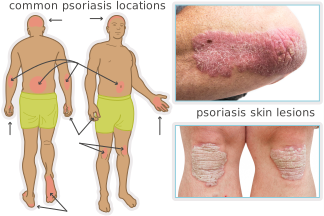
Psoriasis
Classification of Lesions
Mild: less than 5% of body surface area (BSA)
Moderate: 5 to 10% of BSA
Severe: greater than 10% of BSA
Physical Findings
Scaly patches
Bleeding stimulated by removal of scales
Pruritic skin lesions primarily on the scalp, elbows and knees, sacrum, and lateral areas of the extremities (psoriasis vulgaris)
Pitting, crumbling nails
Patient-Centered Care
Medications
There is no cure for psoriasis. Treatment is aimed at decreasing the severity of the manifestations and decreasing the turnover rate of the epidermal cells.
Topical therapies
Corticosteroids (triamcinolone, betamethasone) reduce secondary inflammatory response of lesions and suppresses cellular division/proliferation.
Nursing Actions
Observe skin for thinning, striae, or hypopigmentation with high-potency corticosteroids.
Instruct client on proper application.
Client Education
Apply high-potency corticosteroids as prescribed to prevent adverse effects and take periodic medication vacations.
The provider might recommend warm, moist, occlusive dressings of plastic wrap (gloves, plastic garments, booties) after applying the topical medication. These can be left in place up to 8 hr each day.
Avoid application of high-potency medication on face or into skin folds. Medication can be applied to the scalp.
Monitor for adverse effects of the medication (hypopigmentation, atrophy).
Tar preparations: Coal tar and tars made from trees (juniper, birch, and pine) suppress cellular division/proliferation and reduce inflammation.
Nursing Actions
Monitor skin for irritation.
Instruct the client on proper application.
Client Education
Tar applications can cause stinging and burning.
Tar applications can cause staining of the skin and hair.
Due to odor and staining, apply this product at night and cover areas of the body with old pajamas, gloves, and socks.
Vitamin D analogs (calcipotriene, calcitriol) prevent cellular proliferation and regulate skin cell division.
Nursing Actions
Monitor for itching, irritation, and erythema.
Monitor for hypercalcemia (elevated blood calcium, muscle weakness, fatigue, anorexia).
Client Education
Limit sun exposure due to increased risk of developing skin cancer.
Adhere to proper application. Do not put on face.
Monitor for cancerous lesions.
Vitamin A (tazarotene) slows cellular division and reduces inflammation and causes sloughing of skin cells.
Nursing Actions
Medication is contraindicated during pregnancy. QPCC
Monitor for localized reactions, burning sensation, inflammation, and desquamation of the skin.
Instruct clients on proper application.
Client Education: Avoid exposure to sun or artificial UV light.
A nurse is reviewing information about a new prescription for corticosteroid cream with a client who has mild psoriasis. Which of the following instructions should the nurse include?
Select all that apply.
A
Apply an occlusive dressing after application.
B
Apply three to four times per day.
C
Wear gloves after application to lesions on the hands.
D
Avoid applying in skin folds.
E
Use medication continuously over a period of several months.
Systemic medications
Cytotoxic medications (methotrexate, acitretin) reduce turnover of epidermal cells; used for severe, intractable cases.
Nursing Actions
Monitor liver and renal function tests for toxicity if methotrexate or acitretin therapy is being used.
Methotrexate can cause bone marrow suppression (leukopenia, thrombocytopenia, anemia).
Medication is contraindicated during pregnancy and can cause fetal death or congenital anomalies.
Client Education
Avoid alcohol while taking these medications.
These medications can decrease the effectiveness of contraceptives.
Biologic agents for moderate to severe plaque psoriasis that suppress immune function (adalimumab, etanercept, ustekinumab, alefacept, and infliximab) and suppress the stimulation of the keratinocytes.
Nursing Actions
Evaluate for latent tuberculosis and hepatitis B virus.
Inspect prefilled syringe for particles or discoloration.
Rotate injection sites, and do not rub after administration.
Protect medication from light.
Implement infection control measures. Client is at risk for immunosuppression.
Client Education
Do not to take if pregnant or breastfeeding.
Properly administer subcutaneous medication.
Report manifestations of infection.
Treatment is lifelong, and there is an increased risk of cancer.
Do not receive any live vaccines while taking the medication.
Cyclosporine and azathioprine: Immunosuppressant medications are administered when lesions do not respond to other therapies.
Nephrotoxicity occurs and increases the risk of infections.
These are used for short-term therapy (less than 6 months).
Client education: Monitor blood pressure throughout therapy. Medication can cause hypertension.
Therapeutic Procedures
Photochemotherapy (PUVA) and ultraviolet (UV)
A psoralen photosensitizing medication (methoxsalen) is administered followed by long-wave ultraviolet A (UVA) to decrease proliferation of epidermal cells.
Methoxsalen is given orally 2 hr before UV treatments.
Treatments are given two to three times per week, avoiding consecutive days.
Nursing Actions
Monitor the client’s response.
Ensure that the client wears eye protection during treatment and for 24 hr following a treatment (indoors and outside). QS
Client Education
Notify the provider of extreme redness, swelling, or discomfort.
Long-term effects include premature skin aging, cataracts, and skin cancer.
Obtain regular eye examinations.
Avoid direct sunlight for 8 to 12 hr following treatment.
Protect the skin with the use of sunscreen.
Narrow-band ultraviolet B light therapy can be implemented without medication application and requires fewer treatments.
Laser light therapy is used for mild to moderate psoriasis to target lesions directly and decrease exposure to surrounding skin.
Nursing Interventions
Instruct lifestyle modifications and coping strategies.
Discuss treatment plan with the client.
Client Education
Use comfort measures (baths with emollients, oatmeal baths, emollient creams) to soften scales.
Do not scratch or pick lesions.
A nurse is reinforcing teaching with a client who has a history of psoriasis about photochemotherapy and ultraviolet light (PUVA) treatments. Which of the following instructions should the nurse include?
A
Apply vitamin A cream before each treatment.
B
Administer a psoralen medication before the treatment.
C
Use this treatment every evening.
D
Remove the scales gently following each treatment.
Dermatitis
Health Promotion and Disease Prevention
Avoid exposure to harsh chemicals.
Data Collection
Risk Factors
External skin exposure to allergens
Internal exposure to allergens and irritants
Stress (eczematous dermatitis)
Genetic predisposition (eczematous dermatitis)
Specific cause not always known
Expected Findings
Nonspecific eczematous dermatitis
Development of thickened areas of skin
Can appear dry or moist and crusted
Pruritus
Symmetrical involvement anywhere on the body
Contact dermatitis
Contact dermatitis is caused by direct exposure to allergen, chemical, or mechanical irritation.
Rash is well-demarcated and localized.
Distribution varies depending upon the cause and the exposure to the allergen.
Atopic dermatitis
Chronic rash
Can be caused by allergens or chronic skin disease
Development of thickened areas of skin along with scaling and desquamation
Pruritus, which can be intense
Distribution including face, neck, and upper torso along with skin folds (antecubital, popliteal)
Patient-Centered Care
Avoidance therapy if cause identified
Medications
Steroid therapy: topical, intralesional, systemic (hydrocortisone, betamethasone, triamcinolone, prednisone)
Reduce secondary inflammatory response of lesions
Nursing Actions
Monitor for adrenal suppression.
Instruct client about proper application.
Client Education QPCC
If using steroids for long periods, taper doses when discontinuing medication.
Avoid using topical steroids on lesions that are infected.
Warm, moist dressings can be used over topical application to increase absorption of medication.
Avoid the use of occlusive dressings over rash after applying topical steroid medications.
Antihistamines: topical, systemic (diphenhydramine, cetirizine, fexofenadine)
Relief of redness, pruritus, and edema
Nursing Actions: Monitor for urinary retention with the use of systemic medications.
Client education
Product can cause photosensitivity.
Avoid operating machinery and driving while taking systemic antihistamine.
Take systemic form at bedtime, as product can cause drowsiness.
Topical immunosuppressants: tacrolimus, pimecrolimus
For use in treatment of eczematous dermatitis that has been resistant to glucocorticoid treatment
Relieves inflammation
Nursing Actions
Instruct client on application of medication.
Monitor for erythema, burning sensation.
Avoid the use of occlusive dressings.
Client Education
Avoid use if infection is present.
Discontinue use when rash clears.
Avoid direct sunlight and the use of tanning beds.
A nurse is reinforcing teaching with the guardian of a child who has contact dermatitis. Which of the following information should the nurse include?
A
Use fabric softener dryer sheets when drying the child’s clothing.
B
Apply a warm, dry compress to the rash area.
C
Place the child in a bath with colloidal oatmeal.
D
Leave the child’s hands uncovered during the night.
Infections
Health Promotion and Disease Prevention
Avoid organisms that can cause infection.
Use appropriate skin hygiene (showers/bathing).
Perform appropriate handwashing techniques.
Assessment/Patient-Centered Care
Expected Findings | Medication Management | Nursing Actions/Client Education | |
|---|---|---|---|
Bacterial (furuncles, carbuncles, cellulitis, MRSA) |
|
|
|
Viral (Herpes: simplex/zoster) |
|
|
|
Fungal (Tines/mycosis) (Candidiasis) |
|
|
|
A nurse is reinforcing teaching with a client who has a new prescription for clotrimazole topical cream. Which of the following statements should the nurse include?
A
“This cream reduces the discomfort for viral lesions.”
B
“This cream is for treating bacterial infections.”
C
“Apply the topical medication for up to 2 weeks after the lesions are gone.”
D
“Apply the cream to lesions while they are moist.”
A nurse is reinforcing discharge instructions with a client who has a bacterial infection of the skin. Which of the following instructions should the nurse include?
A
Bathe daily with moisturizing soap.
B
Apply antibacterial topical medication to the crusted exudate.
C
Apply warm compresses to the affected area.
D
Cover affected area with snug-fitting clothing.
Active Learning Scenario
A nurse is reviewing information with a client who has a prescription for pimecrolimus to treat severe eczematous dermatitis. What information should the nurse include? Use the ATI Active Learning Template: Medication to complete this item.
Therapeutic Uses
Nursing Interventions: Describe two.
Client Education: Describe two instruction points.
Click to download this file.
Active Learning Scenario Key
Click to reveal sample responses.