Capital Flows and Balance of Payments - Section 8, Module 41
economists keep track of domestic economy using the national income and product accounts
to keep track of international transactions - balanace of payment accoutns
balance of payment accoutns - summary of the country’s transactions with other countries
balance of payments on the current account/current account - BOP of g/s, factor income, and net international transfer payments
balance of payments on goods and services - most important part of current account, and is the difference between the value of exports and the value of imports
merchandise trade balance (trade balance) - difference between a country’s exports and imports, NOT INCLUDING SERVICES
factor income = payments for the use of factors of production owned by residents other countries
mainly investment income - interest paid on loans from oversees, profits of foreign corps in the US, etc.
but also, labor income - ex if an american is working abroad
international transfers - funds set by residents of one country to residents of another
mainly immigrant residents of one country sending money back home
balance of payments on the financial account (financial account) (called capital account in the past) - transactions that involve the sale/purchase of assets and create future liabilities
BOP includes currenta account and financial account
CA AND FA = ZERO ALWAYS
sources of case must equal uses of cash:
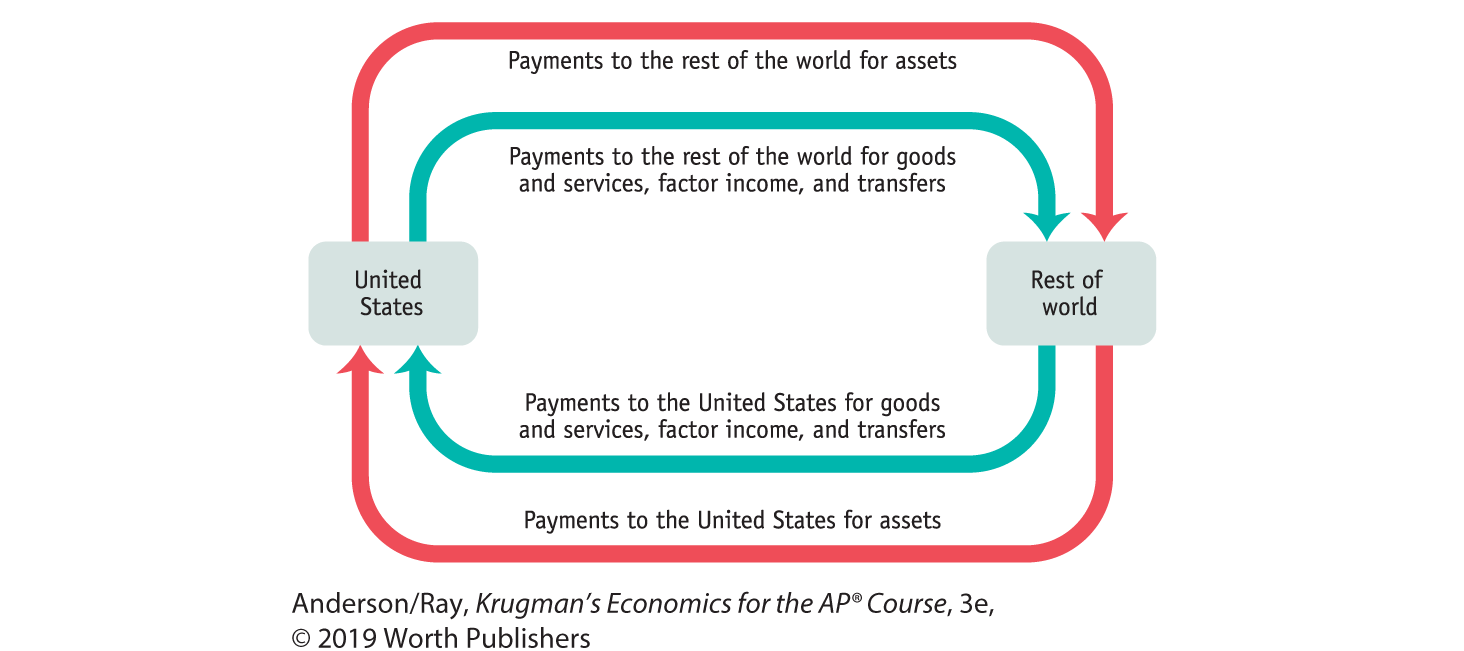
financial assets are exhcnaged for financial capital - funds from savings that are available for investment spending
FA = measure of capital inflows in the form of foreign savings that become available to finance domestic investment spenidng
motivations fo rcapital flows that are causd by prviate decisions = can be found throug loanable funds
simplifications are made: internaltioncapital flows are simplified by the assumption that all flows are in the form of loans (but IRL, they take many forms [such as stocks, foreign real estate, foreign direct investment - companies build factories/get other productive assests abroad]); and the effects of expected changes in exchange rates are ignored
basically, country w the higher interest rate attracts investors to send some of their loanable funds to the foreign country - the capital inflow incr loanable funds supply in tht country = brings interest rate down
at the same time, quantity of loanable funds supplied to country a’s borrowers decr = incr in IR
narrows the gap unitl eliminated
example:
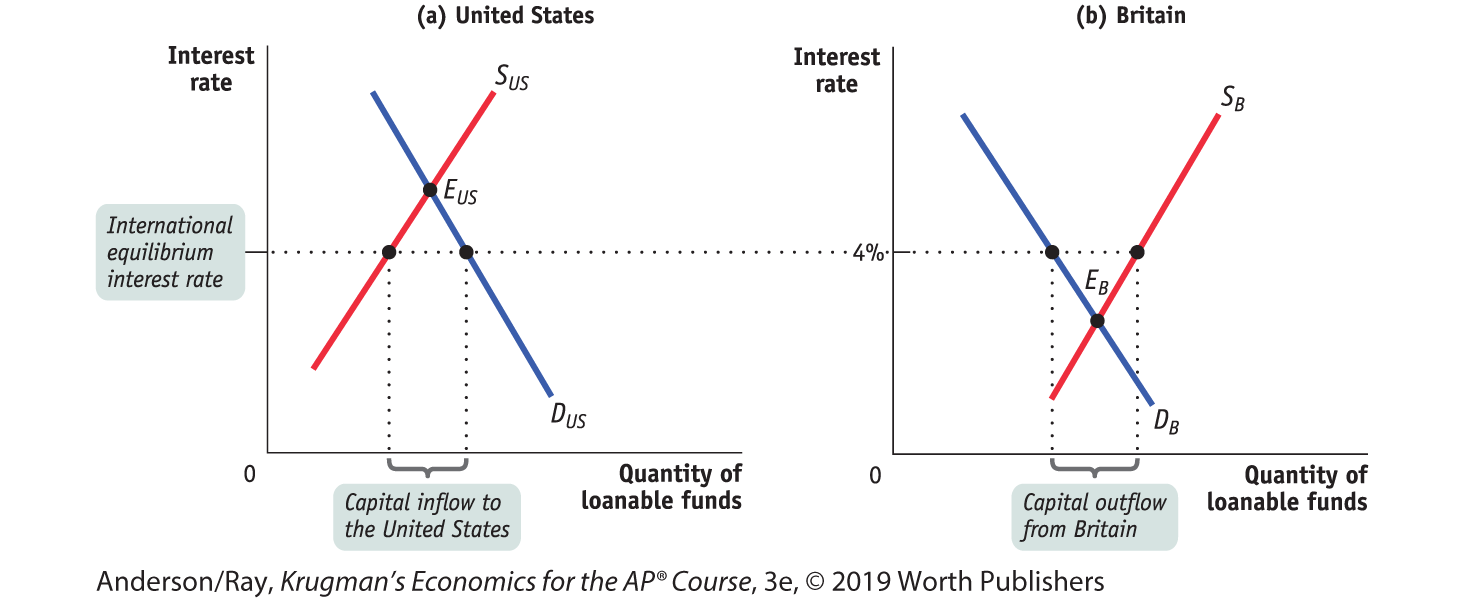
capital flows from countries w low IR to countries w high ir
international differences in demand for funds is bc some countries have more investment opportunities (are more rapidly growing) → they ahve a higher D for capital and offer higher returns to investors
internat differences in supply for funds is bc of the diff in savings → private or national
govt budget deficits (reduce overall national spending) can lead to capital inflows
loanable funds market shows the direction of NET capital flows
gross capital flows takes place in both dreictsion, bc IRL, there are other motives for capital flows other than a higher IR
investors want to diversify against risk by buying foreign/domestic stocks
business stratgey
some countries may be intl banking centers - ppl from all over the world put their money into tht country’s financial institutions, which then uses those funds to invets abroad
these lead to 2 way capital flows: economies are both debtors AND creditors