Level Basic Theory
Staff
A note is a symbol used to represent a sound, which is placed on a series of five horizontal lines called a staff
The number of lines on a staff are counted from the bottom upwards, therefore making the first line the inferior line and the fifth line the superior line. These spaces are counted in the same manner.

A staff is composed of five lines and four spaces. The position of each note determines the pitch of each sound. The higher a note is placed on the staff the higher the pitch while the lower it'‘s placed the lower the pitch
Notes written above or below the staff are distinguished by ledger lines

Treble and Bass Clef
A clef symbol is placed at the beginning of the staff and is used to determine the names of the notes that follow. The clef gives the name to the note on the same line. Using the clef we can determine where what notes are positioned on the staff
The two most commonly used clefs in music are Bass clef and Treble cleff.
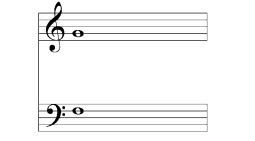
Seen in the image above the treble clef circles the line of the G note, giving the alternative name of G clef. The bass clef however has dots surrounding the line for F, also giving it the rarely used alternative name of F clef.
Note placement
While remembering what notes the respective clefs circle is one way to position the remaining notes, the most common method to remember the order is by using phrases.
For treble clef, the lines cane be remembered by memorizing; “Every Good Boy Deserves Fudge”, (E, G, B, D, F)
While spaces are simply remembered with the word FACE (F, A, C, E)

For bass clef lines can be remembered by saying “Good Boys Do Fine Always” (G, B, D, F, A), while spaces can be recalled with “All Cows Eat Grass” (A, C, E, G,)

While it is common practice, avoid writing note names under notes. It can make the sheet music much harder to read and discourages memorization
Note Values
Notes
Every note represents a duration as well as a sound depending on its position on the staff
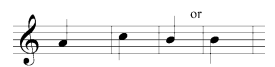
Notes will always be placed in a line-space sequence in any form. If we want to add a stem to notes, it’s important to place them correctly. If the note is below the third line the stem points up and to the right. However if the note is above the third line, its stem points down to the right. On the third line the stem can be placed either direction as long as if it’s up it’s on the right, and if it’s down it’s on the left
There are many types of notes with different values, but the most common are; Whole note, Half note, Quarter note, Eighth note, and Sixteenth note
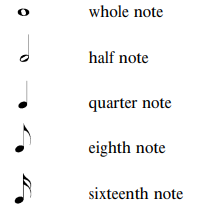
The value of notes is simple division or fractions and can be broken down into a structure as shown below
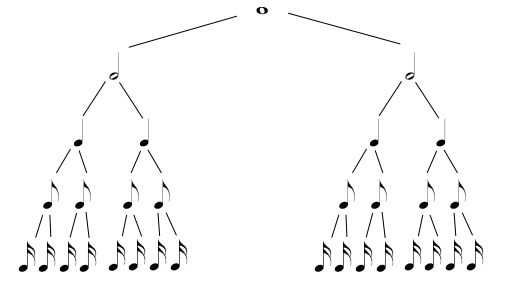
While the image may seem overwhelming, it’s simple.
A whole note is worth two half notes, or four quarter notes, eight eighth notes, of sixteen sixteenth notes.
But, to simplify reading the notes quickly, certain notes are grouped together to fill the beat.
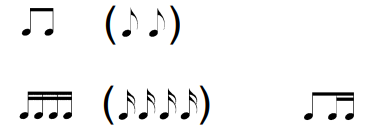
memorization
Rests
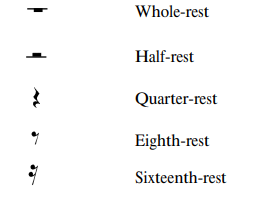
To represent when to pause playing there are different symbols that show how long to stop. While the symbols are different from the notes that make sound, their names are similar and tell you how long to pause for